
Elephant beetle
Orthorhinus cylindrirostris
Description
How to identify
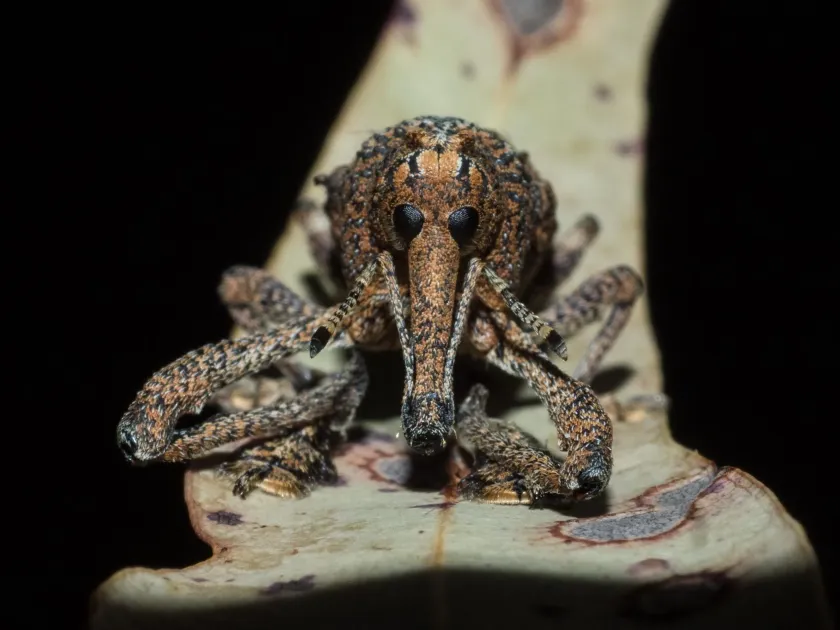
The Elephant beetle (Orthorhinus cylindrirostris) is a large species within the Curculionidae family, easily recognized by its elongated, cylindrical body and a very prominent, long rostrum or snout. They are often referred to as wood-boring weevils due to their lifecycle.
Adult beetles typically measure between 15 and 20 mm in length. Their coloration ranges from dark brown to charcoal black, often camouflaged with greyish or brownish scales that blend perfectly into the bark of their host trees.
The larvae are white, fleshy, and legless with a heavily sclerotized brown head capsule. They are specifically adapted to live and feed within the woody tissue of trees, remaining hidden from the surface for the majority of their development.
As members of the Coleoptera order, they undergo complete metamorphosis. The adults are capable of flight, which allows them to spread across orchards and forests to find suitable hosts for oviposition during the warmer months.
Identifying the adults can be difficult due to their excellent mimicry. However, their size and the unique shape of their snout make them distinct from other common weevil species found in agricultural settings.
What it damages
The Elephant beetle attacks a wide range of woody plants, including both native forest trees and exotic ornamental or fruit-bearing species. It is particularly notorious for damaging grapevines, citrus trees, and various rose family members.
The primary damage is caused by the larvae, which bore extensive galleries deep into the sapwood and heartwood. This activity disrupts the tree's nutrient and water transport system, leading to limb dieback or even the death of the entire tree.
Adults also contribute to the damage by feeding on young shoots, tender bark, and buds. While this external feeding is less lethal than larval activity, it creates entry points for fungal pathogens and wood-rotting organisms.
Young, newly planted trees are most vulnerable and can be girdled or killed within a single season of heavy infestation. In mature orchards, the cumulative damage leads to reduced vigor, lower fruit yields, and premature shedding of leaves.
Because the larvae reside deep within the wood, they are shielded from many standard pesticide applications. This hidden lifestyle makes the Elephant beetle a persistent and difficult pest to eradicate from established landscapes.
Signs of infestation
The most reliable sign of an infestation is the presence of small, round emergence holes on the trunk or main branches. These holes indicate where adult beetles have chewed their way out after completing pupation.
In addition to exit holes, piles of frass (wood dust and excrement) are often found gathered at the base of the tree or caught in bark crevices. This debris is a clear indicator of ongoing larval activity inside the wood.
Tree health often declines noticeably, with symptoms including yellowing leaves, scorched-looking foliage, and the gradual dieback of individual branches. These are signs of impaired sap flow caused by deep larval galleries.
When peeling back the outer bark in severely infested areas, one may find winding, intricate tunnels packed with fibrous material. In quiet environments, the chewing sound of mature larvae can sometimes be detected.
The sudden breakage of limbs during windy conditions is another indicator, as the structural integrity of the wood is compromised by the extensive network of tunnels bored by the growing larvae.
Control measures
Sanitation is the cornerstone of management for this pest. All infested or dying branches should be pruned promptly and destroyed by burning or chipping to prevent the emergence of the next generation of beetles.
Maintaining tree health through proper fertilization and irrigation is essential, as stressed trees are significantly more attractive to egg-laying females. A vigorous tree is more capable of compartmentalizing damage.
During the adult flight season, chemical control using systemic or contact insecticides applied to the bark can reduce the population. These applications are most effective when timed with the emergence of the adults.
Biological control, including the use of entomopathogenic nematodes, shows promise in targeting larvae. These microscopic worms can be applied to the tree surface or injected into tunnels to infect and kill the larvae.
- Regular monitoring of tree trunks for emergence holes.
- Sanitary pruning of all compromised limbs.
- Timely insecticide sprays to target active adults.
- Application of entomopathogenic nematodes for larval management.
Taxonomy
- Latin name
- Orthorhinus cylindrirostris
- Order
- Coleoptera (beetles)
- Family
- Curculionidae
- EPPO code
- ORTRCY
Discussion
No discussions yet — be the first.