
Rice gall midge
Orseolia
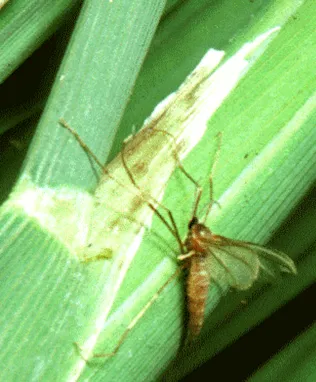
Description
How to identify
The rice gall midge (Orseolia oryzae) is a member of the Cecidomyiidae family, commonly known as gall midges. These are small, fragile, mosquito-like flies that thrive in humid environments and are notorious pests in many rice-growing regions.
Adult midges are short-lived, with a lifespan of only a few days. During this period, the female lays numerous eggs, typically near the ligules of the rice leaf sheaths, ensuring that larvae can easily access the growing point of the plant.
The larvae are small, white or pale-pink, and legless. Upon hatching, they migrate to the shoot apex, where they feed on the meristematic tissue, causing the plant to redirect its growth into the characteristic gall structure.
The development of the midge is highly dependent on ambient temperature and rainfall patterns. Higher humidity levels and cloudy conditions significantly increase the survival rate of the larvae.
Several generations can occur within a single cropping season, making it a persistent threat to rice cultivation throughout the active growing period.
What it damages
The primary host of Orseolia oryzae is the cultivated rice plant. By feeding on the shoot apex, the larvae prevent the formation of normal tillers and the development of the panicle.
Beyond rice, certain wild grasses serve as alternative hosts for the midge. These weeds maintain the population of the pest during the off-season, acting as a bridge for new infestations.
The economic impact of the midge is substantial, as infested plants often fail to produce any grain. In severe cases, large portions of a paddy field may be entirely lost to this pest.
Infestation during the vegetative stage is the most damaging. The plant attempts to compensate for the loss of the primary tiller by producing excessive secondary tillers, but these are often unproductive.
Crop loss severity is directly related to the percentage of infested hills. Early detection and intervention are crucial to prevent the population from exploding across the entire plantation.
Signs of infestation
The most iconic symptom of gall midge infestation is the formation of a "silver shoot" or "onion leaf." This is a hollow, tubular gall that replaces the normal leaf blade.
The gall is distinctively elongated and whitish-grey, standing out sharply against the green foliage of healthy rice plants. It occurs because the larval feeding causes abnormal growth of the leaf sheath.
Infested plants show severe stunting and excessive tillering, giving the crop a bushy, disorganized appearance. These plants are rarely able to produce a panicle or viable seeds.
If you split open a silver shoot, you will find a small, pale larva inside. This is the definitive diagnostic sign of the presence of the rice gall midge in the field.
In the field, infested areas often appear as patches of discolored, stunted rice, which can be easily identified during regular scouting inspections of the paddy.
Control measures
The most effective strategy for managing the rice gall midge is the deployment of resistant rice varieties. These varieties have been bred to withstand larval entry or restrict their development.
Cultural control practices are essential, including the removal of weeds around the field boundaries and irrigation channels to eliminate the alternate hosts for the midge.
Chemical control should involve the use of systemic insecticides, which are absorbed by the plant and target the larvae feeding within the shoot tissues, away from direct surface contact.
Biological control plays a significant role in long-term management, utilizing parasitic wasps that naturally predate upon midge eggs and larvae to keep populations below threshold levels.
- Use of resistant and tolerant rice cultivars.
- Proper field sanitation by removing grassy weeds.
- Adjusting planting dates to avoid peak midge activity periods.
- Application of systemic granular insecticides during the early tillering phase.
Taxonomy
- Latin name
- Orseolia
- Order
- Diptera (flies)
- Family
- Cecidomyiidae
- EPPO code
- ORSESP
Discussion
No discussions yet — be the first.