
New Zealand grass grub
Odontria puncticollis
Description
How to identify
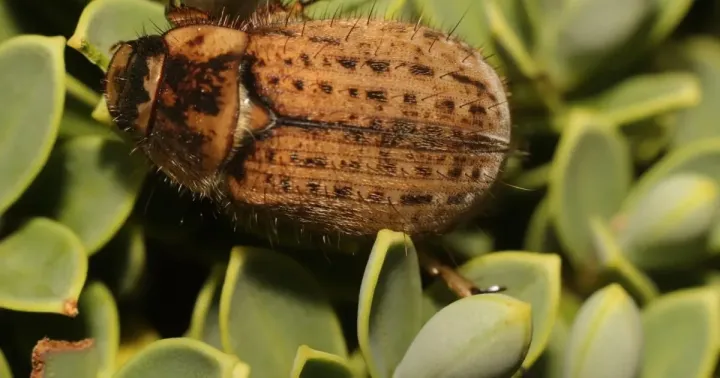
The New Zealand grass grub (Odontria puncticollis) belongs to the Scarabaeidae family, within the order Coleoptera. The adult is a small, brown beetle commonly found in various agricultural landscapes.
The adults exhibit typical scarab beetle characteristics, including clubbed antennae. They usually measure between 10 and 15 millimeters in length, with a finely punctured body surface.
The larvae are the most damaging stage and are easily identified by their C-shaped body, white color, and a dark brown head capsule. They spend their entire developmental period within the soil.
The lifecycle is tightly coupled with soil conditions. Females deposit eggs in the upper soil layers, where larvae feed on organic matter and living roots of host plants.
Identifying the presence of this pest is difficult due to its subterranean lifestyle. Detection usually requires soil sampling or inspecting damaged patches in fields and pastures.
What it damages
The larvae cause significant damage by feeding on the root systems of grasses, cereal crops, and some vegetable species. This feeding behavior disrupts the plant's ability to absorb nutrients and water.
Severe infestations on pastures result in the complete destruction of root systems, leading to the death of the turf. Large, brown, dead patches become common in heavily infested areas.
Plants weakened by larval feeding are highly susceptible to secondary pathogens, including root rot fungi. This secondary impact often leads to total crop failure and reduced yields.
In high-density populations, the grass grub can destroy entire paddocks, creating severe economic losses for farmers. The destruction of the turf layer also increases soil erosion risks.
Although they primarily target grasses, the larvae can also damage the roots of young seedlings of orchard trees and berry crops during outbreaks.
When it appears
Adult beetles are most active during the warmer months, typically emerging for mating flights in the evenings and at night. These flight periods are key for monitoring population levels.
The larvae are active in the soil throughout most of the growing season. Feeding is most intensive during the spring and early autumn when soil moisture levels are optimal.
The pest overwinters as late-instar larvae or pupae, buried deep in the soil profile to avoid freezing temperatures. They migrate toward the surface once soil temperatures rise in the spring.
The lifecycle often spans multiple years, which makes managing outbreaks complex. Overlapping generations can maintain pressure on crops throughout the year.
Environmental conditions, particularly soil moisture, play a crucial role in larval survival. Drought conditions can hinder development, while steady moisture favors larval feeding and growth.
Signs of infestation
The most common sign of infestation is sudden wilting of plants despite adequate surface moisture. The root system of such plants is often completely severed, making them easy to pull from the ground.
On pastures, yellowing and dying patches appear in the turf. This dead turf can often be rolled back like a carpet because the supporting root structure has been entirely consumed.
Increased bird activity, particularly starlings and gulls congregating on fields, is a strong indicator of a high larval population. These birds actively hunt for larvae in the soil.
Digging into the soil around stressed plants to a depth of 5–15 centimeters will usually reveal the presence of C-shaped larvae, confirming the cause of damage.
Reduced forage production and thinning plant density compared to healthy adjacent plots are quantitative indicators of grass grub impact on farm yields.
Control measures
Mechanical control, such as deep plowing, is an effective way to expose larvae to the surface, where they succumb to desiccation by the sun and predation by birds.
Biological control methods include the application of entomopathogenic nematodes. These microscopic worms are effective at suppressing larval populations and are environmentally friendly.
Chemical control using soil-applied insecticides can be employed during high-risk periods. It is critical to apply these treatments according to local agricultural regulations.
Implementing crop rotation is a vital strategy to break the life cycle of the grass grub. Avoiding susceptible crops in high-risk zones reduces the likelihood of severe outbreaks.
Using light traps to monitor adult flight patterns allows farmers to predict infestation levels and apply preventative measures before the next larval generation takes hold.
Taxonomy
- Latin name
- Odontria puncticollis
- Order
- Coleoptera (beetles)
- Family
- Scarabaeidae
- EPPO code
- ODORPU
Discussion
No discussions yet — be the first.