
Cereal leaf miner
Ochsenheimeria vacculella
Description
How to identify
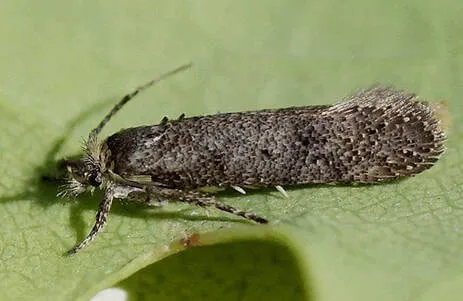
The cereal leaf miner (Ochsenheimeria vacculella) belongs to the family Ochsenheimeriidae, order Lepidoptera. The adult is a small moth with a wingspan of approximately 10–12 mm, featuring dull brownish coloration that provides excellent camouflage against grass stems.
The larva is a caterpillar characterized by a distinct head capsule. It typically reaches up to 8 mm in length and displays a yellowish-white or greyish body with dark spots at the base of its bristles, which serves as a key diagnostic feature for field identification.
This species is univoltine, meaning it completes only one generation per year. It primarily overwinters as young larvae within plant debris or near the base of grass stems, protected from harsh winter conditions.
During the spring, larvae become active as temperatures rise, beginning to feed on the tissues of young cereal plants. Their hidden lifestyle makes early detection difficult without systematic field scouting and examination.
Pupation occurs either inside the mined stem or within a dense, protective cocoon located on the soil surface, providing the pupa with a stable environment until the adult moth emerges.
What it damages
The cereal leaf miner primarily targets winter cereal crops, including wheat, rye, and barley. It also utilizes wild grasses as host plants, which serve as reservoirs for the pest population between growing seasons.
Damage is caused by the larvae, which bore into the stems of young plants. They create internal tunnels (mines) that disrupt the growing point, frequently resulting in the death of the central leaf or the entire shoot.
The most significant damage occurs during the spring tillering stage. Injury to primary shoots at this time leads to a reduced stand density and a direct negative impact on potential grain yield at harvest.
In cases of high pest pressure, fields exhibit significant patchiness, which promotes weed competition and increases the crop's susceptibility to secondary fungal infections due to damaged plant tissues.
In the autumn, larvae may also damage winter crops by boring into stems before winter dormancy, which weakens the plants and reduces their overall cold tolerance and survival rates.
Signs of infestation
The primary symptom of infestation is the yellowing and wilting of the central leaf, which eventually dies off. This symptom is often misidentified as a sign of nutritional deficiency or drought stress.
Upon dissecting an infested stem, internal channels or cavities caused by the larval feeding are visible. These mines often contain frass (larval excrement) appearing as fine brownish debris.
A characteristic indicator is the entry hole located at the lower portion of the stem where the larva penetrated the tissue. The surrounding tissue may appear darkened or slightly discolored.
- Yellowing and premature death of central leaf blades.
- Reduced stem density across the field.
- Presence of internal mining tunnels within internodes.
- Stunted development of affected plants.
Field scouting should be performed in the morning hours using a magnifying lens, focusing on the basal sections of the stems to identify entry points and larval activity.
Control measures
The most critical agronomic practice is strict crop rotation. It is highly recommended to avoid planting winter cereals immediately after other grass crops, especially in fields with significant quackgrass pressure, which acts as a primary host.
Stubble cultivation and deep plowing after harvest are highly effective in destroying a large portion of the overwintering population found in plant residues and soil, thereby disrupting the cycle of the next generation.
Optimizing planting dates is crucial: sowing too early makes winter cereals more vulnerable to autumn infestation by the leaf miner; therefore, adhering to regionally recommended windows is essential for risk reduction.
Chemical control involves the application of systemic insecticides during the peak of larval emergence. Insecticides must have high systemic mobility to reach larvae protected within the stem tissues.
Monitoring adult populations using pheromone traps or sweep nets allows for precise timing of interventions, ensuring that insecticide applications are cost-effective and environmentally targeted.
Taxonomy
- Latin name
- Ochsenheimeria vacculella
- Order
- Lepidoptera (butterflies)
- Family
- Ochsenheimeriidae
- EPPO code
- OCHSVA
Discussion
No discussions yet — be the first.