
Cereal leaf miner
Ochsenheimeria taurella
Description
How to identify
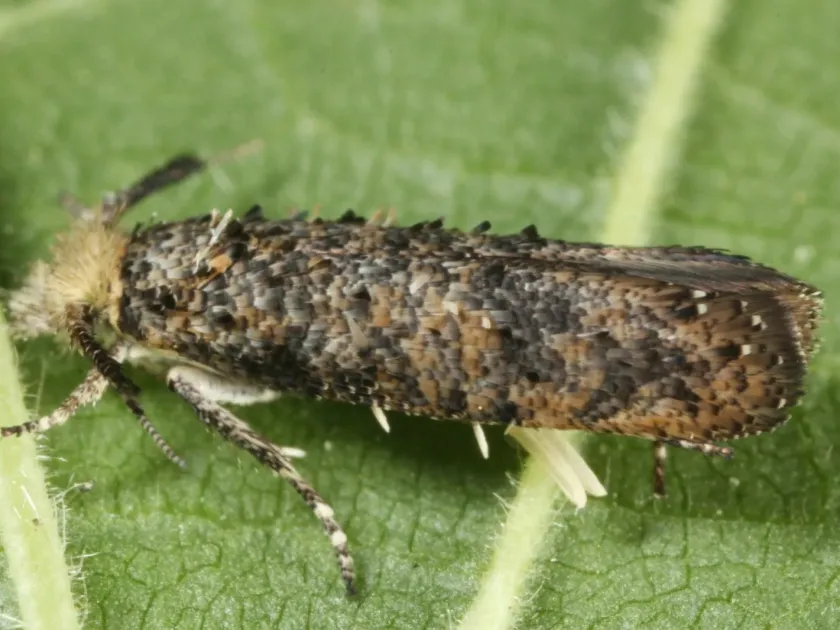
The cereal leaf miner (Ochsenheimeria taurella) is an insect pest belonging to the family Ochsenheimeriidae, within the order Lepidoptera. The adult is a small moth with slender wings covered in scales, which help it blend in with its environment.
Adult moths typically have a greyish-brown or dark brown coloration, with a wingspan ranging from 10 to 13 millimeters. When at rest, their wings are folded tightly against the body, making them difficult to spot on grain stalks.
The larvae progress through several developmental stages. Initially, they are pale, but as they grow, they take on a yellowish-green hue with a distinctly hardened brown head capsule adapted for mining plant tissues.
Eggs are minute, oval-shaped, and usually deposited by females in leaf axils or near the base of cereal plants. Upon hatching, larvae immediately bore into the plant epidermis to begin feeding.
Pupation occurs in durable, white silken cocoons. These cocoons are typically attached to leaves or at the base of the stems of the host cereal crop.
What it damages
The primary hosts for Ochsenheimeria taurella are members of the Poaceae family. This includes major agricultural crops such as winter wheat, rye, barley, and oats, as well as various wild grasses.
Damage is caused exclusively by the larvae, which mine the interior of leaves and stems. This tunneling destroys the plant's vascular tissue, disrupting nutrient and water transport.
The most significant damage occurs in young seedlings during autumn and early spring. The infestation reduces plant vigor, leads to stunted growth, and can result in sparse crop stands.
Plants weakened by larval feeding become more susceptible to secondary pathogens and fungal diseases, which can further decrease overall grain yields and quality.
High population densities can cause widespread wilting of stems, ultimately leading to significant loss of plant density in the field, especially under favorable overwintering conditions.
When it appears
The activity of the cereal leaf miner is seasonal, with the adult flight period typically occurring in late summer and early autumn when winter cereal crops are being established.
The pest generally overwinters in the larval stage, residing inside the stems or at the base of the plants, where the vegetation provides essential protection against cold weather.
During the spring, as temperatures rise, the larvae resume active feeding and move into fresh growth, which constitutes the most critical period for field monitoring.
The species completes one generation per year. Climatic conditions, particularly long and warm autumns, can significantly influence the survival rate of the overwintering generation.
Pupation takes place in late spring or early summer, followed by the emergence of the next generation of adult moths that will disperse to locate new host plants.
Signs of infestation
The most characteristic sign of infestation is the appearance of light-colored spots or stripes on the leaves, which evolve into distinct tunnels known as mines, visible when holding the leaf against light.
Damage to the stems often manifests as small entry holes accompanied by internal cavities filled with larval frass, which compromises the integrity of the grain stalk.
- Yellowing and desiccation of young leaf tips.
- Stunted development of the central shoot.
- Small, distinct entry holes near the base of leaves.
- Presence of small white cocoons on the underside of leaves.
- Visible patchy wilting across the field.
Regular field scouting during the seedling stage is vital for detecting early signs of activity, allowing for timely intervention before economic injury levels are reached.
Visible thinning of plant stands, combined with the presence of mined tissue, serves as a clear indicator of a developing infestation that requires immediate professional assessment.
Control measures
Integrated management begins with agronomic practices, specifically the removal of wild grass hosts and weeds that serve as reservoirs for the pest between growing seasons.
Optimizing sowing dates is a primary defense; avoiding overly early autumn planting can reduce the attractiveness of the field to egg-laying moths.
When the economic threshold is exceeded, the application of systemic insecticides is often necessary. These chemicals must be capable of reaching larvae concealed within the plant tissues.
Deep autumn plowing is a recommended cultural practice to destroy overwintering larvae and pupae by burying crop residues where the insects reside.
Implementing a diverse crop rotation that excludes susceptible cereals for several years helps interrupt the life cycle and effectively reduces the population pressure in the area.
Taxonomy
- Latin name
- Ochsenheimeria taurella
- Order
- Lepidoptera (butterflies)
- Family
- Ochsenheimeriidae
- EPPO code
- OCHSTA
Discussion
No discussions yet — be the first.