
American pika
Ochotona princeps
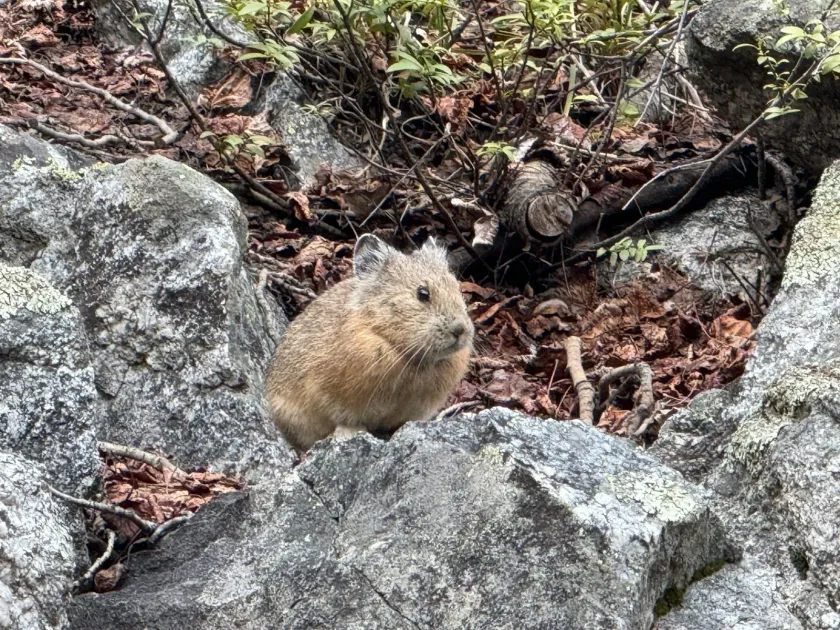
Description
How to identify
The American pika (Ochotona princeps) is a small lagomorph, belonging to the family Ochotonidae. Unlike true rodents, they are closely related to rabbits and hares.
Pikas are typically 15–20 cm long with dense, gray-brown fur designed for cold mountain environments. They have rounded ears and lack a visible external tail.
They are diurnal animals that spend most of their time foraging and creating "haypiles" to survive the harsh winters in their high-altitude habitats.
The species is highly territorial and typically solitary, except for breeding pairs, which naturally limits their population density in a given area.
Reproductive rates are relatively low, with females producing one or two litters per year, making them less of a runaway population risk than common mice.
What it damages
While pikas primarily inhabit wild rocky talus slopes, they can become agricultural pests when farms are situated near these natural habitats.
The primary damage occurs when pikas harvest cultivated grasses, clover, or alfalfa from nearby fields to store as fodder for their winter haypiles.
They cut the stems of plants with high precision, essentially "harvesting" the farmer's crop before it can be collected, leading to significant yield losses.
In addition to direct consumption, their burrowing activities near field edges can contribute to soil erosion and compaction, affecting land quality.
The damage is usually localized to the boundaries of agricultural plots bordering mountainous terrain, but it can be substantial during the peak harvesting season.
Signs of infestation
The most distinctive sign of an infestation is the presence of "haypiles" — piles of drying vegetation tucked away in rock crevices or near field borders.
You may notice patches of crops with neatly cut stems, as pikas use their sharp incisors to harvest vegetation in a very uniform manner.
Auditory evidence is also a key indicator; pikas emit a sharp, shrill call when alarmed, which often gives away their location near your fields.
The presence of latrines, identified by concentrated deposits of droppings, is a clear sign that a pika colony is established in the vicinity.
Identifying burrow entrances in rocky areas adjacent to cultivated fields confirms that the animals are utilizing the field for their foraging activities.
Control measures
Agricultural management should focus on creating buffers between cultivated crops and rocky slopes, such as maintaining weed-free field margins.
Exclusion methods, such as fencing or wire mesh, can be used to prevent pikas from accessing specific high-value plots near their natural habitats.
Biological control methods involve encouraging the presence of natural predators, such as raptors or foxes, which are effective in regulating pika populations.
Chemical control is generally discouraged and often strictly regulated, as American pikas are sensitive species and important components of mountain ecosystems.
Regular monitoring of field edges allows for early detection of colony expansion, enabling non-lethal deterrents to be applied before significant damage occurs.
Taxonomy
- Latin name
- Ochotona princeps
- Family
- Ochotonidae
- EPPO code
- OCHOPR
Discussion
No discussions yet — be the first.