
Northern pika
Ochotona hyperborea
Description
How to identify
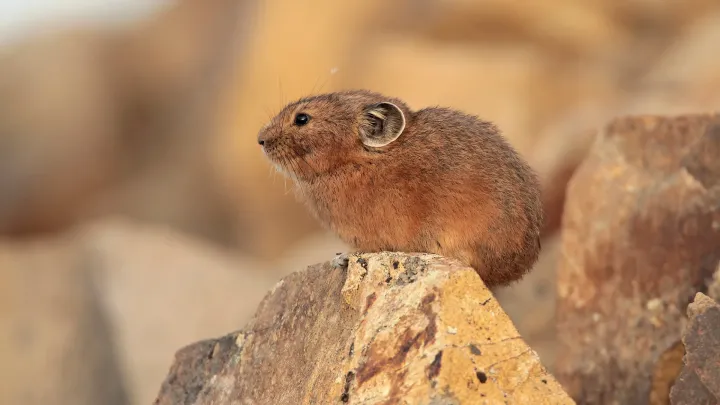
The Northern pika (Ochotona hyperborea) belongs to the order Lagomorpha, family Ochotonidae. It is a small mammal that looks like a tailless hamster with rounded ears.
The animal has dense, brownish or reddish fur, which allows it to camouflage effectively among rocks and dry vegetation in its natural habitat.
Adult individuals can reach a body length of up to 20 cm. Their physiological characteristic is a high metabolic rate, forcing them to spend most of their time foraging.
They are primarily diurnal, preferring rocky talus slopes and alpine tundras, from where they can migrate to nearby agricultural fields to feed.
Breeding takes place in the summer, with females producing 1-2 litters per season, which can lead to a rapid population growth in favorable conditions.
What it damages
This species acts as an indirect agricultural pest, as its primary activity involves harvesting forage for the winter. Pikas cut stems of grasses, legumes, and other plants.
The greatest damage occurs when fields or gardens are located near mountain slopes or rocky ridges where colonies of these rodents reside.
Cereal crops, forage grasses, and vegetable plantings adjacent to wilderness areas are susceptible to damage. The animals eat leaves, stems, and may burrow near roots.
The hay piles, which pikas build for winter, often consist of harvested agricultural crops, resulting in direct yield loss for the farmer.
In years of high population density, these animals can significantly thin out crops on the edges of fields, causing measurable economic losses in mountain regions.
When it appears
The active period for the Northern pika begins in early spring, immediately after the snow melts, and continues until late autumn.
The most intensive forage harvesting activity occurs in the second half of summer and early autumn when plants dry out, making them suitable for winter storage.
The species does not hibernate, so rodents remain active into autumn, collecting remaining vegetation, which poses a significant risk to late-season crops.
The spring season is characterized by a high interest in fresh seedlings, which provide the rodents with necessary vitamins after a long winter.
Pikas remain active throughout the day, requiring constant monitoring of their presence on adjacent territories to prevent sudden crop loss.
Signs of infestation
The primary sign of their presence is the presence of neatly piled hay stacks, usually located among rocks or near burrow entrances.
Specific angled cuts on plant stems indicate the activity of pika incisors, which differs significantly from the damage caused by other rodent species.
The discovery of multiple burrows in rocky areas adjacent to fields is a direct indicator of a colony living in close proximity to agricultural land.
The characteristic sharp whistle emitted by the animals when sensing danger is often the first signal of their presence on a plot.
Presence of excrement near burrows and trails, which the rodents keep clean and use regularly for movement between foraging sites and their shelter.
Control measures
Protecting a farm from the Northern pika primarily involves preventive measures aimed at deterring the animals from the field boundaries.
Installing mechanical barriers, such as fine-mesh wire fences, along the perimeter bordering mountain slopes prevents rodent migration to crops.
- Regular clearing of weeds and brush from adjacent territories.
- Creation of buffer zones made of gravel or rock, which are unsuitable for burrowing.
- Usage of ultrasonic deterrent devices that create discomfort for rodents.
Implementation of biological control methods, such as encouraging natural predators (birds of prey, foxes) on the farm territory.
Chemical control methods using rodenticides should be applied with extreme caution and in strict accordance with regional environmental regulations.
Taxonomy
- Latin name
- Ochotona hyperborea
- Family
- Ochotonidae
- EPPO code
- OCHOHY
Discussion
No discussions yet — be the first.