
Backswimmer
Notonecta undulata
Description
How to identify
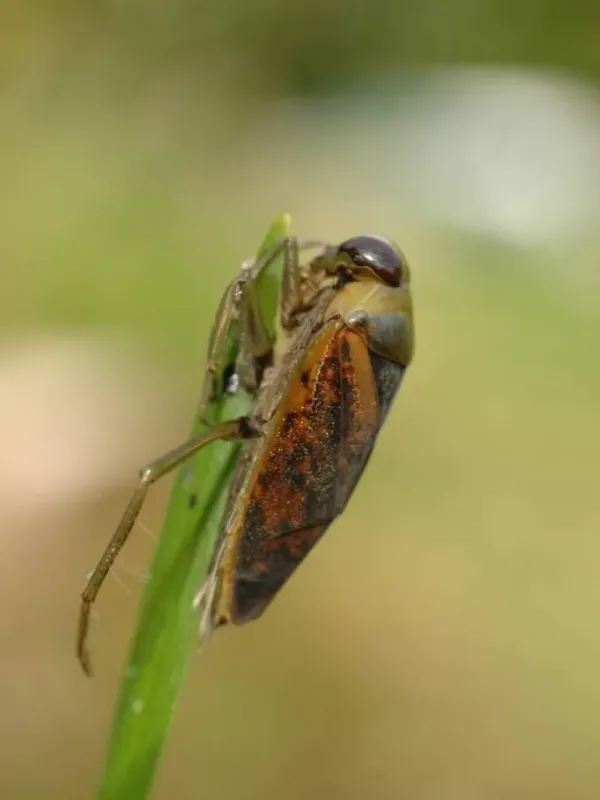
The backswimmer (Notonecta undulata) is a member of the Hemiptera order and the Notonectidae family. It is an aquatic insect known for its boat-like body shape, with a convex back and a flat, pale underside.
Adult insects typically measure between 13 and 15 millimeters in length. Their coloration ranges from yellowish-gray to greenish, providing effective camouflage against the underwater environment and aquatic vegetation.
They are distinct for swimming upside down, utilizing long, oar-like hind legs covered with dense hairs. This unique morphology allows them to propel through the water with remarkable agility and speed.
Equipped with a sharp, piercing proboscis, the backswimmer injects digestive enzymes into its prey. This mechanism allows them to subdue prey much larger than themselves and can cause a painful sting to humans if handled improperly.
The species thrives in stagnant or slow-moving bodies of water. They overwinter in the mud or among dense bottom vegetation, resuming activity as soon as water temperatures rise in early spring.
What it damages
The backswimmer is considered a nuisance in commercial aquaculture and fish hatcheries. As an aggressive predator, it poses a direct threat to the survival of young fish larvae and fry.
Damage is most severe during the spring and summer months when fish fry are most vulnerable. The predators hunt actively, often attacking fish that are the same size or slightly larger than the insects themselves.
In addition to direct predation, backswimmers compete with juvenile fish for food sources. They consume large quantities of zooplankton, such as daphnia and copepods, which are critical for the growth of young fry.
High densities of these insects in nursery ponds can lead to significant mortality rates among fish stock, severely impacting the efficiency of fish farming operations and reducing overall yields.
Beyond commercial hatcheries, their presence in ornamental ponds is often undesirable as they contribute to the stress levels of fish populations and can disrupt the ecological balance of the system.
When it appears
Backswimmer activity typically begins in early spring as water temperatures reach 8–10 degrees Celsius. Overwintered adults emerge from dormancy and immediately begin feeding to regain energy for reproduction.
The reproductive cycle occurs throughout the spring and early summer. Females deposit eggs on underwater structures and vegetation, ensuring that the next generation hatches during the peak fish spawning season.
The peak period of damage occurs from June to July, coinciding with the massive emergence of nymphs. These nymphs are extremely voracious and continue to prey on fish fry throughout their development.
Population levels reach their maximum toward the end of summer. During this time, adults are capable of flight, allowing them to migrate between ponds in search of more abundant food resources or suitable overwintering sites.
As autumn temperatures drop, the insects enter a period of inactivity. They descend to the pond floor and burrow into the sediment, where they remain in diapause until the following spring season.
Control measures
Draining and drying of ponds during the off-season is the most effective management strategy. This process eliminates both the adults and the eggs deposited on vegetation, effectively breaking the pest's life cycle.
Regular maintenance of the pond environment is essential. Clearing the banks and bottom of excessive vegetation reduces the available surfaces for egg-laying and eliminates the hiding spots these predators rely on.
Applying a thin layer of non-toxic oil or specialized surfactant to the water surface can prevent the insects from breathing. As backswimmers rely on atmospheric air, they are forced to the surface to breathe, making them susceptible to this method.
Biological control, such as introducing fish species that naturally feed on aquatic insects, can help keep populations in check. This approach minimizes the need for chemical interventions in fish-rearing areas.
Chemical control should be avoided whenever possible, as most insecticides are toxic to fish and disrupt the pond ecosystem. If absolutely necessary, treatments must be specific and approved for use in aquaculture environments.
Taxonomy
- Latin name
- Notonecta undulata
- Order
- Hemiptera (bugs, aphids, leafhoppers)
- Family
- Notonectidae
- EPPO code
- NOTNUN
Discussion
No discussions yet — be the first.