
Nomia
Nomia
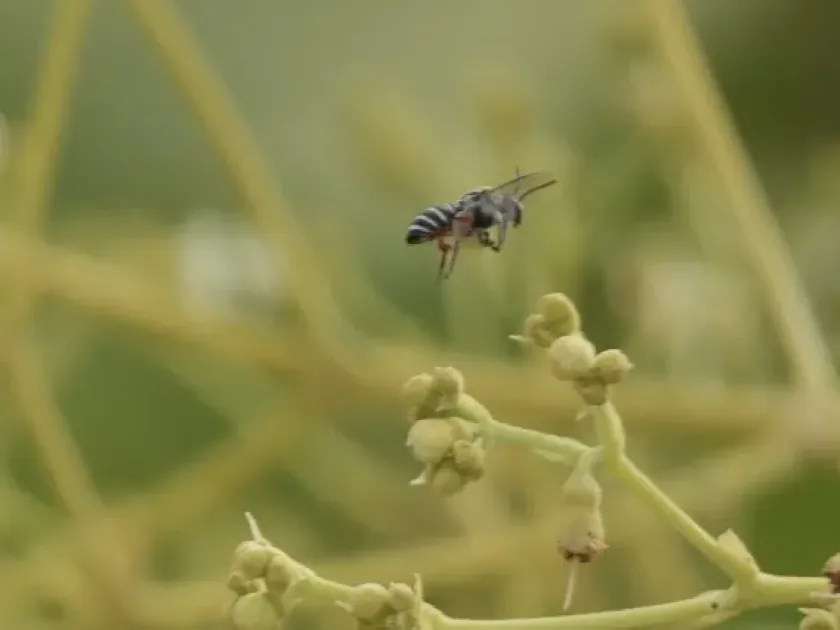
Description
How to identify
The genus Nomia belongs to the family Halictidae within the order Hymenoptera. They are primarily known as solitary, ground-nesting bees.
Adult insects are often recognized by their distinctive appearance, which may include metallic coloration or bright abdominal bands.
These bees typically measure between 8 and 15 millimeters in length, depending on the specific species and local environmental factors.
Females are biologically equipped with specialized structures on their legs, which they utilize for excavating complex nests in the soil.
While many species play a beneficial role in pollination, their nesting habits can occasionally conflict with agricultural practices in specific soil types.
What it damages
The primary concern regarding Nomia in agriculture arises from their tendency to build extensive tunnel networks directly within the soil where crops are growing.
Seedlings and young plants are particularly vulnerable, as the excavation process can physically disrupt root systems and soil capillaries.
Such damage leads to stunted growth, reduced nutrient uptake, and potentially total loss of seedlings if the nest density is sufficiently high.
Crops planted in sandy or loose soil are at the highest risk, as these soil textures are preferred by females for nest construction.
Economic damage is most frequently reported in intensive farming systems where nesting sites are concentrated within rows of cash crops.
When it appears
The activity period for Nomia is primarily during the late spring and summer months when soil temperatures favor reproduction and larvae development.
Adults emerge from their overwintering cells during the spring, coinciding with the phenological stage of host plants and early seasonal blooms.
The life cycle involves the construction of subterranean cells, where larvae are provisioned with pollen and nectar until they mature.
Seasonal occurrence is highly dependent on weather conditions; warm, dry springs typically lead to higher nesting activity levels.
As the season progresses toward autumn, adults die off, and the larvae enter a dormant state deep within the soil profile until the following year.
Signs of infestation
The presence of Nomia is most easily identified by the appearance of numerous small, circular holes in the soil, often accompanied by small mounds of earth.
Visible signs include patchy emergence of crops and the wilting of young plants located directly over or near nest site clusters.
In sunny conditions, one can observe active foraging and constant movement of adult bees near the surface of the soil entrances.
Roots in affected areas may show signs of mechanical abrasion or dry soil pockets resulting from the disruption of moisture pathways.
Farmers can identify nesting areas during field inspection by looking for dense groupings of entrance holes in otherwise undisturbed soil.
Control measures
Cultural control via intensive soil cultivation or deep plowing is the most effective method for destroying nest structures and preventing colonization.
Applying mulch or ground cover can serve as a deterrent, making it more difficult for females to locate suitable spots for tunnel excavation.
Insecticide use should be carefully considered, prioritizing selective applications to avoid harming beneficial pollinator populations in the surrounding ecosystem.
Regular irrigation management that keeps the soil consistently moist can make nesting sites less attractive to the bees.
Integrated pest management (IPM) programs should focus on monitoring nesting density and applying mechanical measures before the peak reproductive phase occurs.
Taxonomy
- Latin name
- Nomia
- Order
- Hymenoptera
- Family
- Halictidae
- EPPO code
- NOMISP
Discussion
No discussions yet — be the first.