
Naupactus godmanni
Naupactus godmanni
Description
How to identify
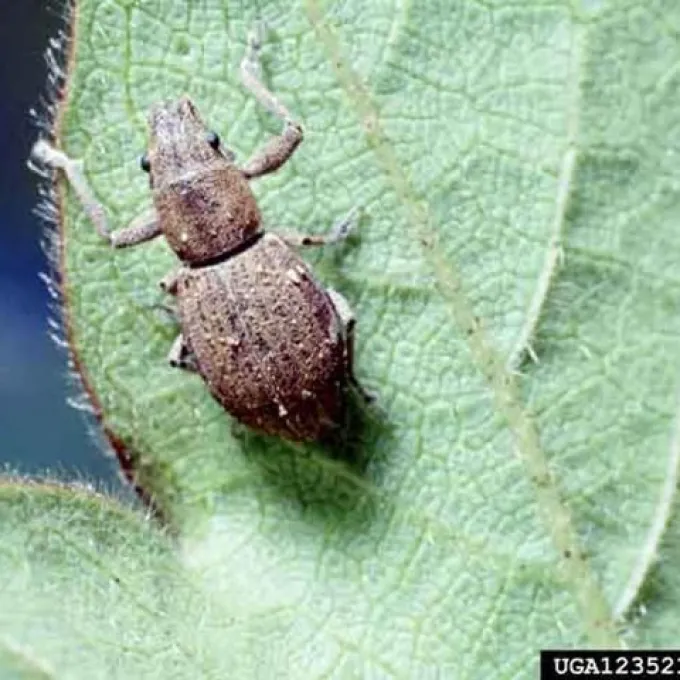
Naupactus godmanni, commonly known as a type of root weevil, belongs to the Curculionidae family within the order Coleoptera. Adult beetles typically measure 10–12 mm in length and possess an oval body, often displaying grayish or brown coloration that allows them to blend seamlessly with soil and bark.
The morphology of these weevils features a short, broad snout, characteristic of the Entiminae subfamily. Adults are flightless, possessing vestigial wings, which significantly restricts their natural dispersal ability; therefore, they rely heavily on human-assisted transport for spreading to new areas.
The larvae are legless, C-shaped, and creamy-white with a robust head capsule equipped with powerful mandibles designed for subterranean feeding. They lack eyes and are entirely specialized for life within the soil profile.
Reproduction in this species is primarily parthenogenetic, meaning females can produce viable eggs without mating. This reproductive strategy allows a single introduced individual to establish a thriving population rapidly, making it a challenging pest to eradicate.
Originating from South America, Naupactus godmanni has become a significant invasive threat in various parts of the world, impacting both commercial plantations and ornamental nurseries where it can cause widespread crop loss.
What it damages
As a polyphagous insect, Naupactus godmanni feeds on a wide range of host plants. The most severe economic damage occurs in citrus orchards, vineyards, and berry farms, particularly where strawberries are cultivated on a large scale.
Field crops such as soybeans, corn, and sunflowers are also susceptible. In nurseries, the beetle can devastate young woody plants, causing significant economic losses to plant production facilities and forestry operations.
Adult beetles inflict damage by feeding on foliage, creating characteristic notches or "crescent" shapes along the leaf margins. While usually not lethal to mature trees, excessive defoliation reduces the photosynthetic capacity of the plants.
The larvae represent the most destructive stage of the lifecycle. By feeding on the root system, they disrupt the plant's ability to uptake water and nutrients, which often leads to severe stunted growth, wilting, and eventually plant death if the infestation density is high.
Root damage serves as an entry point for secondary infections. Pathogenic fungi and bacteria frequently colonize these wounds, resulting in severe root rots and vascular diseases that further accelerate the decline of the infested crop.
When it appears
The lifecycle of Naupactus godmanni is highly synchronized with soil temperature and moisture levels. Adult emergence usually begins in the spring as soil temperatures rise, marking the start of the primary activity period for the generation.
Summer is characterized by intensive feeding and reproductive activity. Females typically lay eggs in protected sites, such as bark crevices, under bud scales, or directly on the soil surface near the crown of the host plant.
After a short incubation period of 2 to 3 weeks, the neonate larvae migrate into the soil. The larval stage is long and resilient, lasting several months, during which they pass through several instars while continuously feeding on subterranean plant parts.
Overwintering occurs primarily in the larval stage deep within the soil profile, which provides protection from extreme winter temperatures. Pupation takes place in specialized soil cells before the cycle repeats the following spring.
In greenhouses or temperate climates, the generation cycle can be overlapping, leading to a constant presence of all life stages throughout the year, which makes management and monitoring significantly more difficult.
Signs of infestation
The most visible sign of an infestation is the presence of irregular, notched edges on leaves. If you observe such damage, it is advisable to inspect the undersides of the leaves at night when the adult beetles are most active.
General plant decline, including chlorosis (yellowing of leaves) and wilting during hot weather, often indicates root-zone damage. These symptoms appear because the damaged roots cannot satisfy the plant's transpiration requirements.
In containerized plants or nursery settings, sudden patches of wilting or death are strong indicators of larval activity in the substrate. Digging near the root zone often reveals damaged or girdled main roots and a lack of fine feeder roots.
Nighttime observation is the best way to confirm the presence of adult weevils. Using a flashlight after sunset on the trunks or foliage of suspected host plants will often reveal the nocturnal beetles.
While secondary pests might be attracted to stressed plants, the presence of these specific notch patterns and subterranean root damage is a diagnostic hallmark of Naupactus species infestation.
Control measures
Managing Naupactus godmanni requires an Integrated Pest Management (IPM) strategy that combines cultural, biological, and chemical control measures to disrupt the lifecycle effectively.
Cultural practices are essential; deep cultivation or tilling of the soil in the autumn and spring can mechanically damage the larvae and expose them to natural predators and environmental stresses.
Biological control has proven highly effective using entomopathogenic nematodes such as Steinernema or Heterorhabditis species. These beneficial organisms are applied to the soil to parasitize and kill the larvae in their subterranean habitats.
Chemical control is aimed at the adult population. Foliar application of insecticides during the evening when the beetles are actively feeding can reduce the adult population, thereby preventing further egg-laying.
- Maintaining clean cultivation by removing weeds that may serve as alternative hosts.
- Using sticky barriers on the trunks of trees to prevent adults from climbing.
- Applying fungal bio-insecticides (e.g., Beauveria bassiana) to the soil.
- Ensuring all nursery stock is inspected for larvae before planting.
Taxonomy
- Latin name
- Naupactus godmanni
- Order
- Coleoptera (beetles)
- Family
- Curculionidae
- EPPO code
- PANMGO
Discussion
No discussions yet — be the first.