
Myoplatypus flavicornis
Myoplatypus flavicornis
Description
How to identify
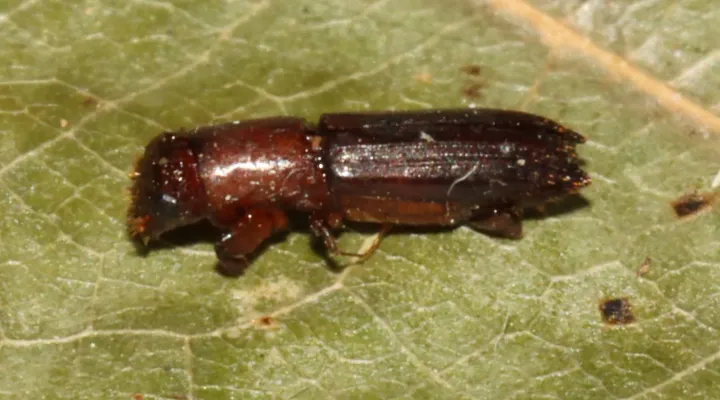
Myoplatypus flavicornis belongs to the Curculionidae family, subfamily Scolytinae, and tribe Platypodini. Adult beetles have a characteristically elongated, cylindrical body, typical for members of this group of ambrosia beetles.
The coloration of the beetle varies from dark brown to black, with antennae showing a distinct yellowish tint, which is reflected in the specific name. The head is tucked closely against the pronotum, allowing the insect excellent mobility while navigating deep inside the wood.
Sexual dimorphism is evident in the structure of the pronotum and the shape of the abdominal tip. Males are generally smaller than females and possess specific projections that assist in pushing "frass" (boring dust) out of the gallery tunnels.
Larvae are white, legless, and have a curved body shape with powerful biting mouthparts. They develop exclusively within the trunk of host trees, feeding not so much on the wood itself, but on the mycelium of symbiotic fungi.
The life cycle of this insect is closely linked to the fungal flora, which the female introduces into the galleries during colony establishment. These fungi serve as the primary food source for both larvae and adults, providing essential nutrients, proteins, and vitamins.
What it damages
This pest primarily infests hardwood species, with various oak species (Quercus) being the most common hosts. Infestations in other members of the beech family (Fagaceae) have also been recorded within their natural range.
Myoplatypus flavicornis prefers weakened, dying, or recently fallen trees, but during high population densities, it can also attack healthy, physiologically active trees in forest stands.
The main danger is that the beetle bores deep into the sapwood and heartwood to construct its galleries. This activity disrupts normal sap flow and compromises the physical structural integrity of the tree trunk.
A secondary negative impact is the inoculation of the wood with fungal pathogens carried by the beetles. These fungi cause specific staining (discoloration) of the timber, which significantly reduces the market value and mechanical strength of the wood.
Mass reproduction of this pest leads to rapid physiological stress, ultimately causing tree mortality. From a forestry perspective, this results in significant resource losses and necessitates urgent sanitary logging operations.
Signs of infestation
The primary sign of infestation is the appearance of fine, powdery wood dust, known as frass, appearing in thin streams on the bark. This finely granulated mass is pushed out by the beetles as they excavate their tunnels.
Upon close inspection of the bark, numerous entrance holes can be observed. These holes are strictly circular in shape, with a diameter corresponding to the body size of the beetle, distinguishing them from other bark beetle damage.
The presence of specific fungal spots on wood cross-sections indicates a deep infection. These spots are often dark or almost black, characteristic of the symbiotic fungi accompanying Myoplatypus flavicornis.
During the flight season, an increased concentration of beetles can be observed near the trunks of suitable host trees. Peak flight usually occurs during the warmer months, coinciding with the period of most active plant vegetation.
- Presence of frass accumulation in the lower and middle trunk sections.
- Circular entry holes on the bark surface.
- Decrease in leaf turgor in infested specimens.
- Fungal staining of the wood (blue stain or black streaks).
- Gradual crown dieback and tree mortality.
Control measures
Sanitary prophylaxis is the primary method of control. It is essential to remove fallen wood, windthrow, and freshly infested trees from forest areas promptly to deny the pest breeding grounds.
The use of trap logs is highly effective in reducing population numbers. Freshly felled trunks are left in infested areas as bait; once they are colonized by the beetles, they are removed or debarked.
Chemical control measures include applying contact insecticides to the trunks during the peak flight period of the beetles. This approach is practical in nurseries or high-value forest parks to protect young plantations.
Biological control involves creating conditions for natural enemies, such as woodpeckers and predatory insects, which actively hunt for larvae and adult beetles beneath the bark.
It is crucial to maintain regular forest pathology monitoring using pheromone traps. This allows for early detection of pest population increases, enabling management interventions before the damage becomes widespread and irreversible.
Taxonomy
- Latin name
- Myoplatypus flavicornis
- Order
- Coleoptera (beetles)
- Family
- Curculionidae
- EPPO code
- MPLTFL
Discussion
No discussions yet — be the first.