
Mycophila speyeri
Mycophila speyeri
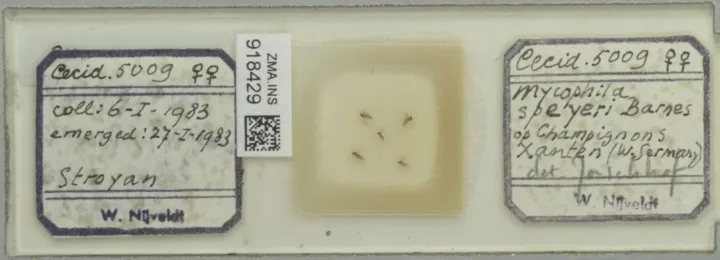
Description
How to identify
Mycophila speyeri is a small species of gall midge belonging to the family Cecidomyiidae. It is known as a significant pest in mushroom production, particularly affecting agaricus mushrooms.
The adult midge is a tiny, delicate fly approximately 1–1.5 mm long, with clear wings and fragile legs. They are frequently seen near light sources or mushroom beds.
The larval stage is the most destructive phase. The larvae are legless, white or yellowish, and reach about 2 mm in length, making them difficult to spot without magnification.
This species is notorious for its ability to reproduce through paedogenesis. This means the larvae can produce offspring within their own bodies, leading to an extremely rapid population explosion.
Their life cycle is highly temperature-dependent, with reproduction occurring rapidly in the humid and warm environments typically found in mushroom growing facilities.
What it damages
The larvae feed primarily on the mushroom mycelium. This feeding behavior destroys the network of the fungus, leading to a significant reduction in overall yield.
Extensive larval activity degrades the growing substrate, making it impossible for healthy mushrooms to develop properly in the affected areas.
When populations reach high densities, larvae may invade the mushroom fruit bodies themselves, boring tunnels into the stems and caps, rendering them unsalable.
Furthermore, these midges serve as vectors for various plant pathogens, including bacteria and molds, spreading diseases throughout the production rooms.
The cumulative damage often results in severe economic losses if the infestation is not detected and treated during the early stages of development.
Signs of infestation
The presence of small, flying midges near the mushroom blocks or ventilation fans is the most immediate indicator of an infestation.
Growers should monitor the surface of the casing layer and the substrate for signs of thinning mycelium or the appearance of localized patches of larval clusters.
Stunted growth or malformed fruit bodies are often indicative of larvae feeding within the mushroom tissue, which disrupts normal development.
A noticeable decline in substrate quality and an unusual, musty odor in the growing room may signal that a larval colony is thriving beneath the surface.
- Adult midges on yellow sticky traps
- Disappearing mycelium
- Deformed fruit bodies
- Patches of larvae in the substrate
Control measures
Strict hygiene is the cornerstone of control. All facilities must be cleaned and disinfected thoroughly between every crop cycle to eliminate residual populations.
Pasteurization of the substrate and casing material is essential to kill all life stages of the midge, including eggs and larvae, before planting the spawn.
Physical barriers such as fine-mesh screens on ventilation ducts are crucial to prevent adult midges from entering the growing rooms from the external environment.
Monitoring using yellow sticky traps allows farmers to detect early activity and apply targeted control measures before an outbreak occurs.
When chemical intervention is required, only approved insecticides should be used, and they must be applied according to the manufacturer's strict safety guidelines.
Taxonomy
- Latin name
- Mycophila speyeri
- Order
- Diptera (flies)
- Family
- Cecidomyiidae
- EPPO code
- MYCPSE
Discussion
No discussions yet — be the first.