
Poplar vagabond aphid
Mordwilkoja vagabunda
Description
How to identify
The poplar vagabond aphid (Mordwilkoja vagabunda) is a pest belonging to the family Pemphigidae. It is known for its complex life cycle involving multiple stages and distinct host plants.
Adult aphids and nymphs possess specialized piercing-sucking mouthparts, which they use to feed on the nutrient-rich phloem sap of the host tree.
These insects are rarely seen in their free-living stage, as they spend the majority of their growth phase enclosed within complex, distorted leaf structures known as galls.
There is significant morphological variation between generations, with individuals ranging from wingless nymphs to winged adults designed for migration.
The species survives the winter in the egg stage, which the females carefully deposit into the crevices of poplar bark to ensure protection from harsh weather.
What it damages
This aphid primarily targets various poplar species, with the eastern cottonwood and hybrid poplars being among the most common hosts.
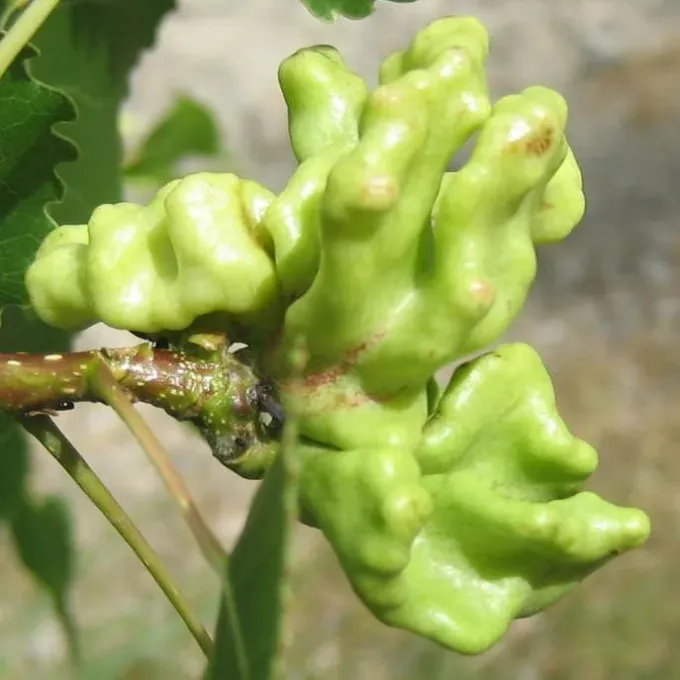
Feeding activity by the aphids triggers a hormonal response in the leaf tissue, causing the plant to grow large, abnormal, and convoluted leaf galls.
These galls typically form at the tips of shoots, drastically altering the architecture of the branches and disrupting normal sap flow.
By diverting the tree's energy into maintaining these galls, the aphids weaken the tree, leading to reduced vigor and stunted growth of the affected shoots.
In cases of high infestation, the aesthetic value of urban trees is significantly diminished due to the unsightly nature of the brown, dried-out galls.
When it appears
The life cycle begins in early spring when the overwintering eggs hatch into stem mothers that colonize the developing leaf buds.
The gall-forming process is most intense during late spring and early summer, coinciding with the rapid growth phase of the poplar leaves.
Throughout the mid-summer months, several generations of the aphid develop safely inside these structures, protected from environmental stressors.
By late summer, the aphids produce winged forms that emerge from the galls to migrate toward secondary host plants for the autumn cycle.
As temperatures drop, the aphids complete their migration back to the poplars to lay the eggs that will remain dormant throughout the winter.
Signs of infestation
The most unmistakable sign of an infestation is the presence of large, crinkled, and convoluted leaf galls on the terminal ends of twigs.
While fresh galls appear greenish and fleshy, they eventually harden, turn brown, and resemble dried, gnarled pieces of vegetable matter.
Distorted and stunted shoot development at the tips of branches is a classic indicator that the aphids have been feeding in that specific area.
Inside an open gall, one may find a teeming colony of soft-bodied aphids, often accompanied by white, waxy secretions and honeydew residue.
A sudden decline in the health or canopy density of specific branches is another symptom that suggests persistent aphid activity over multiple seasons.
Control measures
Management of the poplar vagabond aphid is challenging because the galls act as physical barriers, protecting the aphids from direct pesticide sprays.
Systemic insecticides are the most effective control method, as they are absorbed by the tree and distributed through the sap, reaching the aphids inside the galls.
Application should ideally occur in the spring, just as the buds begin to break, to target the stem mothers before the galls have a chance to seal.
For smaller trees or ornamental collections, physical removal and disposal of the galls before the aphids emerge can help reduce the local population.
- Apply systemic insecticides early in the spring growth period.
- Prune and destroy infested terminal shoots to remove egg-laying sites.
- Monitor trees annually to identify and treat infestations early.
Taxonomy
- Latin name
- Mordwilkoja vagabunda
- Order
- Hemiptera (bugs, aphids, leafhoppers)
- Family
- Aphididae
- EPPO code
- MORDVA
Discussion
No discussions yet — be the first.