
Monotoma longicollis
Monotoma longicollis
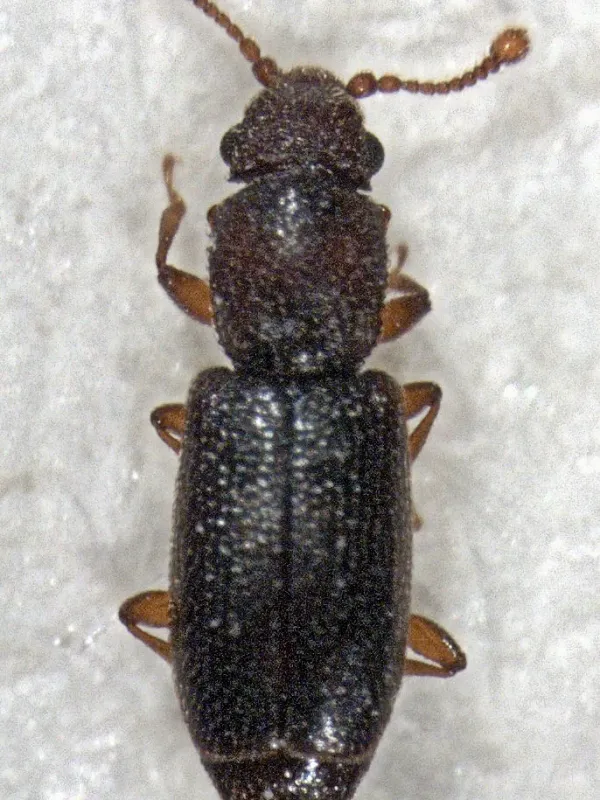
Description
How to identify
Monotoma longicollis belongs to the family Monotomatidae, within the order Coleoptera. Adult beetles are typically very small, measuring between 2 to 3 millimeters in length.
The body is elongated, with a color that generally ranges from yellowish-brown to dark brown. The head is notably extended, providing the characteristic appearance that defines the species.
Larvae of this species are small and whitish in color, usually remaining hidden within the substrate or deep inside cracks in storage facilities.
These insects are primarily associated with environments high in moisture, often thriving where organic matter begins to decay or where fungi are present.
Due to their tiny size, identification usually requires microscopic examination to observe specific morphological traits, such as the shape of the pronotum and antenna structure.
What it damages
The primary food source for this pest consists of fungal spores and mold, which grow on damp grain and other organic materials stored in poorly managed warehouses.
While not a primary pest of whole, sound grain, its presence is a clear indicator of high moisture levels and early-stage deterioration of stored products.
It damages grain crops held in silos or barns where humidity levels exceed safety thresholds, leading to grain heating and spoilage.
Monotoma longicollis can also infest processed products like flour, cereals, and bran if these items are already compromised by mold infestation.
Indirectly, the beetle causes significant damage by actively spreading mold spores throughout the grain pile, accelerating the rotting process of the stored lot.
When it appears
The activity of this beetle is highly dependent on the temperature and humidity levels within the storage facility, with growth being year-round in heated areas.
In unheated warehouses, adults survive the winter in wall crevices, floor cracks, or deep within the grain mass, resuming activity as spring temperatures rise.
Population density typically peaks during warmer months, which correlate with the conditions conducive to mold development, the beetle's primary food.
The life cycle encompasses egg, larva, pupa, and adult stages, with a full generation often being completed in just a few weeks under optimal moisture conditions.
Reproduction rates increase dramatically when the moisture content of the substrate rises above 15 percent, creating a perfect habitat for the pest population.
Signs of infestation
A primary sign of infestation is a distinct musty or moldy odor in the warehouse, which serves as a warning of biological degradation within the grain pile.
Visual detection is possible by sifting through grain samples, particularly from those areas where the bulk of the grain exhibits higher moisture content.
Grain kernels may show signs of discoloration or become covered in fungal growth, which effectively lures the beetles to congregate in those zones.
An increase in the internal temperature of a grain bulk, often referred to as grain heating, is almost invariably associated with a mass outbreak of this beetle.
The presence of fine frass and insect fragments in sifted grain samples serves as definitive evidence of an active pest infestation in the storage unit.
Control measures
The most important control measure is maintaining grain moisture content at a level that inhibits mold growth and prevents internal heating of the storage lot.
Regular sanitation of warehouses, including the removal of dust and old grain residues after every shipment, is essential to deny the beetles a place to breed.
The implementation of active ventilation systems is effective in lowering the humidity of the stored grain mass, thereby stabilizing the environmental conditions.
In cases of severe infestation, professional disinfestation of the facilities using contact insecticides or warehouse fumigation should be performed immediately.
Ensuring airtight storage containers and robust moisture-proofing of the warehouse are critical strategies to prevent the ingress and establishment of this pest.
Taxonomy
- Latin name
- Monotoma longicollis
- Order
- Coleoptera (beetles)
- Family
- Monotomidae
- EPPO code
- MNTOLO
Discussion
No discussions yet — be the first.