
Monostyla monostyla
Monostyla monostyla
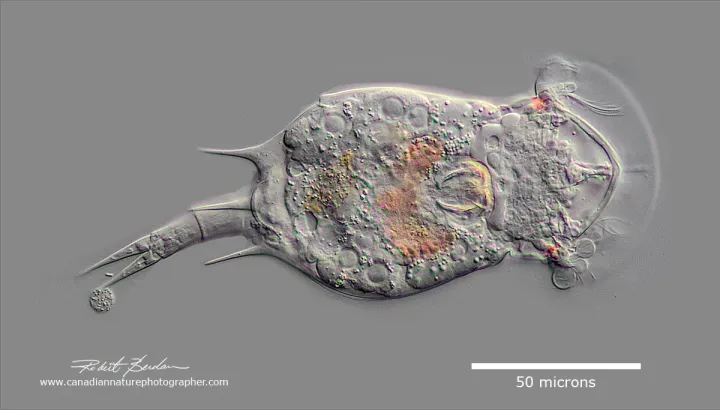
Description
How to identify
Monostyla monostyla (synonym Lecane monostyla) belongs to the phylum Rotifera, class Eurotatoria, order Ploima. These are microscopic aquatic organisms that can thrive in damp soil and nutrient solutions.
The organism is protected by a lorica (shell) which is generally oval or rounded in shape. This structure provides mechanical protection and structural integrity in aquatic environments.
The defining morphological feature of this genus is the presence of a single foot with a single toe, which is adapted for crawling on substrate surfaces within their habitat.
Reproduction is primarily parthenogenic, allowing for rapid population growth when environmental conditions are optimal, such as high moisture and abundant nutrients.
These rotifers exhibit extreme resilience, entering a dormant state known as encystment when moisture levels drop, ensuring survival until conditions become favorable again.
What it damages
While not a primary herbivore for crops, this species causes indirect damage, particularly in hydroponic systems and high-humidity greenhouse environments.
The major economic impact is the clogging of irrigation lines, microtubes, and filters, which disrupts the uniform distribution of nutrients to the crops.
They contribute to the formation of biofilms in irrigation pipes, which can serve as a breeding ground for other harmful pathogens and bacteria.
In seedlings or sensitive hydroponic crops, they may feed on delicate root hair tissues, creating lesions that serve as entry points for root-rot fungi and bacteria.
The accumulation of their biomass alters the chemical properties of the nutrient solution, leading to stunted plant growth and overall reduced yield quality.
When it appears
Activity is most pronounced during periods of high humidity or constant watering, typical of the main growing season in greenhouse facilities.
In controlled environments like greenhouses, the lifecycle continues year-round, provided the temperature remains within the 18–25°C range.
Population surges occur in tandem with intensive watering schedules, which expand the available aquatic habitat for these organisms to migrate and multiply.
During the off-season or in dry conditions, populations decrease as individuals convert into dormant cysts that can persist in the infrastructure until the next season.
The reproductive cycle is exceptionally fast, often completing within less than 24 hours under ideal temperature conditions and nutrient availability.
Signs of infestation
A primary sign of infestation is the appearance of a slimy, translucent biofilm on the inner surfaces of pipes, tanks, and irrigation nozzles.
Visible reduction in the flow rate of irrigation emitters, often misinterpreted as mineral scaling, is a common indicator of rotifer accumulation.
Plant roots may show signs of stress or secondary decay, which may be linked to the rotifers' presence as carriers of plant pathogens.
Changes in the turbidity or odor of hydroponic nutrient reservoirs can indicate that a significant rotifer population has developed within the system.
Laboratory microscopic examination of water samples remains the only definitive way to confirm the presence of this specific species in a facility.
Control measures
Effective management requires regular sanitation of irrigation systems using appropriate oxidizing agents like hydrogen peroxide to break down biofilms.
Installation of high-precision filtration systems with mesh sizes smaller than 20 microns is essential to prevent the spread of rotifers through the water supply.
Agrotechnical strategies focus on managing humidity and preventing waterlogging, which directly limits the environmental suitability for rotifer colonization.
Removing organic detritus and dead plant matter from the system is crucial, as these materials provide the necessary nutrient base for mass populations.
- Implement UV sterilization for all nutrient solution re-circulation.
- Maintain optimal pH levels to inhibit unwanted microbial and invertebrate activity.
- Conduct routine physical cleaning of reservoir tanks and piping networks.
Taxonomy
- Latin name
- Monostyla monostyla
- Family
- Lecanidae
- EPPO code
- MNSTMO
Discussion
No discussions yet — be the first.