
Monostyla
Monostyla
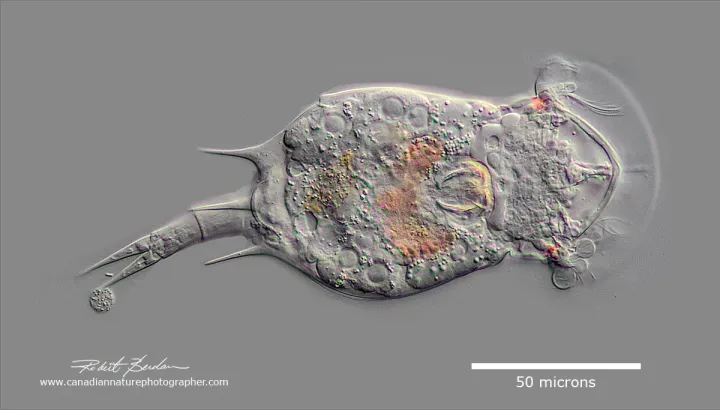
Description
How to identify
Monostyla is a genus of microscopic rotifers which, under specific agro-ecosystem conditions, can act as phytophages or organisms associated with plants. These are tiny invertebrates possessing a characteristic lorica (shell) that protects their soft bodies.
They appear as transparent or translucent microorganisms with a developed corona (ciliary organ) used for movement and feeding. Identification requires laboratory equipment, as their size rarely exceeds a few hundred micrometers.
Systematically, Monostyla belongs to the phylum Rotifera, class Eurotatoria, order Ploima, and family Lecanidae. Scientific classification defines them as one of the most specialized representatives of the group in freshwater ecosystems.
Their morphology is adapted for active foraging in thin films of water on the surface of leaves or stems. The shell may have specific protrusions, which is a key taxonomic feature when identifying the species under a microscope.
It is important to distinguish between Monostyla living in soil water and those directly associated with plant vegetative parts in high-humidity conditions, as the latter are of agronomic interest.
What it damages
This pest mainly affects crops grown in hydroponics or conditions of high soil and air humidity, including vegetable seedlings and ornamental plants.
Monostyla feed on organic debris and microflora, but at high population densities, they can damage the surface epidermis tissues of tender shoots, causing cellular integrity disruptions.
The main damage consists not only of mechanical tissue injury but also the transfer of pathogenic microorganisms that attach to the cuticle or shell of the rotifer.
Damage is often hidden and manifests as microscopic ulcers, which can later become entry points for fungal and bacterial infections.
Crops in a weakened state or experiencing stress from overwatering are most susceptible to the risk of Monostyla colonies developing on the surface of stems and leaves.
When it appears
The period of appearance and active reproduction of Monostyla is closely linked to the presence of a stable water layer on plant surfaces, most often observed in greenhouses.
The most favorable time for the pest's activity is during spring and autumn when the relative humidity level in greenhouses exceeds critical thresholds.
They are capable of rapid reproduction through parthenogenesis, allowing the population to increase geometrically in a few days given sufficient moisture.
Drying out of the substrate or plant surface is a natural limiting factor for their population, as rotifers are extremely sensitive to moisture loss.
In greenhouse complexes, seasonality is almost non-existent, and the pest can be present year-round if humidity control is neglected.
Signs of infestation
Signs of infestation include the appearance of a specific matte coating on the leaf surface, which may seem "alive" upon close inspection due to microscopic movements.
Stunted seedling growth without visible cause is possible, as the pest depletes the surface cell layer by consuming nutrients.
Infestation is often accompanied by the development of accompanying mold, which feeds on the rotifers' metabolic byproducts, visually appearing as dark or gray spots.
Leaves may acquire a chlorotic hue due to impaired transpiration processes caused by the blockage of stomata by microorganisms.
- Loss of turgor in young shoots.
- Appearance of micro-ulcers on the epidermis.
- Development of secondary infections at damage sites.
Control measures
The main control method is strict adherence to water management and the optimization of humidity levels in greenhouses to eliminate standing water on plants.
An effective preventive measure is regular ventilation, which promotes the rapid evaporation of excess moisture from the leaf blade surface.
In cases of mass infestation, the use of specialized disinfectants designed for surface treatment in protected soil is recommended.
Biological control methods include the application of entomopathogenic fungi, which can limit rotifer populations in the substrate.
Agronomic measures include maintaining cleanliness in greenhouses and removing plant debris that serves as a breeding ground for pests during the off-season.
Taxonomy
- Latin name
- Monostyla
- Family
- Lecanidae
- EPPO code
- MNSTSP
Discussion
No discussions yet — be the first.