
Lecanium scale
Lecane
Description
How to identify
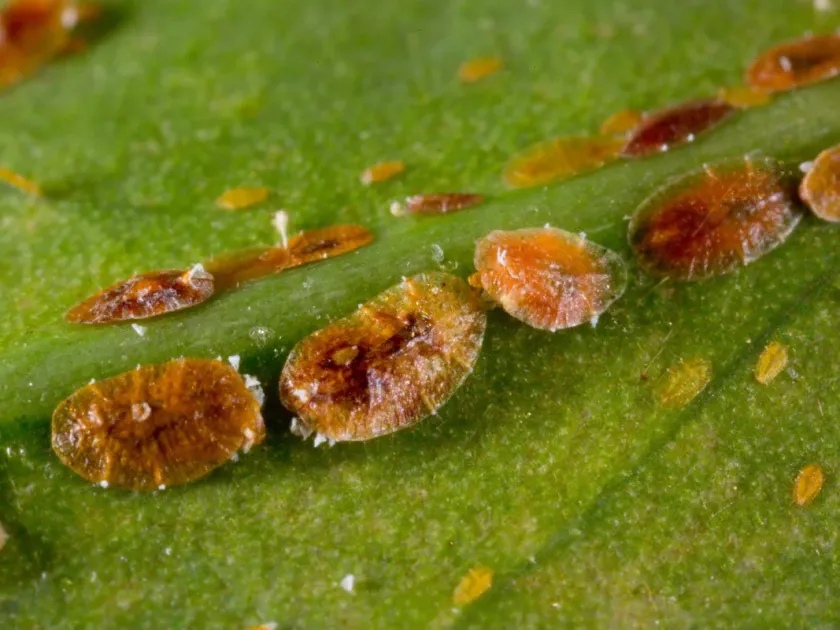
Lecanium scales (family Coccidae) are significant sap-sucking pests. Unlike armored scales, they do not possess a separate, removable shell; instead, their hardened, convex dorsal body surface serves as a protective cover for the insect and its eggs.
Adult females are sedentary, ranging from spherical to elliptical in shape and varying in color from light tan to dark brown. Upon death, the female's body hardens into a protective case that shields the eggs or nymphs underneath.
First-instar nymphs, commonly known as crawlers, are very small and highly mobile. This is the only stage where the pest actively disperses, moving across plant surfaces or drifting via wind currents to colonize new hosts.
These insects exhibit incomplete metamorphosis. Many species are capable of parthenogenesis, allowing populations to proliferate rapidly without the presence of males, often leading to heavy infestations on susceptible plants.
Accurate identification involves examining the shape, size, and texture of the mature female. Some species produce a waxy powder or a specific secretion pattern, which serves as a diagnostic feature for experts.
What it damages
Lecanium scales infest a wide variety of plants, including fruit trees (apples, plums, pears), berries, and ornamental shrubs. They extract vital nutrients directly from the phloem, causing general plant decline.
The primary symptom of feeding is the withdrawal of cell sap, which leads to stunted growth, leaf chlorosis, and premature leaf drop. In severe cases, branches or even entire trees may die back.
A major indirect threat is the production of honeydew, a sticky, sugary waste product. Honeydew accumulates on leaves and branches, creating a perfect substrate for sooty mold fungus to colonize and grow.
Sooty mold coats the leaves, significantly reducing the plant's ability to perform photosynthesis. This creates a feedback loop of stress, making the plant more susceptible to diseases and environmental extremes.
For commercial growers, the aesthetic and physical damage caused by these scales reduces fruit marketability and nursery stock quality, necessitating rigorous and timely management strategies.
When it appears
Lecanium scales typically overwinter as second-instar nymphs. They seek refuge in bark crevices, near bud scales, or at branch junctions, remaining dormant until temperatures rise in the spring.
As spring warms, the nymphs resume feeding and develop into adults. This transition is highly dependent on climate, with emergence occurring earlier in warmer regions or during unusually mild spring seasons.
The life cycle involves egg production in late spring or early summer, depending on the species and local conditions. The females fix themselves to the host plant, swell, and lay eggs beneath their own bodies.
Crawler emergence is the key seasonal event, usually taking place in mid-to-late summer. This represents the most vulnerable stage in the insect's life cycle for chemical control attempts.
Depending on the latitude, some species are univoltine, having one generation per year, while others may complete multiple generations, significantly increasing the pressure on host plants throughout the season.
Signs of infestation
Sticky residue or shiny "wet" patches on the foliage and branches are often the first sign of an infestation. This honeydew frequently attracts ants, which attend the scales to collect the sweet secretion.
Sooty mold, appearing as a thick black coating on leaves and stems, indicates a well-established colony. This is a visual indicator that the infestation has persisted for several weeks at least.
Brown, raised bumps or "scales" along the stems and twigs are characteristic of adult females. Unlike galls, these can often be scraped off with a thumbnail, revealing a soft or hollow underside.
Plants often exhibit signs of stress, such as yellowing leaves (chlorosis), twig dieback, or generally poor vigor. The lower canopy is often the first area to show significant symptoms.
If left unchecked, twigs may crack and become distorted. Close inspection during the dormant season may reveal tiny, flattened nymphs tucked away in protected bark areas.
Control measures
Managing Lecanium scales requires a targeted approach, focusing on the crawler stage when the insects lack the heavy, protective covering that makes them resistant to most contact insecticides.
- Pruning and destroying heavily infested branches to reduce the overall population.
- Using systemic insecticides that are absorbed by the plant and ingested by the feeding scales.
- Applying horticultural oils during the dormant season to suffocate overwintering nymphs.
- Encouraging natural predators such as lady beetles (coccinellids) and parasitic wasps.
- Monitoring crawler emergence using sticky traps to time foliar insecticide applications precisely.
Systemic treatment is often the most effective method, as it bypasses the physical defense of the scale cover. Always ensure that the selected insecticide is registered for the specific crop and pest to avoid phytotoxicity.
Taxonomy
- Latin name
- Lecane
- Family
- Lecanidae
- EPPO code
- LCNESP
Discussion
No discussions yet — be the first.