
Boxwood leaf miner
Monarthropalpus
Description
How to identify
The Boxwood leaf miner (Monarthropalpus flavus or buxi) is a small dipteran insect belonging to the Cecidomyiidae family, known for damaging boxwood shrubs.
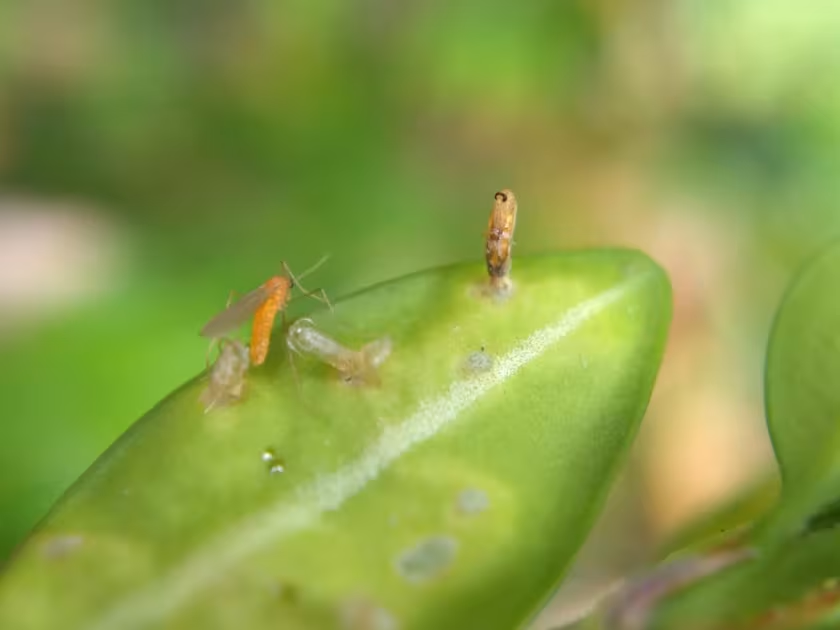
The adult insect is a fragile, orange-yellow mosquito-like midge about 2-3 mm long, which is rarely seen by gardeners due to its short lifespan.
The larval stage is the one responsible for the damage. The larvae are small, orange maggots that live exclusively within the leaf tissue, shielded from external environment.
The lifecycle is strictly univoltine, meaning there is only one generation per year, with the insect spending most of its life inside the foliage.
The insect pupates inside the gall, and the adult emerges in the spring to mate and lay eggs, starting the cycle once again.
What it damages
This pest is highly specialized and attacks only members of the Buxus genus, primarily the common boxwood (Buxus sempervirens).
Larvae feed on the leaf mesophyll, which triggers the formation of galls — bubble-like swellings on the leaves that disrupt the plant's normal metabolism.
Severe infestations cause massive leaf deformation, discoloration, and significant premature leaf drop, stripping the shrub of its evergreen foliage.
Weakened plants show reduced growth rates and become more susceptible to other diseases, drought stress, and winter injury.
In high-density landscapes, extensive damage ruins the architectural shape of the plants, often requiring significant pruning or removal of the shrubs.
When it appears
The adult midge usually emerges in late spring, typically during April or May, depending on the local climate and temperature.
This narrow window is the only time adults are active in the open, searching for new, succulent leaves to deposit their eggs.
After hatching, the larvae bore into the leaf and remain inside the tissue throughout the summer and autumn months, feeding slowly.
The larvae overwinter inside the established leaf galls, remaining protected from the freezing winter temperatures until the cycle resumes in spring.
Timing interventions is critical; applying treatments while adults are active is much more effective than trying to reach the protected larvae inside the galls.
Signs of infestation
Early symptoms are easy to overlook, manifesting as small, pale, or translucent spots on the upper surface of the leaf.
As the season progresses, characteristic blister-like swellings (galls) become visible on the underside of the leaves, housing the developing larvae.
Affected leaves eventually turn yellow or bronze, become brittle, and drop off prematurely, leaving the inner branches of the boxwood bare.
A positive diagnosis can be made by carefully cutting open a gall to reveal the small, vibrant orange larvae feeding inside.
- Pale yellow spots on the upper leaf surface
- Raised blister-like galls on the leaf underside
- Premature yellowing and leaf shedding
- Distorted and stunted new growth
- Loss of plant vigor and foliage density
Control measures
Effective management begins with cultural practices, such as pruning out and destroying heavily infested branches before adults emerge.
Systemic insecticides are the primary chemical control method, applied shortly before or during the adult emergence window to ensure protection.
Using products containing imidacloprid or acetamiprid can effectively kill larvae as they begin to feed within the leaf tissue.
Maintaining proper soil moisture and providing adequate fertilization helps the boxwood recover from the stress caused by the leaf miner feeding.
In smaller gardens, yellow sticky traps can be used to monitor adult activity and reduce the overall population of the pest during the mating season.
Taxonomy
- Latin name
- Monarthropalpus
- Order
- Diptera (flies)
- Family
- Cecidomyiidae
- EPPO code
- MNARSP
Discussion
No discussions yet — be the first.