
Beech gall midge
Mikiola
Description
How to identify
The beech gall midge (lat. Mikiola fagi) is a tiny insect belonging to the order Diptera and the Cecidomyiidae family. Adults are delicate, gnat-like insects that are rarely observed due to their small size and cryptic habits.
The life cycle is closely synchronized with the phenology of the European beech. Females deposit eggs into the leaf tissue of unfolding young leaves during the early spring period.
Following egg deposition, the plant reacts to the insect's stimulus by creating a gall — a complex structure that serves as both a physical shelter and a nutrient source for the larva.
Inside the gall, the larva feeds on the leaf tissue, gradually expanding the chamber as it grows through its developmental stages.
The larva overwinters inside the fallen gall on the forest floor, entering a state of dormancy until the environmental cues of spring trigger pupation.
What it damages
The primary host is the common beech (Fagus sylvatica). The pest specifically targets the foliage, causing the formation of numerous characteristic galls.
While the galls are mostly a cosmetic issue for large, mature trees, high infestation rates can lead to early senescence and premature leaf drop.
The nutritional diversion caused by the larvae impacts the photosynthetic efficiency of the affected leaves, which may reduce the tree's overall vigor.
In nurseries and ornamental landscapes, the presence of these galls significantly degrades the aesthetic appeal of the trees, making them less marketable.
Young trees with heavy infestations may experience slowed growth rates, as the damage stresses the plant during its critical developmental phase.
When it appears
Adult midges emerge in May, coinciding with the flushing of fresh beech leaves, which provides the necessary site for oviposition.
Throughout the summer, the larvae continue their development within the galls, which shift from a soft, light green to a hard, brownish structure.
By late summer and early autumn, the galls harden significantly, protecting the larvae during the transition period before the leaves fall.
During the winter months, the larvae remain protected inside these hard, shell-like structures on the ground among the leaf litter.
The cycle resets in the following spring when the larvae pupate and emerge as adults to restart the infestation cycle on new foliage.
Signs of infestation
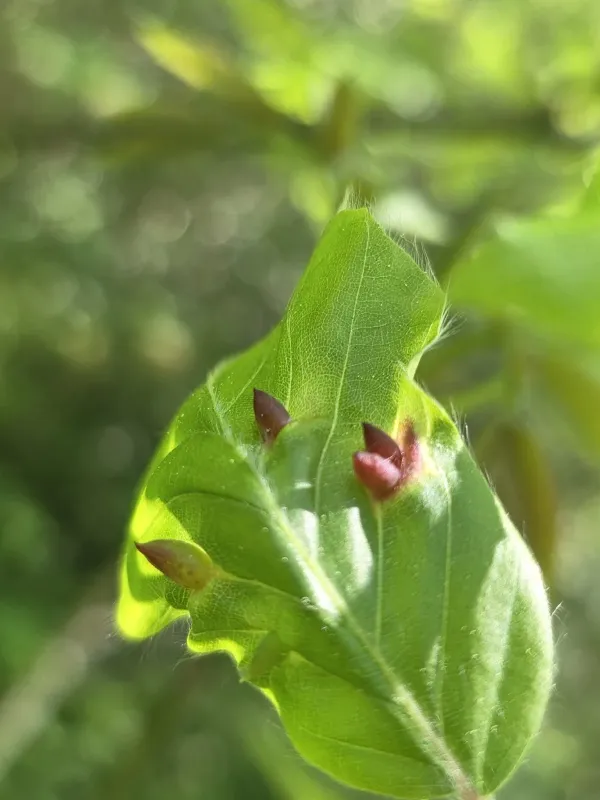
The most distinctive symptom of infestation is the presence of smooth, conical or egg-shaped galls on the upper surface of the leaves.
- Visible smooth galls measuring 5–8 mm in diameter.
- Galls often exhibit striking colors, ranging from bright green to deep red or brown.
- Deformation of the leaf blade due to the localized growth of the gall tissue.
- Localized wilting in areas with heavy gall concentration.
- The presence of hard, woody-textured nodules on fallen leaves in autumn.
Cutting open a fresh gall in mid-season will reveal a single, white-to-yellowish larva occupying the internal chamber.
Control measures
The most practical control method for small-scale landscapes is the raking and removal of leaf litter in autumn to eliminate overwintering larvae.
In high-value ornamental settings or nurseries, systemic insecticides may be applied during the early adult flight period to reduce infestation.
Promoting tree health through proper irrigation and soil management helps the plant better withstand the physiological stress caused by the gall midge.
Biological control agents, including various species of parasitic wasps, play a significant role in naturally regulating midge populations.
For large-scale forestry, management usually relies on natural ecosystem balance, as intervention is rarely cost-effective or necessary for forest health.
Taxonomy
- Latin name
- Mikiola
- Order
- Diptera (flies)
- Family
- Cecidomyiidae
- EPPO code
- MIKISP
Discussion
No discussions yet — be the first.