
Adams leaf beetle
Melasoma adamsi
Description
How to identify
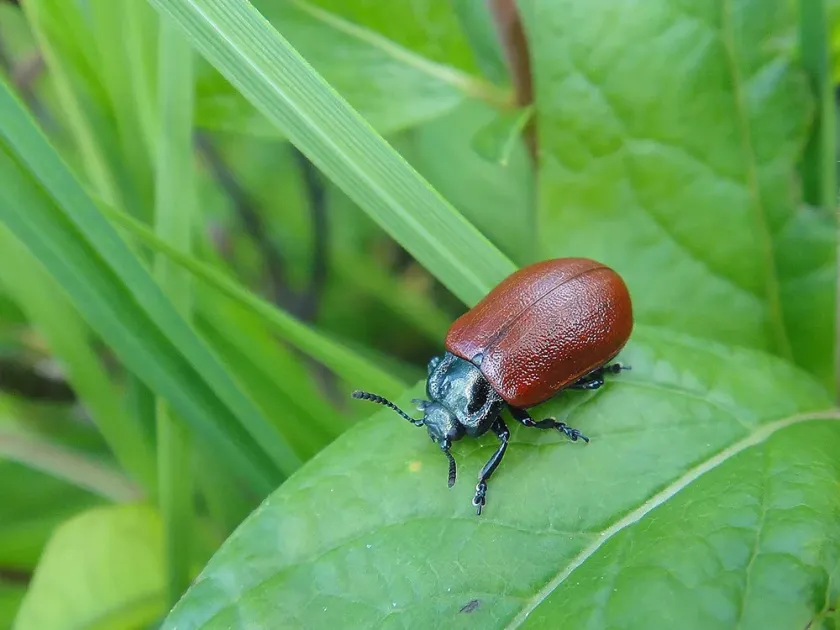
The Adams leaf beetle (Melasoma adamsi) is a member of the Coleoptera order and the Chrysomelidae family. These insects are characterized by a compact, rounded body shape typical of the genus.
The adults display a metallic luster, with colors ranging from bronze to copper and greenish tints. Their larvae are typically grayish-black or yellowish with warty projections that secrete defensive substances when disturbed.
The beetle undergoes a complete metamorphosis, including egg, larva, pupa, and adult stages. The adults are strong fliers and are capable of migrating between trees to find optimal food sources.
Adult beetles hibernate during the winter months, hiding in leaf litter, deep bark crevices, or the upper soil layer beneath the host tree's canopy.
Females deposit their eggs in clusters on the underside of leaves, which provides the developing brood with protection against environmental stressors and immediate access to food upon hatching.
What it damages
The primary hosts for this pest include trees of the Salicaceae family, particularly various species of willow (Salix) and poplar (Populus).
Both adults and larvae contribute to foliage destruction. Adults create irregular holes and notches in leaves, while larvae often skeletonize the foliage, leaving behind only the primary veins.
Heavy infestations can significantly weaken the health of trees, making them more susceptible to secondary pests and various environmental stressors throughout the growing season.
In forest nurseries, this beetle poses a high risk to young saplings, as repeated defoliation stunts growth and prevents the plant from storing enough energy for the winter.
The loss of photosynthetic area caused by the beetle’s feeding activity reduces the tree's overall vigor and can affect its decorative value in parks and urban landscapes.
When it appears
The activity cycle of the Adams leaf beetle begins in early spring, synchronized with the bud break and the emergence of fresh foliage on willow and poplar trees.
The peak feeding period for larvae occurs during the mid-summer months, when temperatures are optimal for their rapid metabolic rate and development.
Depending on local climate conditions and regional temperature sums, the species can complete one or two generations within a single growing season.
Pupation takes place on the leaves or in protected areas near the feeding site, completing the transformation process in a relatively short period of time.
As autumn approaches and temperatures drop, adult beetles gradually move away from the canopy to find secure overwintering sites in the soil or ground debris.
Signs of infestation
The first sign of an infestation is the appearance of small, pin-prick holes on young leaves, which rapidly expand as the larvae grow larger.
Large groups of larvae are easily spotted due to their gregarious feeding behavior on the underside of leaves and the accumulation of dark, slimy excrement.
The damage becomes increasingly obvious as the foliage takes on a lacy, skeletonized appearance, eventually leading to leaves drying out and falling prematurely.
Severe infestations may result in significant defoliation of entire branches, giving the tree a sparse and sickly appearance during the peak of summer.
Observant gardeners can often spot the adult beetles on the upper surface of the leaves during warm daylight hours when they are feeding or mating.
Control measures
Effective management of the Adams leaf beetle requires a combination of monitoring and timely intervention to prevent major population outbreaks.
- Frequent inspection of foliage in spring to identify and manually remove egg clusters.
- Use of bio-insecticides containing Bacillus thuringiensis to target larvae without harming beneficial insects.
- Systemic insecticide applications during the peak larval stage if populations exceed economic thresholds.
- Sanitation of the area under trees by removing leaf litter to reduce the number of overwintering sites.
- Encouraging natural predators such as predatory bugs, lady beetles, and ground beetles within the landscape.
Taxonomy
- Latin name
- Melasoma adamsi
- Order
- Coleoptera (beetles)
- Family
- Chrysomelidae
- EPPO code
- LEMAAD
Discussion
No discussions yet — be the first.