
Dusky scrubfowl
Megapodius freycinet
Description
How to identify
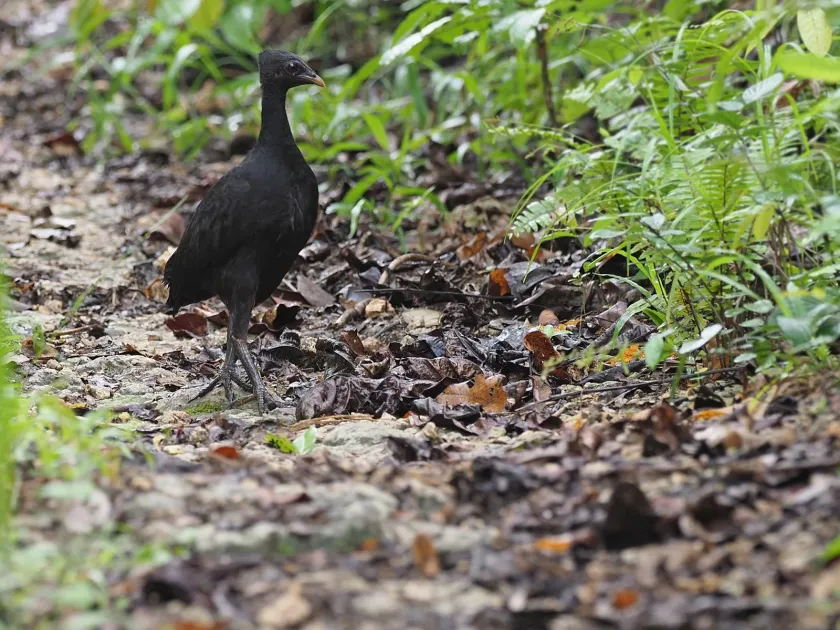
The dusky scrubfowl (Megapodius freycinet) is a member of the Megapodiidae family, order Galliformes. These birds are known for their unique nesting habits, where they construct massive incubation mounds rather than incubating eggs via body heat.
They are robust, ground-dwelling birds with dark plumage and powerful feet. These physiological traits allow them to move large quantities of soil and organic matter when building their nests.
Adult birds are generally elusive, preferring dense thickets and forest edges. However, their instinct to build mounds frequently leads them to disturb soil and vegetation in nearby farmlands.
The bird measures approximately 40 cm in length. Its heavy, curved beak and large feet are specialized tools for digging and gathering materials for their unique reproductive sites.
They are highly territorial, and once a pair establishes a nesting mound in a particular area, they will defend and maintain it, which can cause persistent problems for neighboring agricultural fields.
What it damages
The primary damage caused by dusky scrubfowl is mechanical. They destroy crops and disturb the soil surface while gathering leaves, debris, and soil to build their large incubation mounds.
As they scrape together material for their mounds, they effectively uproot seedlings and destroy young plantings, making cultivation impossible in those specific areas of the field.
Their activities disrupt the soil structure, leading to increased erosion and preventing proper irrigation and uniform growth of agricultural crops near forest boundaries.
Although they do not feed on the crops directly, their habitat modification behavior ruins the seedbed and nursery areas, causing significant losses to small-scale farmers.
The constant maintenance of these mounds means the birds visit the same spots repeatedly, ensuring that any attempt at replanting in those areas will likely result in the same destruction.
Signs of infestation
The most obvious sign of their presence is the construction of large, domed mounds composed of decaying vegetation, leaf litter, and topsoil, which look like artificial heaps in the field.
Evidence of digging, such as deep furrows and scraped soil, clearly indicates that the birds have been searching for nesting material within the planting area.
Farmers can hear their characteristic clucking and cackling calls during dawn and dusk, which often reveals their activity levels and approximate location.
Claw marks left by the birds in freshly turned soil provide proof of their nightly movements across the agricultural plots.
Disappearance of young plants and a lack of soil uniformity at the edges of the fields serve as direct confirmation that the scrubfowl are using that area for nesting activities.
Control measures
Physical barriers are the most reliable way to protect crops. Installing sturdy fencing around the perimeter of fields prevents the birds from accessing the land to forage or gather materials.
Acoustic deterrents, such as the playback of predator calls, can be an effective way to discourage the birds from settling in a specific location.
Maintaining a clean buffer zone between forest areas and fields is essential; removing leaf litter and debris reduces the availability of materials for mound construction.
Visual deterrents like realistic scarecrows or moving reflective objects can help deter the birds from choosing your farm as their nesting site.
Integrated pest management strategies, such as frequent soil tilling in buffer zones, make the terrain less attractive for mound building, effectively pushing the nesting sites away from productive fields.
Taxonomy
- Latin name
- Megapodius freycinet
- Family
- Megapodiidae
- EPPO code
- MGPOFR
Discussion
No discussions yet — be the first.