
Australian brush-turkey
Alectura lathami
Description
How to identify
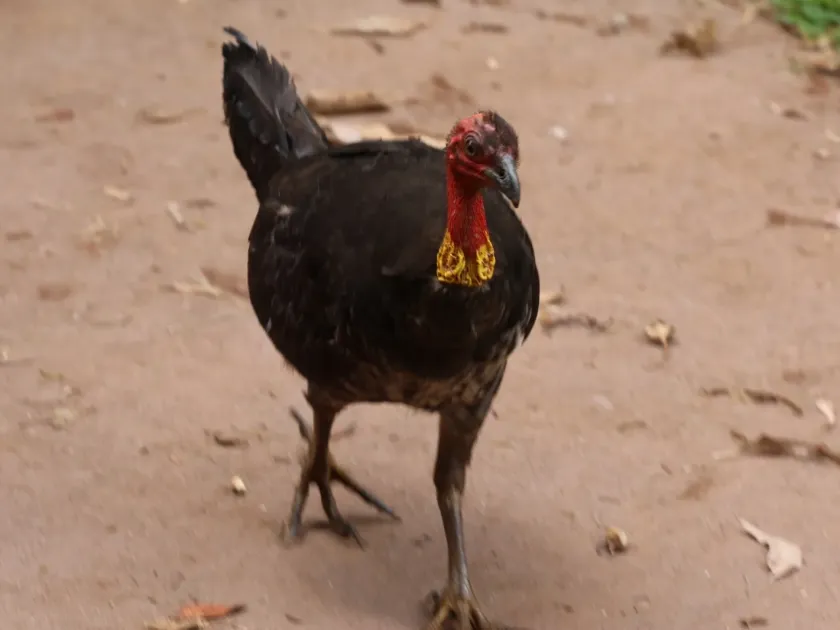
The Australian brush-turkey (Alectura lathami) belongs to the family Megapodiidae, within the order Galliformes. It is a large, black-plumaged bird with a featherless red neck and a distinct yellow wattle.
The birds possess powerful legs with sharp claws, which are evolutionary adaptations for intense ground foraging and excavating large quantities of soil and organic matter.
Adult individuals can grow up to 60–70 centimeters in length and weigh over 2 kilograms. They are largely terrestrial and rarely fly, preferring to inhabit dense undergrowth and garden environments.
A unique characteristic of this species is that they do not incubate their eggs. Instead, they build massive mounds of decaying leaves, soil, and debris, where the heat generated by decomposition incubates the eggs.
These birds are territorial and sedentary. The male constantly maintains the nesting mound, which often involves significant displacement of soil and debris, causing disruption to any landscape within its range.
What it damages
Significant damage to agricultural and ornamental plants occurs during the construction of nesting mounds. Brush-turkeys aggressively scrape up mulch, compost, topsoil, and young plants to create these large mounds.
Flower beds, berry bushes, and vegetable gardens are frequent targets. The birds essentially strip the soil surface, destroying root systems and leaving previously fertile garden beds barren.
Mechanical destruction is severe: vegetable crops, herbs, and saplings are often uprooted or buried under thick layers of debris, leading to plant death due to lack of sunlight and nutrient access.
In addition to destroying specific crops, they cause aesthetic damage by digging up lawns and pathways while foraging for insects, larvae, and seeds that make up their diet.
In suburban and rural areas, this species can be a major nuisance, as a single pair can move several tons of soil and garden mulch during a single breeding season.
Signs of infestation
The most obvious sign of an infestation is the presence of a massive mound of earth, twigs, and organic matter, which can reach up to 4 meters in diameter and exceed 1 meter in height.
Deep trenches and bare patches of earth are characteristic indicators, as the birds clear the surrounding area entirely to provide materials for their mound construction.
Finding excavated seeds, exposed flower bulbs, or young seedlings scattered on the surface is a direct indication of their foraging and construction activity.
Homeowners may observe large three-toed footprints in a radius of up to 50 meters around the nesting site, signifying that the birds are actively patrolling the area.
Loud, repetitive calls from the male, especially during the early morning hours, indicate that a male has claimed the territory and is preparing a nesting site.
Control measures
The most effective strategy for protection is installing sturdy fencing made of wire mesh at least 1.5–2 meters high, which effectively prevents access to the cultivated area.
Avoid applying heavy layers of mulch in garden beds, as this loose organic material is highly attractive to brush-turkeys searching for nesting resources.
If an early-stage mound is discovered, it is essential to destroy it immediately and repeatedly until the birds abandon the attempt and move to a more suitable location.
Motion-activated deterrents, such as high-intensity lights or automated water sprayers, can be highly effective in startling and discouraging birds from entering the garden.
- Use strong wire mesh fencing around vegetable patches.
- Avoid thick mulch in areas prone to bird activity.
- Regularly dismantle nesting mounds in early construction stages.
- Install motion-activated water sprayers or flashing lights.
Taxonomy
- Latin name
- Alectura lathami
- Family
- Megapodiidae
- EPPO code
- ALEKLA
Discussion
No discussions yet — be the first.