
Two-striped soy beetle
Medythia nigrobilineata
Description
How to identify
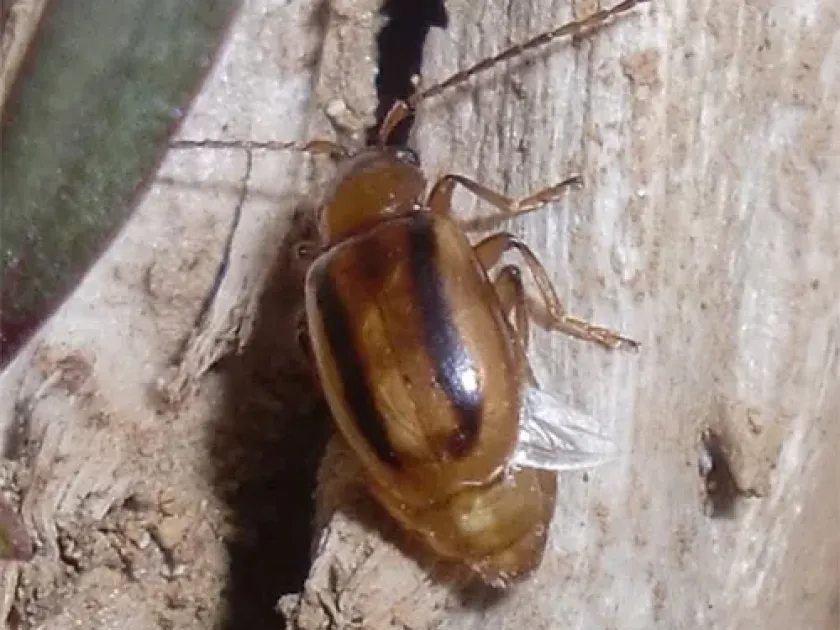
The two-striped soy beetle (Medythia nigrobilineata) is a member of the Chrysomelidae family, commonly known as leaf beetles. These insects are recognized by their distinct appearance featuring two longitudinal black stripes on yellow-brown elytra.
Adult beetles typically measure between 5 and 7 millimeters in length. Their bodies are oval-shaped, and they possess filiform antennae, which is a characteristic trait for this specific subfamily of leaf-feeding beetles.
The larvae are small and usually found on the underside of leaves or within the soil layers near the host plant. They undergo several molts before reaching the pupal stage, often remaining hidden from predators by feeding in sheltered areas.
The lifecycle of M. nigrobilineata is highly temperature-dependent. Adults emerge in spring after overwintering, seeking young soybean sprouts to feed on and subsequently laying eggs to initiate the next generation.
Monitoring for adults is easiest during warm, sunny periods of the day when the beetles are most active on the upper surface of the leaves. Their flight activity allows them to spread rapidly across large agricultural fields.
What it damages
This beetle is primarily known as a significant pest of soybeans. Both adult beetles and their larvae feed on the foliage, though the damage from adults is often more immediately visible to farmers during scouting.
Adults consume the green tissue of the leaves, creating small, circular holes. Under high population pressure, these holes can coalesce, causing significant loss of leaf surface area, which impairs the plant's photosynthetic capacity.
Larval feeding can also impact root health and lower stem integrity, depending on the specific phase of the insect's life cycle. Severe infestations can lead to stunted plant growth and reduced pod formation.
In addition to direct foliage consumption, the damage caused by M. nigrobilineata can stress the plant, making it more susceptible to secondary pathogens, including various fungal and bacterial soybean diseases.
Yield loss is directly proportional to the density of the beetle population. If the infestation peaks during the critical R-stages (reproductive stages) of the soybean plant, economic damage can be substantial.
Control measures
Crop rotation remains the most effective long-term strategy for managing the two-striped soy beetle. By alternating soybean crops with non-host species, producers can significantly disrupt the pest's reproductive cycle.
Deep plowing in the autumn helps to destroy the overwintering sites of the adults. Maintaining clean fields by controlling leguminous weeds is essential, as these weeds often serve as secondary hosts for the beetle.
Chemical control involving systemic or contact insecticides is recommended when pest thresholds are exceeded. It is crucial to select products that are effective against adults while considering the impact on local pollinator populations.
Integrated Pest Management (IPM) practices, such as the use of yellow sticky traps, help track beetle migration patterns. This data-driven approach allows for targeted applications rather than preventative broad-spectrum spraying.
Biological control agents, including parasitic wasps or entomopathogenic fungi, are increasingly being researched as sustainable alternatives to chemical interventions for the control of M. nigrobilineata.
Taxonomy
- Latin name
- Medythia nigrobilineata
- Order
- Coleoptera (beetles)
- Family
- Chrysomelidae
- EPPO code
- MEDYNI
Discussion
No discussions yet — be the first.