
Southern oak bush-cricket
Meconema meridionale
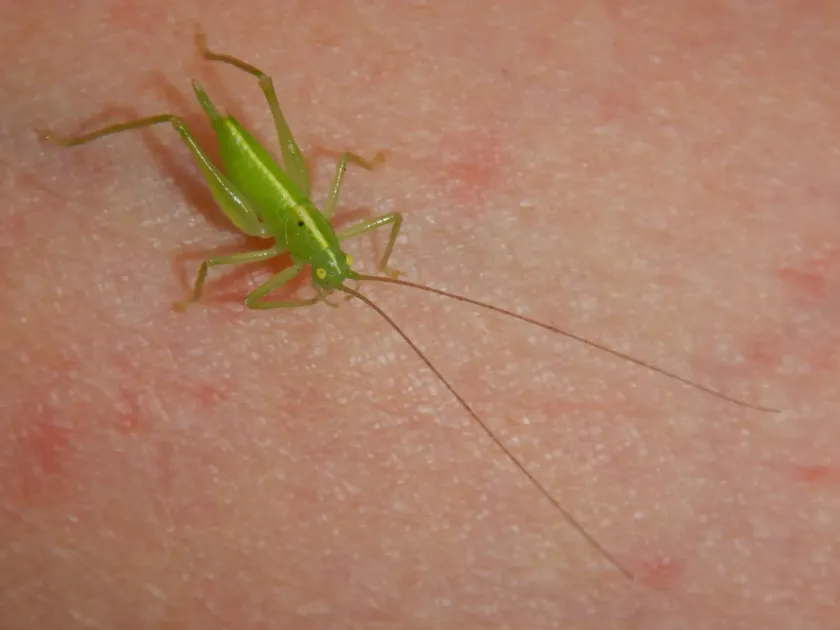
Description
How to identify
The southern oak bush-cricket (Meconema meridionale) belongs to the order Orthoptera, family Tettigoniidae. This insect features a slender, greenish body that provides excellent camouflage within foliage.
A key characteristic of this species is the absence of stridulatory organs in males, meaning they do not produce the typical chirping sound associated with other bush-crickets. Adults typically reach lengths of 12–15 millimeters.
Their wings are poorly developed, which significantly limits their ability to fly over long distances; however, they are highly mobile when climbing trees and shrubs.
They primarily inhabit the canopies of fruit trees, ornamental shrubs, and forest areas. These insects are nocturnal and lead a hidden lifestyle, making them difficult to detect in the early stages of infestation.
Larvae resemble smaller versions of the adults and undergo several molting stages before reaching sexual maturity.
What it damages
This pest primarily damages fruit trees, including apples, pears, and plums, and has increasingly been observed affecting vineyards in recent years.
The insects feed mainly on leaves, consuming irregular-shaped holes and reducing the photosynthetic surface area of the plant.
Beyond foliage, adults can damage tender young shoots by gnawing on the epidermis, creating pathways for fungal infections to enter the plant tissues.
If the population density is high, the pest can cause significant physiological stress, negatively impacting the plant's overall health and yield.
Although the southern oak bush-cricket is sometimes considered a predator of other small insects, its phytophagous behavior in commercial orchards makes it an economic concern.
When it appears
The life cycle of the species is univoltine (one generation per year). Eggs overwinter, having been deposited by females in bark crevices or wood fissures of trees.
Larvae emerge in the spring, coinciding with the bud-break period and the onset of the active growing phase of most fruit crops.
Adult insects appear towards the end of summer, usually in August, and remain active until the onset of cold weather in late autumn.
Being a strictly nocturnal species, their peak feeding activity occurs during the night, while they spend the daylight hours resting in the dense foliage.
Climatic conditions play a decisive role in population development: mild winters facilitate better survival rates for egg clutches and lead to larger early-season populations.
Signs of infestation
The first sign of infestation is the presence of characteristic holes in leaves, which display jagged, uneven edges from the insect's gnawing.
Insects can be detected by inspecting tree trunks or the undersides of leaves during evening hours using a flashlight.
Indirect evidence of infestation includes the premature wilting or drying of young shoot tips caused by tissue damage during the insect's feeding.
At night, adults are often attracted to artificial light sources placed near orchards, which serves as a monitoring method to gauge their numbers.
General plant decline and reduced resistance to secondary diseases can also be indicators of a persistent presence of this pest.
Control measures
Effective control measures include insecticide applications during the larval emergence period, when the pests are most vulnerable to chemical treatment.
Sanitary pruning and removing old, loose bark from trunks significantly reduce the number of suitable sites for egg-laying.
Biological control involves promoting populations of insectivorous birds, which naturally help to suppress bush-cricket numbers in horticultural settings.
- Applying sticky bands to trunks to restrict the movement of wingless insects.
- Removing weeds around tree bases to minimize hiding spots.
- Using biological pesticides that are safe for beneficial predatory insects.
Regular orchard monitoring using adhesive traps allows for the early detection of population spikes, enabling timely interventions to prevent significant crop damage.
Taxonomy
- Latin name
- Meconema meridionale
- Order
- Orthoptera (locusts)
- Family
- Meconematidae
- EPPO code
- MECNME
Discussion
No discussions yet — be the first.