
Hessian oat fly
Mayetiola avenae
Description
How to identify
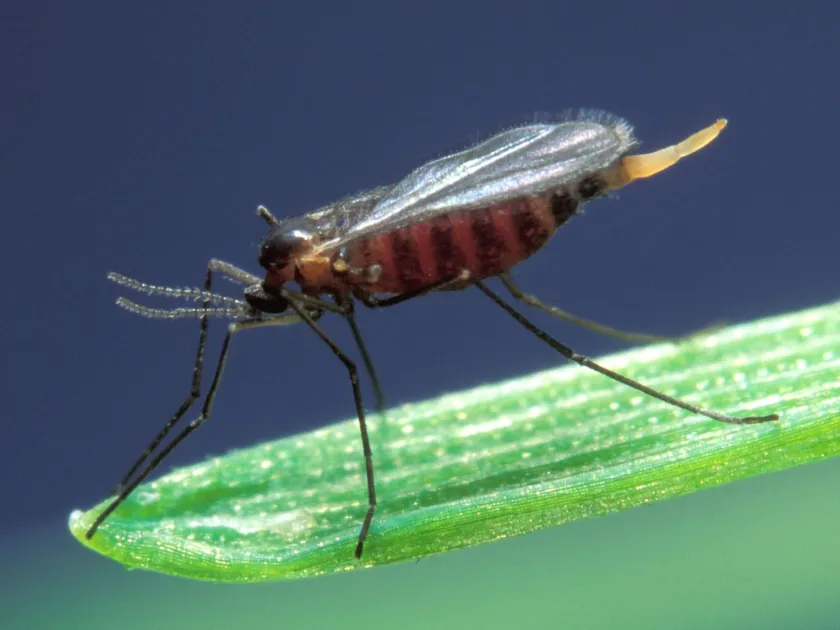
The Hessian oat fly (Mayetiola avenae) is a member of the Cecidomyiidae family, commonly known as gall midges. Adult flies are tiny, fragile insects measuring approximately 3-4 mm in length, with a dark, slender body that provides excellent camouflage within cereal crops.
The larval stage is the most critical for agricultural impact. These legless, maggot-like larvae evolve from transparent to yellowish-orange as they feed. They are typically found in the leaf sheaths of the host plant, where they remain sheltered from direct sunlight and environmental stressors.
The insect undergoes a complete metamorphosis: egg, larva, pupa, and adult. The pupal stage is spent within a dark brown structure known as a puparium, which resembles a flax seed. This protective shell allows the pest to survive harsh winter conditions in the stubble of harvested fields.
Depending on the climatic zone, the Hessian oat fly may produce one or several generations per year. The adults are short-lived, usually surviving only a few days, during which they focus exclusively on mating and laying eggs on the leaves of young cereal plants.
Environmental factors like temperature and humidity significantly influence the timing of the flight. Moist, warm conditions generally trigger massive outbreaks, making early-season monitoring essential for farmers to prevent widespread crop failure.
What it damages
The primary host for this pest is oats, although it also poses a significant threat to barley and other related cereal crops. The damage is caused by the larvae, which pierce the plant tissue to suck sap, injecting toxic enzymes in the process.
This feeding behavior causes the stem to become distorted and brittle. In the early stages of development, such as the tillering phase, the loss of nutrients and the physiological stress can result in stunted growth and the death of young tillers.
Affected plants often show a reduction in overall vigor and biomass. The damage to the vascular system of the stem disrupts the transport of water and nutrients to the developing spike, leading to poor grain filling or complete sterility of the panicle.
Economic damage occurs when the infestation level is high, causing substantial thinning of the crop stand. This not only reduces the potential yield but also weakens the plant's natural resistance to secondary pathogens and drought stress.
Fields infested by the Hessian oat fly are characterized by uneven growth and visible patches of weak, stunted plants. This irregular stand density forces the crop to mature unevenly, complicating harvesting processes and reducing the quality of the harvested grain.
Signs of infestation
The most noticeable sign of an infestation is a change in the appearance of the crop. Infected plants appear darker green than the healthy surrounding foliage, often with stunted, dwarf-like appearances that are easily recognizable in the early growth stages.
Close inspection of the stem base reveals the characteristic damage. The leaf sheaths may be swollen, and if pulled back, one can often find the dark brown puparia nestled tightly against the stem, which is a definitive diagnostic sign of the pest.
During the heading phase, infected stalks may fail to produce a healthy panicle. These stalks either remain entirely vegetative or produce thin, empty, and withered heads that clearly contrast with the surrounding healthy plants.
Weakened stems are prone to lodging. Because the larvae damage the structural integrity of the plant, even moderate winds can cause the stems to snap at the site of infestation, leading to significant pre-harvest losses.
- Stunted growth and lack of tillering.
- Swelling and deformation at the base of the stems.
- Presence of brown puparia under leaf sheaths.
- Withering of the central leaves in seedlings.
- Higher susceptibility to stem breakage.
Control measures
Strategic crop rotation is the cornerstone of managing the Hessian oat fly. By avoiding consecutive planting of host cereals, growers can disrupt the life cycle of the pest and prevent the build-up of the population within the soil.
Tillage practices play a vital role in population control. Deep plowing of stubble immediately after harvest buries the puparia, preventing the adult flies from emerging in the spring and effectively reducing the local pest pressure.
Optimizing sowing dates is another critical tactic. By planting winter crops later in the season and spring crops earlier, farmers can ensure that the most vulnerable growth stages of the plants do not coincide with the peak flight period of the adult flies.
Maintaining clean fields by removing wild grasses and volunteer cereals is essential, as these serve as bridge hosts for the pest during the off-season. Eliminating these reservoirs reduces the likelihood of early-season infestation.
When the economic threshold is reached, chemical control through systemic insecticides can be applied. These chemicals are absorbed by the plant, providing protection against the larvae residing inside the stem and preventing significant yield loss.
Taxonomy
- Latin name
- Mayetiola avenae
- Order
- Diptera (flies)
- Family
- Cecidomyiidae
- EPPO code
- MAYEAV
Discussion
No discussions yet — be the first.