
Spider crab
Maia squinado
Description
How to identify
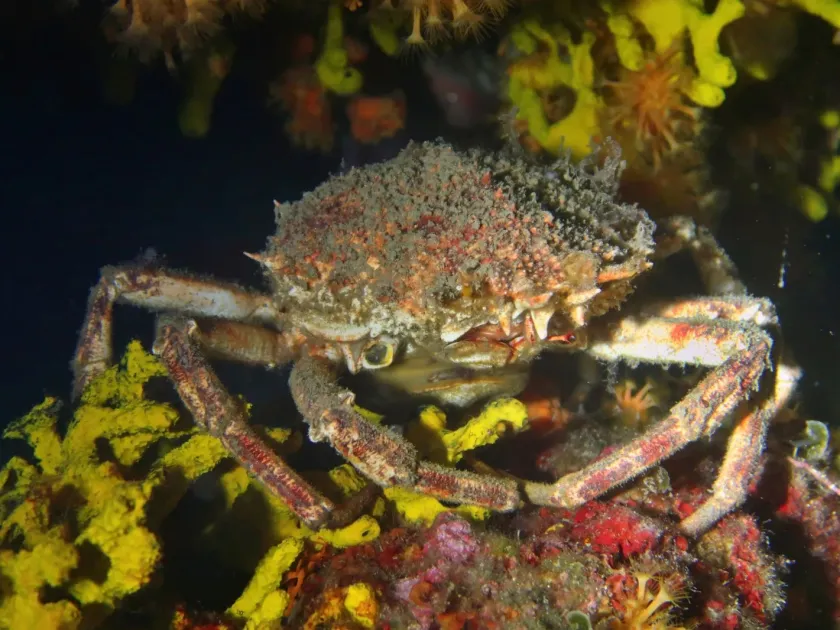
The spider crab, scientifically known as Maja squinado (or Maja brachydactyla), is a crustacean belonging to the family Majidae. These crabs are recognized by their large, pear-shaped carapaces that can reach 20 cm in length.
Their bodies are covered with tubercles and sharp spines, providing excellent camouflage against the rocky seabed. Their legs are characteristically long and spindly, which accounts for their common name.
The coloration of the spider crab varies from yellowish-brown to deep red, depending on the environment. They possess strong, well-developed claws used for feeding and defense.
These crabs spend most of their life cycle in deep waters, but perform seasonal migrations to coastal regions for mating and molting. Their development involves a planktonic larval stage.
As adult crustaceans, they are opportunistic scavengers and predators that play a significant role in marine ecosystems, sometimes encroaching on human-made cultivation sites.
What it damages
Spider crabs are not pests of terrestrial agriculture, but they pose a significant threat to marine aquaculture and seaweed farming operations. They are known to consume cultivated plants.
In seaweed farms, spider crabs can cut through young shoots and destroy the structure of the crops, leading to substantial biomass loss for the farmers.
In shellfish aquaculture, specifically for mussels and oysters, spider crabs cause direct damage by crushing shells with their powerful claws. This renders the product unsellable.
Crabs also cause indirect damage by interfering with farming infrastructure. They often cut through nets, cages, and ropes, allowing escape of stocks or ingress of further pests.
Their high density during breeding seasons can lead to the overgrazing of cultivated areas, completely exhausting the biological resources within the farming zone.
When it appears
Spider crab activity is highly seasonal, driven by water temperature and the biological requirements for reproduction. Spring marks the start of their migration towards shallower coastal waters.
During late spring and summer, crabs gather in large numbers for mating and molting. This peak period correlates with the highest threat level for coastal aquaculture farms.
Autumn brings cooler temperatures, prompting the crabs to return to deeper, more thermally stable waters. During this time, their impact on shallow-water farms diminishes.
Winter is the period of lowest activity for the species. Metabolism slows down significantly, and the crabs stay deep, which provides a reprieve for aquaculture operations.
Farmers must monitor seasonal shifts closely, as the arrival of crabs in coastal zones is predictable based on water temperature patterns and historical migration data.
Signs of infestation
Detection of spider crab presence is often marked by physical damage to crops, such as frayed or severed seaweed stalks and crushed shell fragments found near the cages.
Signs of netting damage, specifically small, precise holes or clean cuts in the mesh, are indicative of crab activity rather than environmental wear and tear.
Visual confirmation via underwater drones or cameras remains the most effective sign of an ongoing infestation, revealing individuals lurking around the cultivation structures.
The presence of molted exoskeletons on the seafloor near the farm is a clear indicator of a local population of spider crabs residing or passing through the area.
Changes in the behavior of captive stock, such as stress or reduced feeding, can sometimes indicate the proximity of predatory crabs within the farming enclosure.
Control measures
Mechanical exclusion using heavy-duty, small-mesh netting is the primary defense strategy. These barriers prevent the crabs from entering the aquaculture enclosures.
Trapping programs are essential for population control. Placing baited traps around the periphery of the farm helps to capture and remove the crabs before they cause damage.
Harvesting the crabs for commercial sale is a sustainable and profitable way to manage the population, effectively turning a pest management cost into a revenue stream.
Proper site selection for aquaculture farms, specifically avoiding known crab migration paths, is a strategic preventive measure to reduce the risk of infestation.
Regular maintenance of the farming equipment, combined with rapid repair of any netting breaches, ensures that the farm remains a difficult environment for spider crabs to exploit.
Taxonomy
- Latin name
- Maia squinado
- Family
- Maiidae
- EPPO code
- MAIASQ
Discussion
No discussions yet — be the first.