
Tansy aphid
Macrosiphoniella millefolii
Description
How to identify
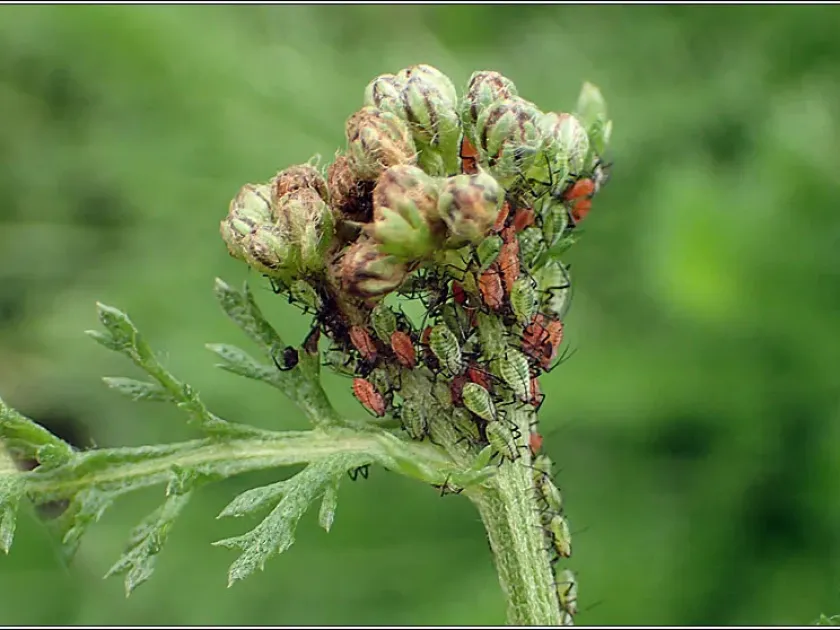
The Tansy aphid (Macrosiphoniella millefolii) belongs to the order Hemiptera and the family Aphididae. It is a specialized pest species that specifically targets plants within the Achillea (yarrow) genus.
Adult aphids typically measure between 2 and 3 millimeters in length. They possess an elongated body shape, and their color can range from pale green to brownish, providing excellent camouflage on their host plants.
A distinctive feature of this species is the presence of long, dark siphunculi (cornicles) on the rear end of their abdomen. These structures are easily visible with a hand lens and serve as a primary identification mark.
The species exhibits both wingless and winged morphs. Winged individuals primarily appear when the colony reaches a high density, serving to colonize new plant hosts in the surrounding area.
The lifecycle involves overwintering as eggs, which are deposited on the lower stems of yarrow plants, ensuring the population survives through harsh winter conditions.
What it damages
Tansy aphids primarily feed on various yarrow species, focusing their attention on the tender, growing parts of the plant, such as shoot tips and immature flower buds.
By inserting their mouthparts into plant tissues and extracting cell sap, the aphids deprive the host of essential nutrients, leading to stunted growth and impaired physiological processes.
Severe infestations often cause the deformation of inflorescences, leading to reduced flower quality and lower yields of essential oils, which is a major concern for herb cultivation.
As they feed, aphids also act as vectors for various plant viruses, introducing pathogens that can cause systemic infections throughout the plant population.
The honeydew excreted by the aphids provides a growth medium for sooty mold, which coats the leaves and physically inhibits the plant's ability to perform photosynthesis.
When it appears
The active season for this aphid starts in early spring when larvae emerge from overwintering eggs as soon as new plant shoots appear.
Population levels generally peak during the early to mid-summer period, particularly in June, when environmental conditions are ideal for rapid reproduction.
Under favorable temperatures ranging from 20°C to 25°C, one generation can develop in just a few days, allowing the pest to colonize large areas quickly.
As summer progresses, the population may fluctuate due to extreme heat, depletion of host plant resources, or natural predation by beneficial insects.
By late autumn, the aphids shift their reproductive strategy to produce eggs that will remain dormant on the host plant until the following spring.
Signs of infestation
The first visual sign of an infestation is the curling and yellowing of the youngest leaves on shoot tips, which often begin to wilt despite adequate watering.
Close inspection of the underside of leaves and stems usually reveals dense clusters of aphids, which appear as a mass of small insects covering the plant tissue.
A common secondary sign is the heavy presence of ants, which visit the aphid colonies to harvest the honeydew, effectively protecting the aphids from predators.
Flower stalks may become twisted or fail to open correctly, indicating that the aphids have significantly drained the nutrients from the reproductive organs.
The presence of a sticky, shiny substance on the leaves (honeydew) is a clear indicator that the plant is under attack and requires urgent attention.
Control measures
Effective management begins with good horticultural practices, such as maintaining healthy soil conditions and removing surrounding weeds that could serve as alternative host plants.
In home gardens, mechanical control methods, including spraying the plants with a strong stream of water or pruning heavily infested shoot tips, can significantly reduce numbers.
Biological control, by encouraging natural predators such as ladybugs, lacewings, and hoverflies, is a sustainable way to keep the aphid population below the economic threshold.
In cases of severe outbreaks, systemic insecticides labeled for use on these specific crops may be required, provided that safety instructions are strictly followed.
- Monitor plants weekly during the spring and early summer.
- Plant beneficial insect-attracting flowers nearby.
- Control ant colonies to remove their protective influence over aphids.
Taxonomy
- Latin name
- Macrosiphoniella millefolii
- Order
- Hemiptera (bugs, aphids, leafhoppers)
- Family
- Aphididae
- EPPO code
- MACRMI
Discussion
No discussions yet — be the first.