
Currant sawfly
Macrophya ribis
Description
How to identify
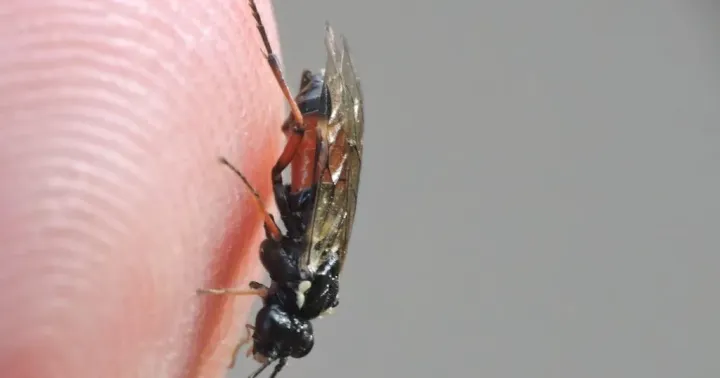
The currant sawfly belongs to the Tenthredinidae family of the order Hymenoptera. Adults are small, dark-bodied insects with clear wings, measuring approximately 10-12 mm in length. They are typically active in early spring.
The larvae, often referred to as false caterpillars, are yellowish-green with distinct black spots along their bodies. They possess more pairs of prolegs than true butterfly caterpillars, a key feature that distinguishes them during identification.
The life cycle involves complete metamorphosis, consisting of four stages: egg, larva, pupa, and adult. The synchronized development of these stages with the currant plant's phenology is critical for pest management.
These pests overwinter as pupae or mature larvae inside durable cocoons located in the soil at a depth of 5-10 cm. The emergence of adults coincides with the budding and flowering phase of currant shrubs.
Understanding this biological timing is essential for gardeners, as the first generation of larvae causes the most significant damage to the plant's foliage.
What it damages
The currant sawfly primarily targets black and red currants, although it can also affect gooseberries. The feeding activity of the larvae can cause widespread defoliation if left unchecked during the growing season.
Larvae begin feeding on the underside of young leaves. Initially, they create small holes, which quickly enlarge as the larvae grow, leading to the characteristic skeletonization of the leaves.
Massive infestations can result in total defoliation of the bush, forcing the plant to use its energy reserves for regrowth instead of fruit production. This dramatically reduces the yield and quality of the berries.
Persistent attacks over several years weaken the plant significantly, making it susceptible to secondary infections, environmental stress, and even winterkill in colder climates.
Damage to the foliage also affects the plant's photosynthetic capacity, which impacts the development of flower buds for the following year, creating a cycle of declining productivity.
Signs of infestation
The earliest signs of infestation are tiny, pin-prick holes on the leaves located in the inner and lower sections of the shrub. Frequent inspection of these areas is recommended in late spring.
Larvae are typically found on the margins of leaves. If you see the edges of leaves being eaten rapidly, or observe larvae in a resting S-shaped posture, the shrub is likely under attack.
Visible quantities of frass (larval droppings) on the leaves or the surface of the soil beneath the canopy indicate active and heavy feeding by the pest population.
Premature leaf drop or yellowing of the foliage can also serve as a secondary symptom, indicating that the bush is suffering from extreme stress due to foliage loss.
In cases of advanced infestation, branches may appear stripped of their leaves, with only the main veins remaining, which is a clear diagnostic feature of sawfly activity.
Control measures
Cultural control is a primary method for managing this pest. Digging or tilling the soil under the bushes in autumn or early spring helps destroy the cocoons, significantly reducing the population for the next season.
For smaller infestations, hand-picking the larvae in the early morning is highly effective. The larvae are sluggish at low temperatures and can be easily collected and destroyed.
Biological insecticides, specifically those containing Spinosad or Bacillus thuringiensis, are effective and safe options for treating the foliage without leaving harmful chemical residues on the ripening berries.
Chemical control should be reserved for severe outbreaks and applied with caution. Always adhere to the pre-harvest interval (PHI) specified on product labels to ensure the safety of the harvested fruit.
- Install fine netting around bushes to prevent adult sawflies from laying eggs.
- Mulch the soil heavily around the base to prevent adults from successfully emerging.
- Encourage local populations of predatory birds and parasitic wasps that target sawfly larvae.
- Ensure adequate pruning to maintain airflow and discourage a moist, protected microclimate for larvae.
Taxonomy
- Latin name
- Macrophya ribis
- Order
- Hymenoptera
- Family
- Tenthredinidae
- EPPO code
- MACYRI
Discussion
No discussions yet — be the first.