
Beech gall midge
Macrolabis luceti
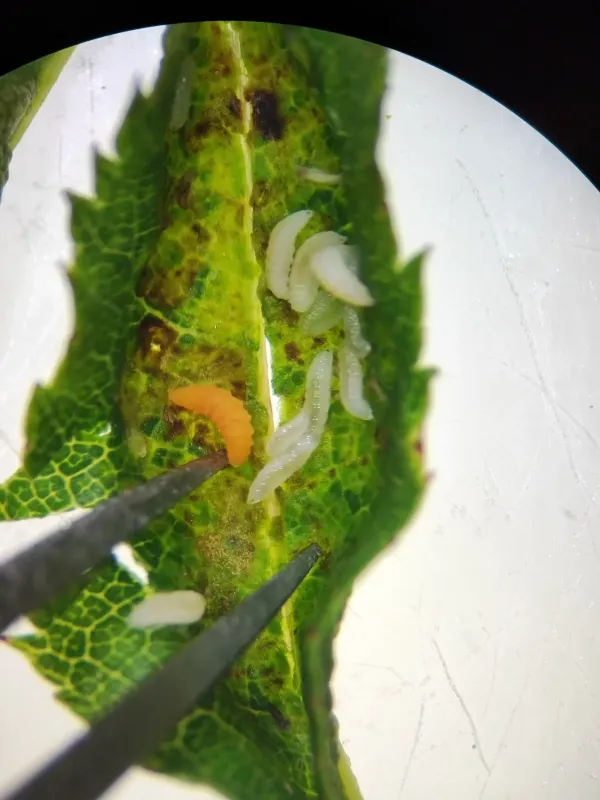
Description
How to identify
The Beech gall midge (Macrolabis luceti) belongs to the Diptera order, specifically the Cecidomyiidae family. It is a highly specialized pest that targets beech trees.
Adults are very small and elusive, often overlooked in the forest canopy. They focus exclusively on the phenology of their host tree, the common beech (Fagus sylvatica).
The larvae are cylindrical, legless, and translucent to whitish in color. They secrete substances that trigger the host plant to grow protective and nutrient-rich tissues known as galls.
The taxonomic classification reflects the genus-specific nature of this midge, making it an excellent example of long-term co-evolution between an insect and a woody plant.
Understanding the life cycle of M. luceti is essential for arborists and foresters responsible for managing healthy woodland ecosystems.
What it damages
The pest causes significant distortion of the beech leaves. Larval feeding induces the formation of leaf galls, primarily along the leaf margins.
These galls prevent the leaf from expanding properly, leading to severe leaf curling and stunted development that hinders photosynthesis.
In cases of high infestation, the total surface area of the leaves is drastically reduced, which can stress the tree and impact its annual wood growth.
Although rarely fatal for mature, healthy trees, repeated yearly infestations can weaken young saplings in nurseries, causing long-term health issues.
The aesthetic value of beech trees in landscape design is compromised when foliage becomes heavily deformed and prematurely brown due to larval damage.
When it appears
The emergence of adults is strictly synchronized with the budburst of the beech tree in late spring, typically in April and May.
Females lay eggs directly into the developing leaf tissues, ensuring that the larvae have an immediate food source as the leaves unfold.
The larval development period lasts throughout the early summer months. The galls serve as both a food supply and a defensive chamber for the developing insects.
By mid to late summer, the larvae leave the galls to descend into the soil or the leaf litter, where they undergo diapause until the following spring.
The life cycle is univoltine, meaning there is only one generation per year, which dictates the timing of monitoring and protection efforts.
Signs of infestation
The most diagnostic sign of an infestation is the presence of thickened, curled, and distorted leaf margins on the new spring growth.
Closer examination reveals galls, which may appear as slight swellings or distinct rolls along the edge of the leaf blade, often containing the small larvae inside.
Affected parts of the leaves often turn chlorotic or brown, eventually becoming brittle. This can lead to premature leaf drop during the summer season.
During a peak infestation, the canopy may appear sparse or sickly, especially when compared to unaffected neighboring trees of the same species.
- Curled and distorted leaf edges
- Presence of pathological galls on foliage
- Larvae visible inside the leaf tissue
- Early leaf senescence and drop
Control measures
Sanitation is a primary management strategy. Clearing away leaf litter in the autumn can reduce the population of overwintering larvae significantly.
Promoting a healthy environment for natural predators, such as parasitoid wasps and predatory mites, helps keep midge populations in check naturally.
In nursery settings where aesthetic quality is paramount, systemic insecticides may be used, provided they are applied exactly when the larvae hatch.
Monitoring the trees during the early leaf-opening phase is crucial for detecting the infestation before galls become firmly established.
Ensuring trees receive adequate water and nutrients helps them remain vigorous, allowing the tree to better withstand the stress caused by the midge.
Taxonomy
- Latin name
- Macrolabis luceti
- Order
- Diptera (flies)
- Family
- Cecidomyiidae
- EPPO code
- MACALU
Discussion
No discussions yet — be the first.