
Anchusa flea beetle
Longitarsus anchusae
Description
How to identify
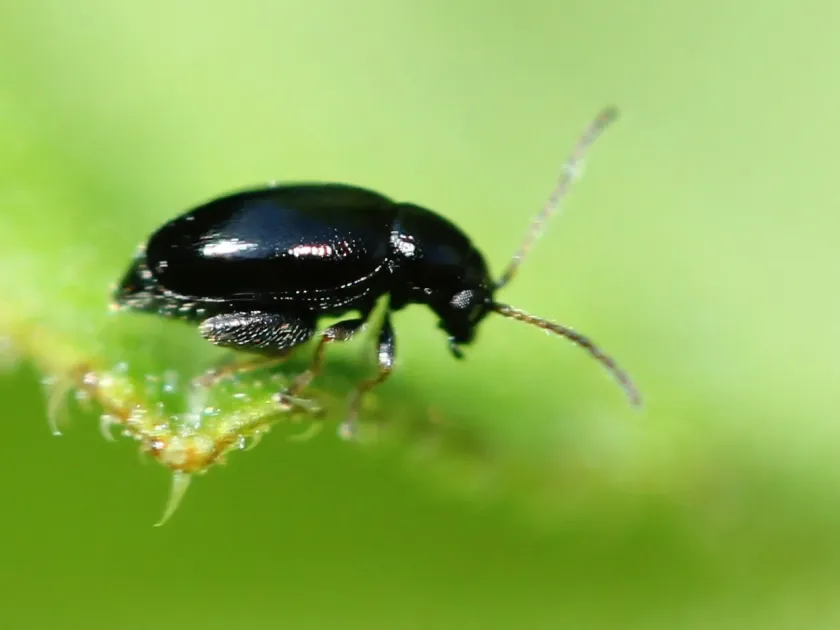
The Anchusa flea beetle (Longitarsus anchusae) is a member of the leaf beetle family (Chrysomelidae) within the order Coleoptera. These are small, saltatorial (jumping) beetles, usually measuring between 2 to 3 millimeters in length.
Their body coloration typically ranges from yellowish-brown to reddish-brown, allowing them to blend in effectively with plant foliage. The most prominent feature of this species is their thickened hind femora, which provide the explosive power needed for jumping away from predators.
The head and pronotum might appear darker than the elytra, and the antennae are characteristically filiform and relatively long for this genus. These morphological features are essential for correct field identification.
The larval stages are primarily soil-dwelling or endophagous, meaning they live hidden within plant tissues. Due to this cryptic behavior, they are rarely seen unless one actively searches the soil or root zones.
As active flyers and jumpers, adult beetles are highly mobile. They move across fields in response to weather patterns and the availability of their specific host plants, making them difficult to contain.
What it damages
The primary hosts for this pest belong to the Boraginaceae family. Agricultural crops and medicinal plants such as Anchusa and Cynoglossum are particularly susceptible to their feeding activities.
Adult beetles feed on the foliage, creating numerous tiny, shot-hole-like perforations. This feeding pattern, known as pitting, reduces the plant's photosynthetic surface area, leading to general debilitation and stress.
Larval feeding causes damage to the root system or lower stems. When larvae feed on roots, they impair the plant's ability to absorb water and nutrients, which often results in wilting, especially under water-stressed conditions.
In high densities, the combined pressure of adult foliar feeding and larval root damage can lead to the stunting of crops or even the complete loss of seedlings in early growth stages.
Secondary infections by pathogens are common in the wake of flea beetle damage. The open wounds caused by the beetles provide an ideal entry point for fungi and bacteria that further reduce crop quality.
When it appears
The Anchusa flea beetle typically overwinters as an adult in the soil, under plant debris, or in sheltered areas. They emerge in early spring as temperatures begin to rise, seeking food sources.
During the spring and early summer, adults feed, mate, and deposit eggs. The eggs are usually laid in the soil or at the base of the host plant, ensuring that larvae emerge in close proximity to their food supply.
The lifecycle includes several stages: egg, larva, pupa, and adult. Multiple generations can occur within a single growing season, depending on local climate conditions and regional temperature patterns.
Activity peaks during the warm months, particularly June and July. During this time, the beetles are most active in their feeding, and the impact of the pest is most visible to farmers and growers.
As autumn approaches and temperatures drop, adults decrease their feeding activity and gradually seek overwintering sites, remaining dormant until the cycle restarts the following spring.
Signs of infestation
The most common indicator of an Anchusa flea beetle infestation is the appearance of tiny holes in the leaves. This signature «shot-hole» damage gives the plant foliage a sieve-like appearance.
If you disturb the plants in a field during a sunny day, you can observe the beetles jumping away. This immediate movement is a clear diagnostic sign of their presence in the crop canopy.
Yellowing of the lower leaves or stunted overall growth can indicate subterranean larval damage. If the foliage looks healthy but the plant is wilting, it is prudent to inspect the root zone.
Severe infestations lead to premature leaf drop and the drying of branches. This significantly impacts the marketability of medicinal herbs where the leaf quality is the primary value component.
Monitoring with yellow sticky traps is an effective way to confirm the species and track the migratory peaks of adult beetles entering the field during the growing season.
Control measures
Effective management begins with robust agronomic practices, such as strict crop rotation and the removal of wild Boraginaceae weeds that serve as alternate hosts for the beetles.
Autumn tillage is highly recommended to disrupt the overwintering sites of the beetles. By turning the soil, many adults are exposed to unfavorable conditions, significantly reducing the starting population for the next year.
Biological control methods include the application of entomopathogenic fungi or beneficial nematodes that target the soil-dwelling larval stages without causing harm to the surrounding environment.
When the economic threshold is met, the application of registered insecticides is necessary. Choosing selective chemicals is vital to protect non-target species like pollinators and natural predators.
- Consistent field monitoring for early detection.
- Use of row covers for young plants during high-risk periods.
- Implementation of trap crops to lure beetles away from the main production area.
Taxonomy
- Latin name
- Longitarsus anchusae
- Order
- Coleoptera (beetles)
- Family
- Chrysomelidae
- EPPO code
- LONIAN
Discussion
No discussions yet — be the first.