
Liothrips
Liothrips
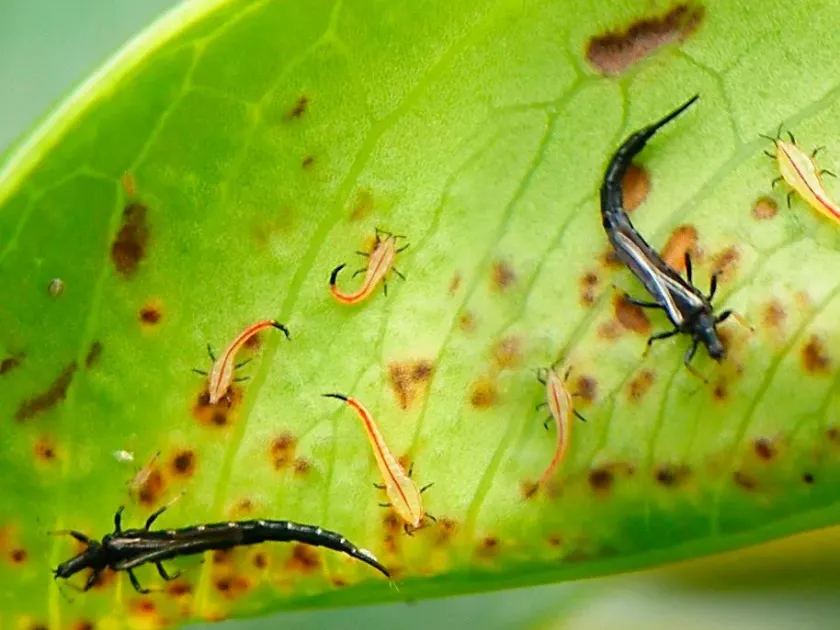
Description
How to identify
Liothrips is a genus of insects belonging to the order Thysanoptera and the family Phlaeothripidae. These are relatively small insects, typically ranging from 2 to 4 mm in length.
Adult Liothrips usually exhibit a dark brown to black coloration and have an elongated head structure with mouthparts adapted for piercing and sucking plant tissues.
The life cycle of these insects includes several stages: egg, two larval instars, prepupa, pupa, and adult. They are known for their hidden lifestyle.
Many species within this genus are host-specific, often forming colonies that lead to characteristic leaf curling or gall formation on their host plants.
Identification often involves inspecting the undersides of leaves or protected areas of the plant where these insects tend to aggregate in larger groups.
What it damages
Liothrips species act as significant plant pests, impacting various ornamental and agricultural crops, including ornamental woody plants and orchids.
By piercing and sucking plant sap, these insects cause mechanical damage that disrupts the physiological processes of the leaf tissue.
The saliva injected by the thrips often leads to toxic reactions in the plant, manifesting as stunted growth, deformed leaf blades, and tissue necrosis.
In severe infestations, the cumulative damage leads to heavy leaf drop, reduced plant vigor, and significant losses in the aesthetic or marketable quality of the crop.
These pests can also create entry points for secondary pathogens, such as fungi or bacteria, further damaging the infected plant.
When it appears
In greenhouse environments, Liothrips can maintain continuous generations throughout the year, provided there is a steady food supply and favorable temperatures.
In outdoor settings, the activity of these pests is strictly correlated with seasonal warming, typically reaching peak levels during hot and dry summer months.
The development time from egg to adult is temperature-dependent and can be as short as a few weeks under optimal climatic conditions.
Females insert their eggs directly into the plant tissue, which provides a level of protection against both environmental extremes and standard surface-level pest control.
Populations are known to increase rapidly under drought stress, as plants become weaker and more susceptible to infestation during dry periods.
Signs of infestation
The initial signs of an infestation include the appearance of tiny pale or silvery spots on leaves, which gradually develop into large brown necrotic patches.
Leaf curling, twisting, or deformation are classic symptoms, as the insects prefer to feed in the shelter of folded or young, tender leaves.
Small black fecal droplets scattered on the underside of the leaves serve as a diagnostic indicator of the presence of thrips colonies.
Infested plants may show significant growth retardation, shortened internodes, and, in some cases, the complete failure of floral bud development.
Upon closer inspection, the adult insects are visible, often displaying a distinctive behavior of lifting their abdomen when disturbed.
Control measures
Effective management of Liothrips involves an integrated approach combining monitoring, physical removal, and chemical intervention.
Monitoring using yellow or blue sticky traps is essential to detect the arrival of the pest early and initiate control measures promptly.
Maintaining high hygiene standards in greenhouses, including the removal of infested plant debris, significantly reduces the overwintering population.
- Use of systemic insecticides is highly recommended, as they penetrate the plant tissues where the thrips reside and feed.
- Biological control through the release of predatory mites or bugs can be effective in maintaining population levels below the economic threshold.
- Regular spray programs with different modes of action prevent the development of insecticide resistance in pest populations.
Repeated applications are usually necessary to effectively manage subsequent generations hatching from eggs embedded in the plant tissue.
Taxonomy
- Latin name
- Liothrips
- Order
- Thrips
- Family
- Phlaeothripidae
- EPPO code
- LIOTSP
Discussion
No discussions yet — be the first.