
Common dab
Limanda limanda
Description
How to identify
The common dab (Limanda limanda) is a marine flatfish species belonging to the family Pleuronectidae. It is widely distributed across the shallow waters of the North Sea and the Northeast Atlantic.
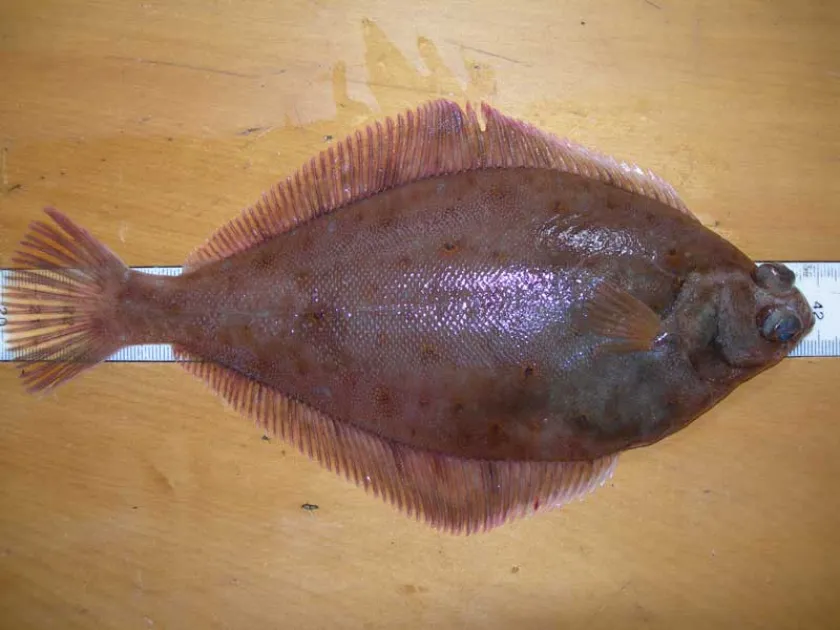
The fish is characterized by a flattened, rhombic body with both eyes situated on the right side. The color of the eyed side is typically brownish or yellowish, often with darker spots that provide excellent camouflage against sandy bottoms.
One of the most reliable identification features of Limanda limanda is the distinct, sharp curve in the lateral line above the pectoral fin.
The skin is covered with ctenoid scales, which feel rough when stroked from tail to head. It is a relatively small species, with adults usually measuring between 25 and 40 centimeters in length.
As a purely marine organism, this species does not cause damage to agricultural crops and is not categorized as a pest in an agronomic context.
When it appears
Spawning of the common dab takes place during the winter and spring months, typically from January to May, depending on local water temperatures.
During the spawning season, adult fish migrate toward shallower coastal waters where they release their eggs into the water column for external fertilization.
The eggs and larvae are pelagic, drifting with ocean currents until the larvae undergo a complex metamorphosis, transforming into a flatfish shape and settling on the sea floor.
Once they reach the benthic stage, the young fish start feeding on small invertebrates such as crustaceans, mollusks, and polychaete worms found in the sediment.
The growth rate and seasonal activity of the common dab are heavily influenced by the temperature of the sea, which dictates their metabolic rates and feeding intensity throughout the year.
Taxonomy
- Latin name
- Limanda limanda
- Family
- Pleuronectidae
- EPPO code
- PLNCLI
Discussion
No discussions yet — be the first.