
Owlfly
Libelloides coccajus
Description
How to identify
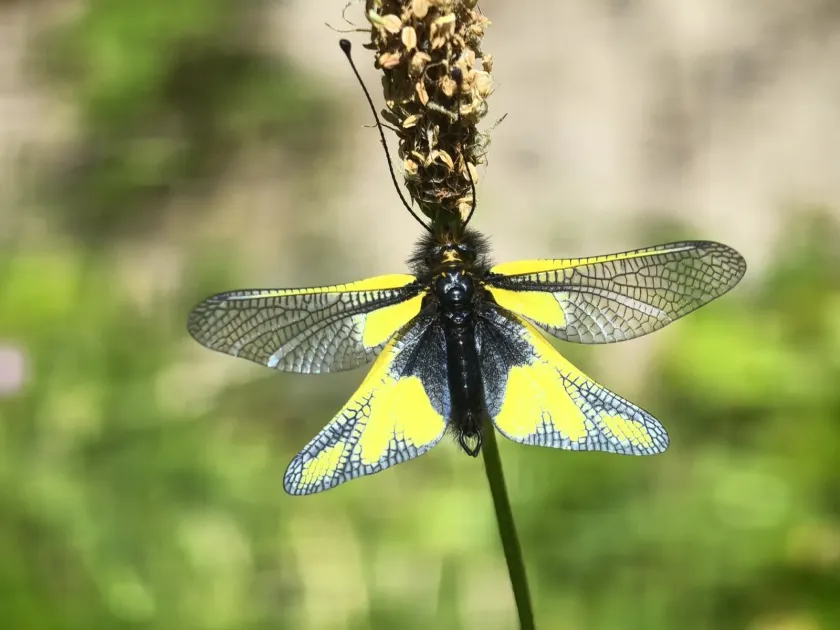
The Owlfly (Libelloides coccajus) belongs to the order Neuroptera and the family Ascalaphidae. Visually, it resembles a dragonfly, but it is easily distinguished by its long, clubbed antennae.
The body of the adult is covered in dense hairs, giving it a characteristic appearance. With a wingspan of 45 to 60 mm, its wings are transparent and marked with distinct dark patterns.
The larvae are specialized predators with flattened bodies and powerful, sickle-shaped mandibles, which they use to capture and consume their prey.
The coloration of the adults typically involves a combination of yellow and black, serving as a defensive mechanism to deter predators while they are active.
Unlike many other neuropterans, the Owlfly is diurnal, meaning it is most active during the day, which makes it visible in agricultural fields under bright sunlight.
What it damages
In the context of agronomy, the Owlfly is categorized as a beneficial predator rather than a pest, as it consumes various small invertebrates in the field.
The larvae act as generalist predators, feeding on small arthropods found on the soil surface or within low vegetation, including potential pests.
There is no evidence that this species causes direct damage to crops, such as feeding on leaves, stems, or fruits, as it is strictly zoophagous throughout its life cycle.
Potential economic concerns only arise if the species significantly reduces the population of other beneficial predatory insects that are vital for pest management.
Therefore, its impact is primarily ecological, and it should generally be viewed as a helpful component of the field's natural biological control system.
When it appears
Adult Owlflies are typically active from late spring through mid-summer, specifically from May to July, depending on local temperature conditions.
During this peak period, they focus on hunting, mating, and laying eggs on plant stems or branches to ensure the next generation finds a suitable environment.
The life cycle involves complete metamorphosis: egg, three larval instars, pupa, and adult. The insect usually overwinters as a larva in the soil or under leaf litter.
The insect prefers warm, sunny, and open habitats, where it can actively fly and patrol its territory during the warmest parts of the day.
As the season progresses, adult activity declines as the focus of the population shifts toward developmental stages within the soil or protected shelters.
Signs of infestation
The presence of the Owlfly is best identified by observing the adults flying over crops on sunny days. Their distinct flight pattern and clubbed antennae make them recognizable.
Larvae are harder to spot as they remain concealed near the soil level, but they may be detected during targeted soil inspections or sweep-net sampling.
The absence of plant-based damage, such as chewed foliage or wilting, is a primary indicator that the insect is not a threat to the crop itself.
Regular monitoring of the field helps to determine the balance between beneficial predators and potential pests, allowing for better-informed agricultural decisions.
If you observe these insects in high numbers, it is often a sign of a healthy ecosystem with active biological control processes in place.
Control measures
Because the Owlfly is a beneficial predator, specific control measures are not recommended. In most cases, its presence should be encouraged to help regulate pest populations.
Farmers should avoid the broad-spectrum use of insecticides, as these chemicals often eliminate beneficial insects alongside the pests, disrupting the natural balance.
Integrated Pest Management (IPM) strategies are the best way to maintain a sustainable field environment where natural predators like the Owlfly can thrive.
- Minimize the use of non-selective chemical pesticides.
- Maintain buffer zones and hedges to provide habitat for predatory insects.
- Use selective insecticides only when necessary and during non-peak activity hours.
The overall management approach should focus on protecting natural biodiversity to ensure long-term sustainability and reduced reliance on chemical inputs.
Taxonomy
- Latin name
- Libelloides coccajus
- Family
- Ascaphalidae
- EPPO code
- LIBDCO
Discussion
No discussions yet — be the first.