
Owlfly
Libelloides
Description
How to identify
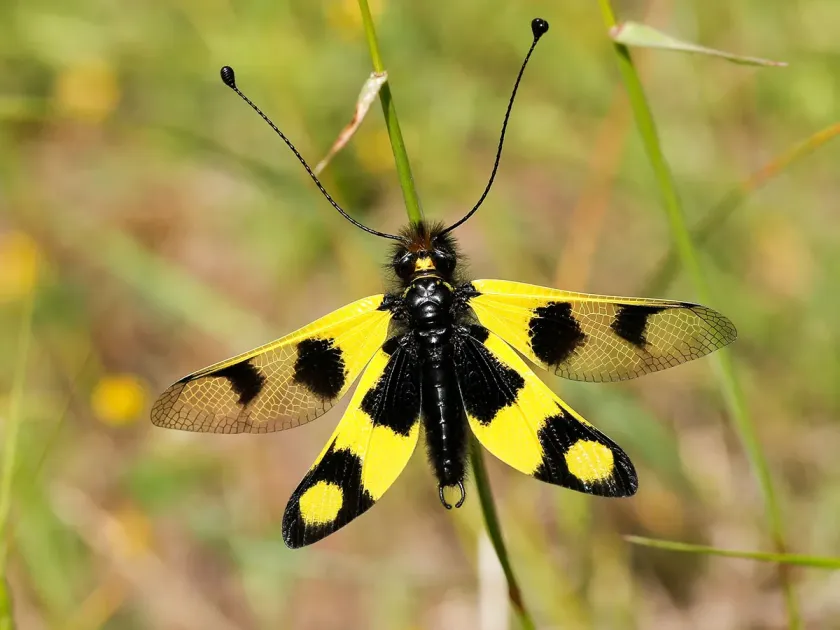
The owlfly (Libelloides macaronius) is a large, predatory insect belonging to the order Neuroptera and the family Ascalaphidae. Despite their appearance, which resembles a dragonfly, they are distinguished by long, club-shaped antennae and patterned, transparent wings.
Adult owlflies are covered in fine, dense hairs, aiding in thermoregulation during flight. With a wingspan reaching up to 70 millimeters, they are easily recognizable in open fields and grasslands where they hunt for prey.
Larval stages are characterized by a stout, segmented body and strong, sickle-shaped jaws. These larvae are secretive and often conceal themselves within soil or debris, making them difficult to detect during standard field inspections.
As complete-metamorphosis insects, they progress through egg, larva, pupa, and adult stages. The total duration of their life cycle is typically one to two years, highly dependent on local climatic conditions and food availability.
They are primarily identified by their unique aerial hunting patterns during sunny days, as they are strong flyers and active predators in their habitat.
What it damages
While adults are predators, their presence can disrupt agro-ecosystems by preying on beneficial pollinators, such as bees. This imbalance can lead to reduced fertilization rates in entomophilous crops like sunflowers.
Larvae can damage crops by disturbing the soil near root zones, which may negatively impact seedling health. Their predatory behavior in the ground can injure young roots, causing stunted growth in susceptible plants.
Heavy infestations, though rare, can compromise soil quality by altering the local population of beneficial microorganisms and invertebrates that aid in soil aeration and nutrient cycling.
Seedlings are the most vulnerable stage for crop damage. When larvae are active in the root zone, they may weaken the plant's structural integrity, leading to increased susceptibility to secondary fungal infections.
Agricultural losses are often indirect; by preying on natural enemies of other crop pests, owlflies can inadvertently allow populations of aphids or other harmful insects to spiral out of control.
When it appears
Adult owlflies are highly active during the day throughout the summer months, specifically from June through August. They prefer warm, sunny weather to maximize their hunting efficiency.
Larval activity is most pronounced during the spring and autumn months when soil moisture levels are optimal for movement and hunting in the rhizosphere.
Mating and egg-laying occur in mid-summer, with females depositing clusters of eggs onto plant stems or nearby rocks. This strategy ensures that larvae have immediate access to prey upon hatching.
Overwintering occurs at the larval stage, where they burrow deep into the soil or hide within dense organic matter to survive freezing temperatures until the following spring.
Seasonal weather patterns drastically affect population dynamics; extended droughts can reduce survival rates, while mild, moist seasons often lead to localized population booms.
Signs of infestation
The most apparent sign of an owlfly presence is the sight of adults flying over the fields on bright, sunny afternoons. Their distinct wing patterns make them stand out against the background.
Evidence of larval activity is usually found through soil examination. Small burrows or disrupted soil around the base of the crop can indicate where larvae have been hunting.
A decline in the number of bees or other pollinators on the field is a strong indicator of an active owlfly population, as they are efficient hunters that can reduce local pollinator numbers.
Clusters of light-colored eggs found on weeds or crop stems represent the early stage of a new infestation cycle and should be monitored for hatching.
Unexpected plant wilting, unrelated to water stress or nutrient deficiency, can sometimes be linked to larval damage in the root zone, particularly in young, sensitive crops.
Control measures
The primary control method for owlflies is robust soil management. Deep plowing and frequent mechanical cultivation disrupt the larvae’s habitat and interrupt their development cycle.
Chemical control should be avoided during the flowering phase to protect pollinators. If intervention is necessary, soil-applied insecticides should be used in accordance with local regulations.
Maintaining a weed-free field helps discourage adult owlflies from laying eggs, as they often prefer dense vegetation to hide their clutches. This improves the overall pest management profile of the farm.
Encouraging natural predators, such as birds or insectivorous animals, can help keep owlfly populations in check throughout the summer season without the use of toxic chemicals.
- Regular soil tilling to destroy overwintering larvae.
- Crop rotation to break the life cycle of the insect.
- Use of biological control agents targeting soil-dwelling pests.
- Implementation of pheromone traps for monitoring purposes.
Taxonomy
- Latin name
- Libelloides
- Family
- Ascaphalidae
- EPPO code
- LIBDSP
Discussion
No discussions yet — be the first.