
Leptopilina
Leptopilina
Description
How to identify
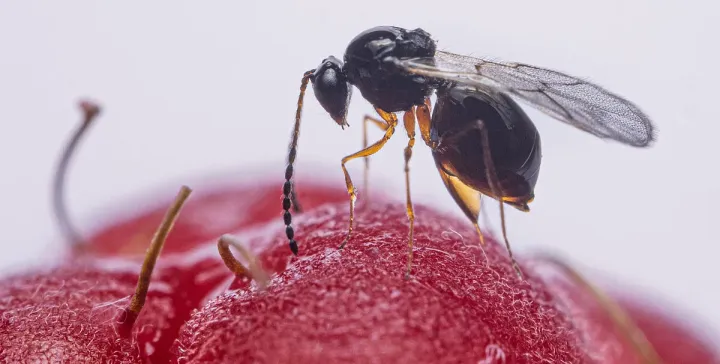
Leptopilina is a genus of hymenopteran insects belonging to the family Figitidae. These small parasitoid wasps are widely recognized for their specialized relationship with dipteran larvae.
The adult wasps are generally 2 to 3 millimeters in length, characterized by a dark-colored, robust body structure that allows them to navigate through decaying organic matter.
They possess a specialized ovipositor which the females use to inject their eggs directly into the larvae of their host, typically Drosophila species.
Despite their small size, they are highly efficient at detecting the chemical cues released by rotting fruits, which signal the presence of host larvae.
Their morphological adaptations make them perfectly suited for life in complex micro-environments like fruit debris and orchard floors.
What it damages
It is critical to distinguish that Leptopilina is not a plant pest. These insects do not feed on crops, foliage, or healthy fruits under any circumstances.
In the agricultural ecosystem, they are strictly beneficial as they act as natural biological control agents against various species of fruit flies.
By parasitizing fruit fly larvae, these wasps directly contribute to reducing the population of pests that are responsible for significant post-harvest losses.
There is no economic damage associated with the presence of Leptopilina; instead, they serve as a component of Integrated Pest Management (IPM).
Agricultural managers view their presence as an indicator of a healthy, functioning ecosystem where pest populations are managed by natural forces.
When it appears
The seasonal occurrence of Leptopilina is synchronized with the lifecycle of their fruit fly hosts, which thrive during the warmer months of the year.
In many regions, their activity peaks in late summer and autumn when the availability of fermenting fruit provides optimal breeding conditions for the hosts.
Inside controlled environments like greenhouses, these wasps can remain active as long as the temperature is favorable for host development.
Winter dormancy occurs in cooler climates, where the insects may overwinter in the soil or protected debris near host habitats.
Monitoring seasonal trends helps researchers and farmers predict when biological control pressure will be at its highest in the field.
Signs of infestation
Detection of Leptopilina is primarily achieved through entomological sampling methods rather than observing physical damage to crops.
Researchers often use rearing chambers to analyze pupae collected from the field; the emergence of adult wasps instead of flies confirms the presence of the parasitoid.
Yellow sticky traps used in monitoring programs may occasionally catch these wasps, allowing for population estimation and identification.
The reduction of fruit fly populations in an orchard, despite the presence of decaying fruit, is often a sign of effective parasitism by species such as Leptopilina.
Since they do not leave visible marks on plants, their activity remains "invisible" to standard visual field scouting conducted by farm workers.
Control measures
As Leptopilina is a beneficial parasitoid, control measures are not required; rather, management focuses on conservation strategies.
To support these wasps, growers should avoid applying non-selective pesticides that have high toxicity levels for beneficial hymenopterans.
The maintenance of diverse field margins and natural areas provides the necessary refuge and supplemental food sources for adult wasps.
Implementation of integrated pest management protocols ensures that chemical interventions do not disrupt the natural biological control provided by these insects.
- Prioritizing biological pest control over broad-spectrum chemicals.
- Preserving natural habitats surrounding fields.
- Using species-specific monitoring to guide pest control decisions.
Taxonomy
- Latin name
- Leptopilina
- Order
- Hymenoptera
- Family
- Figitidae
- EPPO code
- LTOPSP
Discussion
No discussions yet — be the first.