
Raspberry gall midge
Lasioptera rubi
Description
How to identify
The raspberry gall midge (Lasioptera rubi) is a small dipteran insect belonging to the Cecidomyiidae family. Adult midges are very small, measuring about 2-3 mm, with dark bodies and transparent wings.
These insects are rarely seen due to their size and brief adult lifespan. The primary damage is inflicted by the larvae, which live inside the host plant's tissues.
The taxonomic classification defines the midge's strict dependence on the Rubus genus. Its life cycle is perfectly adapted to the seasonal growth patterns of raspberries.
Larvae overwinter inside the galls they have induced. In the spring, they pupate and emerge as adults to lay eggs on young, tender raspberry canes.
Identification is primarily based on the presence of characteristic swellings on the stems, as the insect itself is too small for routine visual monitoring in the field.
What it damages
The midge exclusively affects raspberry plants. Larvae feed under the bark, triggering a physiological response in the plant that results in pathological tissue growth.
This growth forms a gall, which serves as both food and shelter for the developing larvae throughout the growing season.
Infested canes suffer from stunted growth, reduced nutrient transport, and overall weakness, leading to a significant decrease in berry production.
The structural integrity of the cane is compromised at the site of the gall. This makes the canes prone to breaking under stress from wind or the weight of ripening fruit.
Damaged tissues are also more susceptible to secondary fungal infections, which can further weaken the plant and lead to premature cane dieback.
Signs of infestation
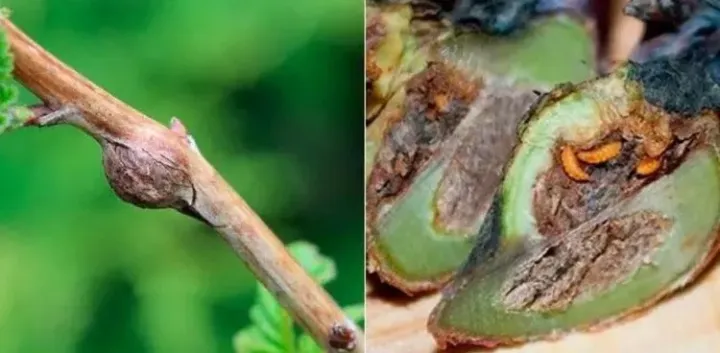
The most prominent sign of infestation is the formation of a distinct gall or swelling on the raspberry cane, usually located near the base or in the middle sections.
These galls are typically elongated, spindle-shaped, and can grow up to 5 centimeters in length. They may darken or crack as they mature over the season.
Opening a gall will reveal multiple small, orange-colored larvae inside separate larval chambers, confirming the presence of Lasioptera rubi.
Visual inspection is most effective during the dormant season, especially in late autumn or early spring, when the absence of leaves makes the galls easy to spot.
Wilted upper growth during summer on seemingly healthy canes can also indicate that a gall has disrupted the flow of sap in the lower stem.
Control measures
The primary control strategy is cultural: the prompt removal and destruction of all infested canes as soon as galls are identified.
It is critical to prune these stems close to the ground and burn them immediately to kill the larvae before they emerge as adults in the spring.
Maintaining a clean plantation by removing weeds and ensuring proper plant spacing helps reduce the likelihood of spreading the pest between canes.
Chemical insecticides are rarely effective once the galls have formed, as the larvae are protected inside the plant tissue, making systemic prevention or timing of sprays difficult.
Encouraging natural predators and ensuring optimal plant health through balanced fertilization can help the raspberry plants tolerate and recover from mild infestations.
Taxonomy
- Latin name
- Lasioptera rubi
- Order
- Diptera (flies)
- Family
- Cecidomyiidae
- EPPO code
- LASORU
Discussion
No discussions yet — be the first.