
Laricobius nigrinus
Laricobius nigrinus
Description
How to identify
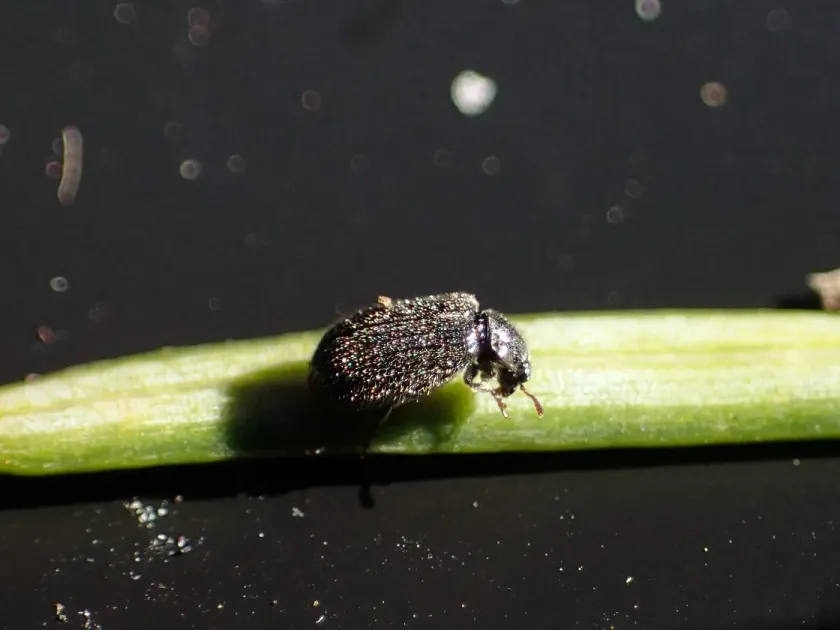
Laricobius nigrinus is a small predatory beetle belonging to the family Derodontidae, order Coleoptera. Adults typically measure between 2 to 3 mm in length and are dark brown to black in color, helping them blend into tree bark.
Morphologically, these beetles have a convex, oval-shaped body with distinct punctures on their elytra, which is a key identifying characteristic for specialists.
The larvae are also minute and undergo several stages of development, closely associated with the branch architecture of their host coniferous trees.
Native to the western regions of North America, this species has been extensively studied for its potential in managing invasive pest populations.
The classification of this beetle highlights its status as a specialized predator, distinguishing it from generalist insects that inhabit coniferous forests.
What it damages
Laricobius nigrinus is primarily recognized for its role in predating on Adelges tsugae, commonly known as the hemlock woolly adelgid, a significant threat to hemlock trees.
By consuming the eggs and nymphs of this pest, the beetle acts as a crucial natural regulator, preventing extensive damage to forest health caused by the adelgid.
The beetle does not cause direct harm to plants; rather, it is a highly specialized biological control agent that limits the expansion of destructive parasitic insects.
Its ecological impact is positive, as it helps mitigate the decline of hemlock populations that would otherwise be decimated by uncontrolled adelgid outbreaks.
In terms of economic value, its use as a biocontrol agent saves forest resources by reducing the dependency on large-scale chemical applications.
When it appears
The life cycle of Laricobius nigrinus is synchronized with the phenology of its prey, the hemlock woolly adelgid, defining its seasonal appearance and activity.
Adult beetles are most active during the cooler months of late autumn and winter, which aligns with the peak reproductive cycle of the adelgid.
Larval development typically culminates in the spring, after which the larvae descend to the soil to pupate near the base of the hemlock trees.
The summer season is characterized by a period of estivation, or summer dormancy, allowing the beetles to survive the warmer temperatures.
This biological timing makes the species an extremely effective predator precisely when the target pest is most vulnerable to biological suppression.
Control measures
Because Laricobius nigrinus is a beneficial species, control measures are rarely directed at it; instead, management focuses on population monitoring.
Regular visual surveys and the use of pheromone-based monitoring tools are standard procedures to track the beetle's distribution and density in infected areas.
It is essential to avoid the use of broad-spectrum insecticides in areas where this predator has been established, as these chemicals can harm the beetle populations.
Conservation of natural forest habitats, including undisturbed soil, is critical for the long-term success of the beetle's pupal stage in the environment.
Integrated pest management strategies are recommended to preserve this beneficial beetle while concurrently managing target pest populations through eco-friendly means.
Taxonomy
- Latin name
- Laricobius nigrinus
- Order
- Coleoptera (beetles)
- Family
- Derodontidae
- EPPO code
- LARCNI
Discussion
No discussions yet — be the first.