
Laricobius
Laricobius
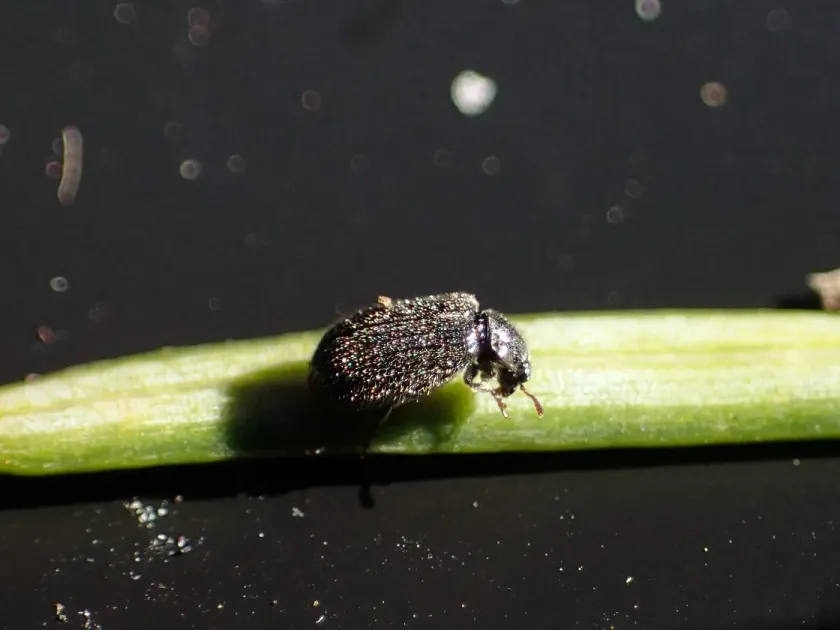
Description
How to identify
Laricobius is a genus of small beetles belonging to the Derodontidae family within the order Coleoptera. These insects are typically 2–3 mm long, featuring a dark-brown or black body covered in fine punctures.
The larvae are specialized, often developing within the buds or beneath the bark scales of coniferous trees, which allows them to remain concealed from most predators and human observers.
Morphologically, these beetles possess an 11-segmented antenna and specialized mouthparts adapted for consuming tender plant tissues or, in some documented cases, feeding on adelgids.
Identification to the species level usually requires microscopic examination of the male genitalia, as many species within the genus appear visually identical in the field.
Their life history is closely tied to the phenology of their host trees, making them highly dependent on the availability of new growth during the early spring season.
What it damages
The primary damage caused by Laricobius involves the larvae feeding on the developing buds and young needles, which effectively stunts the tree's vertical and lateral growth.
Injured trees exhibit weakened health, characterized by decreased sap flow, needle discoloration, and, in severe cases, the complete dieback of terminal shoots.
In forest nurseries and plantations, repeated damage to the leading shoot causes permanent deformation of the tree, significantly reducing its commercial and aesthetic value.
Ongoing feeding stress makes the conifers more susceptible to secondary infestations by bark beetles and wood-boring insects, which can lead to eventual tree mortality.
The impact is most devastating in younger stands where the tree is still allocating substantial energy resources toward establishing its structural height and crown density.
When it appears
Adult beetles typically emerge from their overwintering sites during early spring, coinciding with the first signs of bud break in their host coniferous species.
The mating and egg-laying processes occur throughout the spring, ensuring that the next generation of larvae has immediate access to nutrient-rich growing tissues.
Larval development progresses rapidly during the warmer months, followed by a transition into the pupal stage, which usually occurs in the soil or leaf litter beneath the host tree.
The species typically undergoes one generation per year, entering a state of diapause as adults before the arrival of winter to survive cold temperatures.
Favorable weather conditions, specifically mild and moist springs, contribute significantly to higher larval survival rates and potential population outbreaks.
Signs of infestation
Visual identification of an infestation starts with spotting minute entrance holes at the base of buds or along the scales of fresh shoots on the host tree.
Trees may display localized yellowing of needles on terminal growth, followed by premature needle drop as the tree attempts to shed the damaged parts.
Resinosis, or abnormal sap flow, is a common defensive reaction observed on the bark near the areas where the larvae have been actively feeding.
Careful inspection will reveal small, dark, granular deposits—the larval excrement—tucked away in the crevices of the branches or at the base of the needles.
- Small entry holes in buds
- Yellowing or premature needle drop
- Exudation of resin on branches
- Presence of granular frass on twigs
Control measures
Chemical control focuses on the timely application of systemic insecticides that target the adults during their spring emergence before they lay eggs.
Sanitation practices, such as the pruning and immediate destruction of infested branches, are essential for reducing the local population and preventing further spread.
Biological control strategies, including the use of entomopathogenic fungi or protecting natural predators, can be integrated into broader management plans for larger forests.
Maintaining optimal tree vigor through correct fertilization and irrigation practices helps improve the tree's natural defense mechanisms against larval feeding.
Long-term monitoring using sticky traps or pheromone lures is highly recommended for nursery managers to detect Laricobius presence before visible damage appears.
Taxonomy
- Latin name
- Laricobius
- Order
- Coleoptera (beetles)
- Family
- Derodontidae
- EPPO code
- LARCSP
Discussion
No discussions yet — be the first.