
Laricobius erichsonii
Laricobius erichsonii
Description
How to identify
Laricobius erichsonii is a small beetle belonging to the family Derodontidae. It is a specialized insect often found in association with adelgids on coniferous trees.
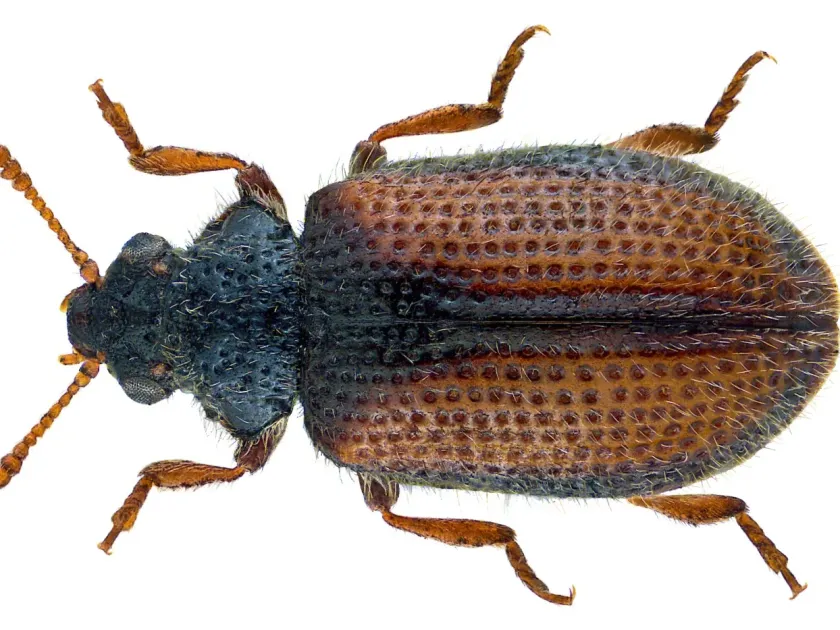
The adult beetle typically measures between 2 and 3 millimeters in length. Its body is oval-shaped and ranges in color from dark brown to black, often exhibiting a slight metallic sheen.
The larvae are elongate and possess a structure that allows them to move efficiently through the woolly secretions produced by their prey, the adelgids.
The life cycle of this beetle is highly synchronized with its host prey. It undergoes complete metamorphosis, passing through egg, larval, pupal, and adult stages within a single season.
Identification often requires careful inspection, as the beetle is small and its coloration helps it blend into the bark or the woolly patches of its host insects.
What it damages
The primary diet of Laricobius erichsonii consists of adelgids, particularly those affecting spruce and larch trees. It is often regarded as a beneficial predator in forest ecosystems.
However, when the balance between the predator and the host insect is disrupted, or in high-density nursery settings, the beetle can cause damage to the host plant.
Feeding activities on young shoots can lead to stunted growth, needle discoloration, and potential deformation of the foliage, impacting the health of the tree.
While the direct damage by the beetle is often secondary compared to the damage caused by the adelgids themselves, the presence of the beetle at high numbers can be an indicator of a severe infestation.
In ornamental tree production, even minor aesthetic damage to needles and shoots is considered a significant loss, necessitating intervention to protect the market value of the plants.
When it appears
The adult beetles become active in early spring, coinciding with the warming of temperatures and the emergence of the adelgids on the host plants.
During the spring and early summer, the larvae complete their development while feeding extensively on the colonies of their prey.
By mid-summer, the larvae typically drop to the soil or seek shelter in bark crevices to undergo pupation, remaining in a dormant state for the duration of the summer and autumn.
The overwintering stage is usually passed as an adult, hiding in the soil litter or under the bark of the host tree to survive the winter cold.
Environmental conditions, particularly winter temperatures and humidity, play a critical role in the survival rate of the population and the subsequent infestation level next year.
Signs of infestation
One of the most obvious signs of the presence of this insect is the disruption of the woolly, white wax masses typically associated with adelgid colonies on the twigs.
Discolored needles, ranging from yellow to brown, often indicate that the shoot is under stress from both the adelgid feeding and the beetle's activity.
- Presence of dark frass pellets on the needles or bark.
- Early needle drop on spruce or larch branches.
- Stunted or twisted young growth on the current season's shoots.
- Visible larvae within the white, woolly adelgid clusters.
Inspectors often look for these signs in the late spring, as this is when the beetle activity is at its peak and the damage becomes most visible to the naked eye.
Because the beetle is a predator, its presence is often accompanied by the reduced viability of the adelgid population in the immediate area of the infestation.
Control measures
Control strategies for Laricobius erichsonii must be carefully managed to avoid destroying the predatory population, which is essential for biological control of adelgids.
Integrated Pest Management (IPM) is recommended, focusing on maintaining tree vigor through proper fertilization, watering, and pruning of infested branches.
Chemical intervention should be considered only as a last resort, using highly selective products that minimize the impact on beneficial predator populations.
Biological monitoring is vital to determine the correct timing for any necessary treatments and to assess whether the beetle population is effectively controlling the adelgids.
In forest nurseries, sanitation measures such as removing severely infested branches can help prevent the spread of the pest without resorting to broad-spectrum insecticides.
Taxonomy
- Latin name
- Laricobius erichsonii
- Order
- Coleoptera (beetles)
- Family
- Derodontidae
- EPPO code
- LARCER
Discussion
No discussions yet — be the first.