

Pest · Coleoptera (beetles) · affects Potato, Fodder beet, Winter wheat
Especially harmful
Click beetles
Elateridae
Description
How to identify
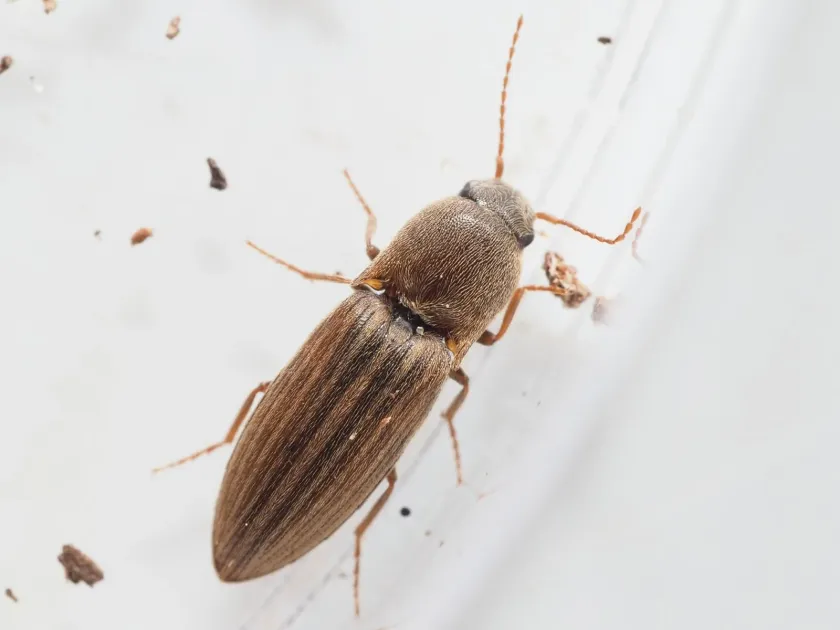
The click beetle (family Elateridae) is a well-known group of beetles recognized by their ability to "click" and flip themselves upright if turned on their backs. They are primarily nocturnal or crepuscular.
The larvae of these beetles, known as wireworms, are the primary agricultural pests. They have long, hard-bodied, cylindrical shapes and are typically yellow to reddish-brown in color, resembling a piece of wire.
The life cycle of a click beetle is complex and ranges from 3 to 5 years. Most of this time is spent in the larval stage, residing within the soil profile where they feed on roots and organic matter.
Adults and larvae overwinter in the soil at varying depths depending on the season and temperature. They become active as the soil temperature increases in the spring.
While adult click beetles can feed on foliage, they cause minimal economic damage compared to the wireworms, which remain the significant concern for commercial crop production.
What it damages
Wireworms are generalist feeders and represent a major threat to a wide range of crops including cereals, maize, sunflowers, and root vegetables like potatoes and carrots.
Damage often occurs below the soil surface, where larvae consume germinating seeds, roots, and underground stems, leading to reduced plant density and uneven crop stands.
In potatoes, wireworms tunnel into the tubers, creating small, deep entry holes that lead to significant internal damage, making the crop unmarketable and prone to secondary rot.
Maize and cereal crops are highly susceptible at the seedling stage. Wireworms can kill young plants by severing the roots or boring into the base of the stem, causing them to wither and die.
In nurseries and orchards, young saplings are frequently damaged by wireworms feeding on the root bark, which can stunt tree growth or cause mortality in young plantations.
When it appears
Larval activity begins in early spring as the soil warms up. During this period, wireworms move upward into the root zone to feed on emerging crops and organic debris.
As summer temperatures rise and soil moisture decreases, wireworms migrate deeper into the soil profile to find cooler and more stable moisture conditions, often moving below 50 cm.
A second period of activity often occurs in the late summer and early autumn when soil moisture levels increase due to rainfall, prompting wireworms to move back toward the surface.
Adult flight and mating typically take place in late spring and early summer. Females lay eggs in moist, grassy areas, which serve as the foundation for future larval populations.
Because of the extended life cycle, multiple larval age groups can coexist in the same field, resulting in persistent pressure that requires a long-term management strategy.
Signs of infestation
A classic sign of wireworm infestation is the presence of yellowing, wilting plants that appear in irregular patches across the field without any apparent foliage disease.
Affected seedlings can be easily pulled from the ground, revealing partially eaten or completely destroyed root systems and damaged underground stems.
For potato or carrot crops, the most definitive sign is the presence of distinct, narrow entry tunnels through the produce skin, often with the larva still found inside.
The observation of adult click beetles in early spring, especially near field edges or grassy borders, serves as an indicator of potential wireworm populations in the soil.
Monitoring using bait traps made of soaked wheat or potato pieces buried 10-15 cm deep is the standard method for determining the presence and population density of wireworms.
Control measures
Integrated Pest Management (IPM) is essential. Crop rotation plays a key role, avoiding susceptible crops like potatoes for several years and rotating with non-host crops.
Tillage practices, including deep autumn plowing, help reduce wireworm populations by exposing them to the surface, where they become vulnerable to predators and environmental stress.
Soil management, such as liming acidic soils, creates a less favorable environment for wireworms, as they prefer acidic soil conditions for optimal growth and survival.
Chemical control involving seed treatment or soil-applied granular insecticides at planting time is often necessary in fields with high recorded populations of wireworms.
- Effective weed control, particularly of quackgrass, to remove alternate food sources
- Utilization of biological control agents such as Metarhizium anisopliae or entomopathogenic nematodes
- Monitoring fields prior to sowing to determine the need for preventive chemical protection
Content graph
Connections · Click beetles
Most often together:
Marketplace
Products · 12

Biology
Taxonomy
- Latin name
- Elateridae
- Order
- Coleoptera (beetles)
- Family
- Elateridae
- EPPO code
- 1ELATF
Community
Discussion
No discussions yet — be the first.