

Pest · Lepidoptera (butterflies) · affects Wild cabbage, Apple, Grapevine
Especially harmful
Cabbage moth
Mamestra brassicae
Description
How to identify
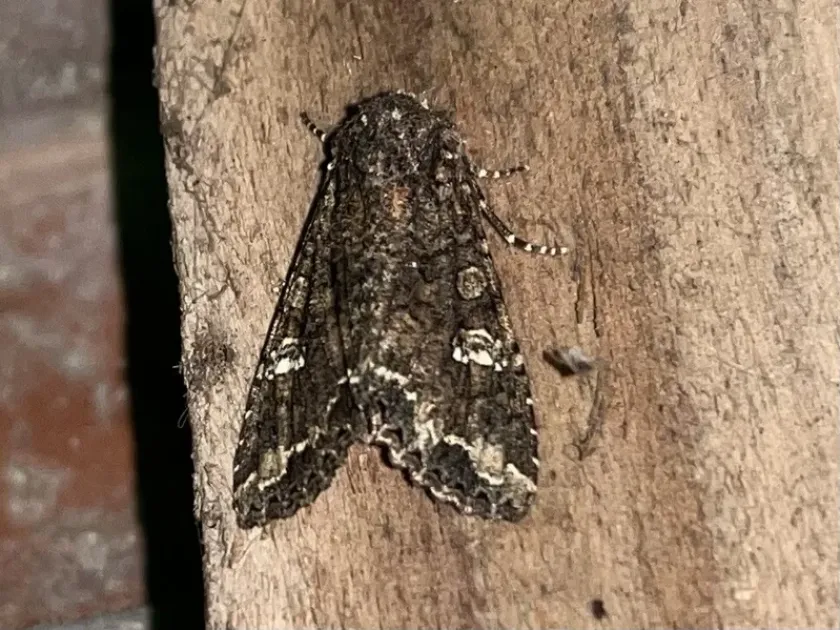
The cabbage moth Mamestra brassicae is a significant agricultural pest belonging to the Noctuidae family. The adult moth has a wingspan of about 40–50 mm, with mottled brown-grey forewings featuring distinctive white markings.
The larvae, or caterpillars, undergo six instars. They change from pale green in the early stages to dark grey or brown with yellow lateral lines as they mature. Fully grown larvae can reach up to 50 mm in length.
The pupae, typically reddish-brown, overwinter in the soil at a depth of 5 to 10 cm. The eggs are laid in clusters, often on the undersides of leaves, and appear as small, pale-yellow, semi-spherical structures.
This species is highly adaptable, with a life cycle that includes egg, larval, pupal, and adult stages. Depending on the environmental conditions, they can complete one to three generations per year.
Adult moths are nocturnal and are strongly attracted to light sources, which allows for the use of light traps as an effective tool for monitoring their population density in fields.
What it damages
The cabbage moth is a notorious polyphagous pest that affects a wide variety of crops. It is particularly damaging to cruciferous vegetables, such as cabbage, and oilseed crops like winter rapeseed.
Its host range also includes fodder beet, soybean, winter barley, domestic apple, alfalfa, and tobacco. This diversity of food sources makes it difficult to eliminate entirely from agricultural ecosystems.
Young caterpillars skeletonize leaves by consuming the soft tissue while leaving the veins. Older larvae tunnel deep into the heads of cabbages, causing severe structural damage to the crop.
Contamination with excrement renders the produce unmarketable and susceptible to rot. The entry points created by larvae often facilitate secondary bacterial and fungal infections.
On non-heading crops like soybeans or beets, the damage results in reduced leaf surface area, which significantly impacts photosynthesis, growth rates, and overall agricultural yields.
When it appears
Adult flight usually begins in late spring or early summer, once soil temperatures consistently exceed 10-12°C. This period marks the start of the primary infestation window.
Mass oviposition occurs throughout the summer months. The incubation period for eggs typically ranges from 5 to 12 days, depending heavily on the daily mean temperature.
The most intense feeding activity of the caterpillars occurs during July and August, coinciding with the rapid growth phase of many vegetable crops, leading to significant yield losses.
Pupation occurs in late summer or early autumn. The larvae burrow into the soil to create a protective cell where they will remain dormant throughout the winter season.
Warm and humid conditions during the summer favor the development of multiple generations, significantly increasing the population pressure on crops throughout the growing season.
Signs of infestation
The most reliable early warning sign is the presence of egg batches on the undersides of lower leaves. Regular scouting is essential for catching the infestation at the early larval stages.
Presence of larvae is indicated by characteristic holes in leaves, often described as 'window-paning', and by the accumulation of dark fecal pellets on the leaf surface.
If the crop is heading, tunnels and rotting material inside the head are clear indicators of cabbage moth infestation. Often, the damage is internal and may go unnoticed until harvest.
Plants may show signs of stunted growth or premature leaf yellowing, which often results from the internal damage and stress caused by the feeding activity of the larvae.
The presence of adult moths during dusk or nighttime around garden lights indicates an ongoing active generation and the potential for a new wave of larval infestation.
Control measures
Cultural control methods such as deep autumn plowing are effective for exposing pupae to harsh weather conditions and avian predators, thereby reducing the overwintering population.
Sanitation practices, including the removal of weeds and crop residues, are vital to eliminate alternative food sources and resting sites for the pest throughout the year.
Biological control, such as using Bacillus thuringiensis, provides an effective, environmentally friendly way to suppress larval populations without impacting beneficial insect species.
Chemical control measures should be timed with the peak of egg-hatching or early larval activity to ensure maximum efficacy before the caterpillars become too large or enter plant heads.
- Utilize pheromone traps for precise timing of chemical applications.
- Implement crop rotation to break the cycle of pest colonization.
- Introduce natural egg parasites like Trichogramma to reduce the population.
In brief
14
Damages crops
Content graph
Damages crops · 14
Content graph
Connections · Cabbage moth
Most often together:
Marketplace
Products · 44


Actofit, KE
Manufacturing enterprise "Ukrzoovetprompostach"
Insecticides
0
0
·
66
2 offers
11.09 €per 1 l
Buy

Actofit
Manufacturing enterprise "Ukrzoovetprompostach"
Insecticides
0
0
·
65
69 offers
8.14 €per 1 l
Buy


Tom, c.i., (alpha-cypermethrin, 100 g/l)
China Chemical Industrial & Rice Co. Ltd
Insecticides
0
0
·
60
1 offer
30.49 €per pack
Buy


Antigusin k.e.
«Ред Сан Груп Корпорейшн, Лтд.,Китай
Insecticides
0
0
·
53
11 offers
5.09 €per 1 l
Buy

BIOLEP (LEPIDOCID)
ТОВ ВО «СІББІОФАРМ», Російська Федерація
Insecticides
0
0
·
51
1 offer
16 €per 1 l
Buy


Fas c.e.
«Нанджин Ессенс Файн-Кемікал Ко. Лтд» (Китай)
Insecticides
0
0
·
40
1 offer
37.5 €per 1 l
Buy


Dragun
Nanjing No.1 Pesticide Factory of Red Sun Group Co., Ltd.
Insecticides
0
1
·
2.3K
No offers
—
Details


Altex 100 i.u., (alpha-cypermethrin, 100 g/l)
China Chemical Industrial & Rice Co. Ltd
Insecticides
0
0
·
51
No offers
—
Details


Avers c.e.
Ф.Нанджин Уссенс Файн-Кемікал Ко. Лтд. ,м.Черкаси. Україна.
Insecticides
0
0
·
49
No offers
—
Details


Biology
Taxonomy
- Latin name
- Mamestra brassicae
- Order
- Lepidoptera (butterflies)
- Family
- Noctuidae
- EPPO code
- BARABR
Community
Discussion
No discussions yet — be the first.