
Inostemma walkeri
Inostemma walkeri
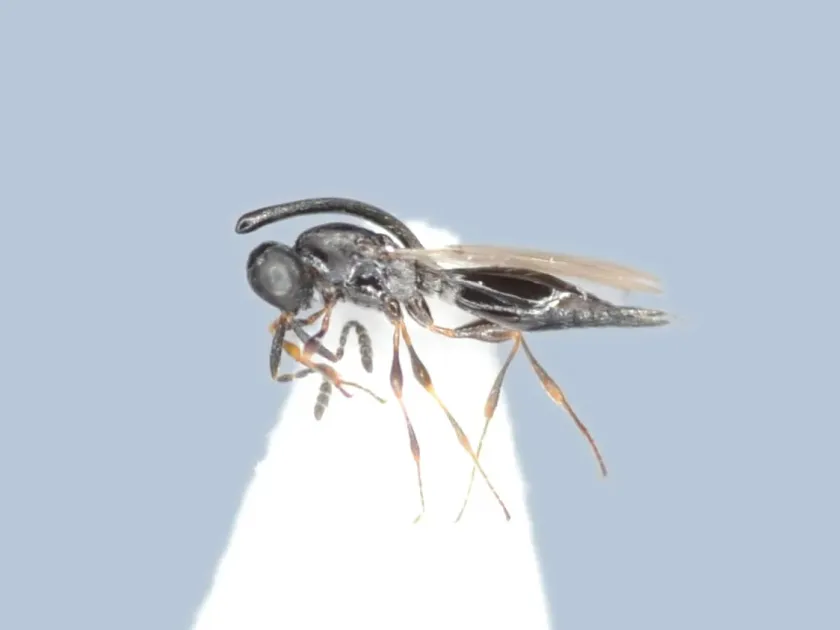
Description
How to identify
Inostemma walkeri is a species of parasitic wasp belonging to the family Platygastridae (order Hymenoptera). It is recognized by experts as a specialized parasitoid that targets various species of gall midges.
The defining morphological feature of this genus is the long, horn-like projection on the abdomen, which arches forward over the thorax. This structure is a unique identifying characteristic for this group of wasps.
Adult wasps are extremely small, often appearing as tiny black or dark-colored specks. Because of their size, their identification typically requires professional entomological expertise and magnification tools.
The life cycle of Inostemma walkeri is intrinsically linked to the host's development. Being an endoparasitoid, the wasp lays its eggs inside or on the eggs of gall midges, ensuring its larvae develop while consuming the host.
Understanding the biology of this insect is essential for sustainable agriculture. As a biological control agent, it plays a vital role in maintaining the natural equilibrium within grain crop ecosystems.
What it damages
Inostemma walkeri is not a plant pest; it is a highly beneficial insect that serves as a natural enemy to agricultural pests, particularly gall midges that affect cereals and other crops.
The actual damage to crops is caused by gall midges (Cecidomyiidae), which can significantly reduce yields by damaging stems, leaves, and reproductive tissues. Inostemma walkeri helps to mitigate these losses.
By parasitizing the larvae or eggs of gall midges, Inostemma walkeri prevents the completion of the pest's life cycle. This process significantly reduces the population pressure on crops throughout the growing season.
The presence of this parasitoid is a sign of a healthy, functioning agroecosystem. It serves as a natural regulator, often keeping pest populations below the economic injury level without human intervention.
Farmers should recognize this species as an ally. Over-reliance on broad-spectrum pesticides can eliminate these beneficial wasps, leading to secondary pest outbreaks due to the removal of natural controls.
When it appears
The seasonal activity of Inostemma walkeri is tightly synchronized with the life cycles of its gall midge hosts. Typically, the wasp appears during the spring and summer when the hosts are most active.
During the winter, Inostemma walkeri undergoes diapause. It usually survives in the form of larvae or pupae within the remains of the host or within crop residues left in the field after harvest.
As spring temperatures rise, the adults emerge in tandem with the onset of the host's egg-laying period. This synchronization ensures that the wasps find sufficient hosts to lay their eggs immediately.
Multiple generations of the wasp can occur during a single growing season. This overlapping of generations provides continuous pressure on the gall midge population, effectively suppressing it over several months.
By late autumn, the wasp enters its overwintering state, preparing for the next year. This cycle makes it a reliable biological component that persists in fields if habitat conditions are maintained.
Signs of infestation
Detecting the presence of Inostemma walkeri in a field is challenging because the wasps are inconspicuous. Signs of their activity are usually found through laboratory dissection of infested plant materials.
One clear sign is the failure of gall midge larvae to develop into adults when collected and incubated. If the larvae are parasitized, the wasp will eventually emerge from the host's remains instead of the midge.
Monitoring the population dynamics of gall midges over time can reveal the impact of the parasitoid. A sudden drop in midge numbers in untreated fields often indicates successful biological control.
Yellow sticky traps used in integrated pest management (IPM) programs can occasionally capture adult Inostemma, serving as an indicator of their presence and abundance in the local ecosystem.
Overall, farmers should look for the absence of significant damage despite the known presence of pest eggs. This suggests that natural enemies are effectively managing the pest population.
Control measures
The "control" of Inostemma walkeri involves its conservation. The primary goal is to foster an environment where these beneficial wasps can thrive and perform their natural pest-suppression functions.
Reduction in the use of broad-spectrum insecticides is crucial. If chemical intervention is necessary to control other pests, farmers should use selective, narrow-spectrum products that do not harm parasitoid wasps.
Implementing conservative tillage or specific residue management can help preserve overwintering sites for the wasp, ensuring that the population remains viable from one season to the next.
Promoting habitat heterogeneity by maintaining floral strips or hedgerows around field edges provides adult wasps with nectar sources and shelter, increasing their efficiency and lifespan.
By adopting an Integrated Pest Management (IPM) approach, farmers can balance the need for crop protection with the protection of natural enemies, ensuring long-term agricultural sustainability.
Taxonomy
- Latin name
- Inostemma walkeri
- Order
- Hymenoptera
- Family
- Platygastridae
- EPPO code
- INOSWA
Discussion
No discussions yet — be the first.