
Inostemma
Inostemma
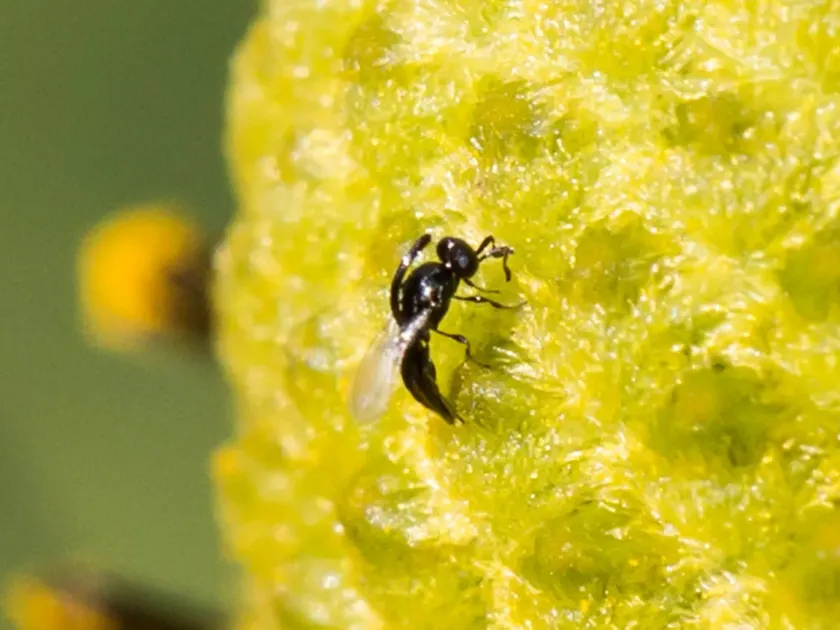
Description
How to identify
Inostemma is a genus of minute parasitic wasps belonging to the family Platygastridae (order Hymenoptera), often overlooked in agricultural field surveys.
These insects are characterized by their extremely small size and a unique morphological trait: a long, horn-like projection on the female's abdomen.
This abdominal horn usually curves forward, extending toward the head, which serves as a key diagnostic feature for species identification under a microscope.
Adult wasps are typically dark, often black with a metallic sheen, featuring specific wing venation patterns typical for the Platygastridae family.
Due to their microscopic size and secretive behavior, they are rarely seen by farmers unless specific traps or sweep nets are utilized during surveys.
What it damages
Inostemma is widely considered a beneficial insect rather than a traditional pest, as it acts as a parasitoid of various gall midges (Cecidomyiidae).
By parasitizing the larvae of destructive gall midges, Inostemma effectively limits their populations on major cereal crops like wheat and barley.
The term "pest" is inaccurately applied here, as their presence actually contributes to the reduction of true crop-damaging organisms in the field.
However, in highly specific agricultural scenarios, the ecological balance might be complex, but their primary role remains that of a natural control agent.
Farmers benefit from the presence of Inostemma, as they provide a free, biological service by suppressing pests that would otherwise reduce yields.
When it appears
The life cycle of Inostemma is strictly synchronized with the phenology of its host gall midges to ensure the survival of its progeny.
Adult emergence typically occurs in spring or early summer, coinciding with the peak activity and egg-laying period of the target gall midges.
The female wasp deposits her eggs inside the eggs or early-stage larvae of the gall midge, where the parasitoid larva develops internally.
The number of generations per year is dependent on temperature and the availability of suitable host stages within the crop ecosystem.
Inostemma overwinter as larvae or pupae within the remains of their host, often protected inside crop residues or within the soil.
Signs of infestation
The primary sign of Inostemma activity is a measurable decline in gall midge infestation rates across the field during the growing season.
Direct detection requires entomological expertise, as one must examine the host larvae to identify the presence of the internal parasitoid.
Microscopic analysis of gall midge larvae reveals the development of the wasp larva inside, which eventually kills the host from within.
Presence of these wasps serves as a bioindicator, suggesting a healthy and functioning biological control system within the farm boundaries.
- Reduced midge larvae survival rates.
- Exit holes found in the puparia of host insects.
- Presence of tiny black wasps on leaf surfaces during early morning.
Control measures
Since Inostemma acts as a natural biological control agent, management practices should focus on conservation rather than eradication.
The excessive use of broad-spectrum insecticides should be avoided, as these chemicals kill beneficial parasitoids along with primary pests.
Integrating agricultural practices, such as proper crop rotation and tillage management, can help maintain natural enemy populations.
Focusing on Integrated Pest Management (IPM) allows for the preservation of these wasps, which provide cost-effective pest control for the grower.
Field scouting and monitoring the level of parasitism help agronomists determine when insecticide applications are truly necessary, avoiding unnecessary harm.
Taxonomy
- Latin name
- Inostemma
- Order
- Hymenoptera
- Family
- Platygastridae
- EPPO code
- INOSSP
Discussion
No discussions yet — be the first.