
Rugged pine bark beetle
Hylurgops rugipennis
Description
How to identify
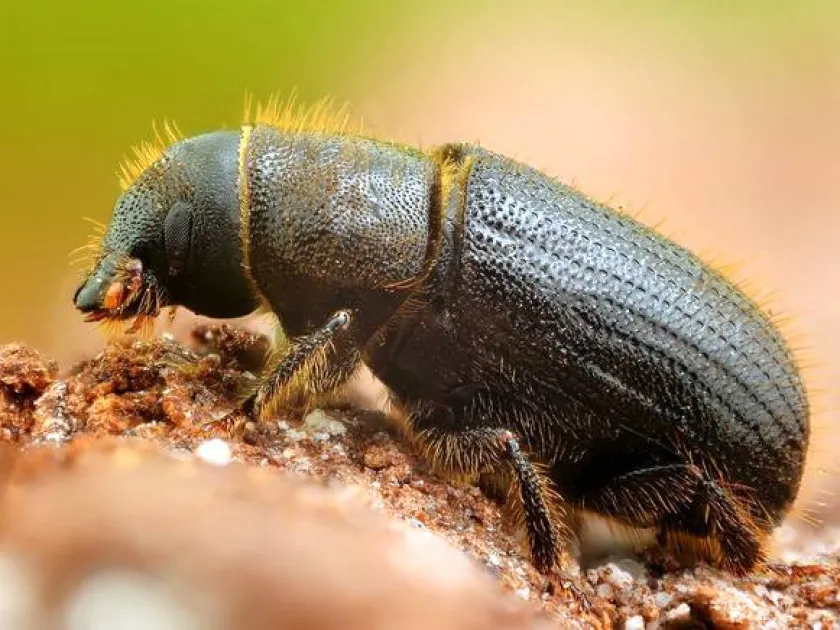
The rugged pine bark beetle (Hylurgops rugipennis) belongs to the order Coleoptera and the family Curculionidae (subfamily Scolytinae). It is a small insect, typically measuring between 4 and 5 millimeters in length.
The body is elongated and dark brown to black. The most distinct morphological feature is the presence of coarse wrinkles on the surface of the elytra, which gives the species its common and scientific name.
The pronotum is heavily punctated. Larvae are typical of bark beetles: white, C-shaped, legless, and equipped with a yellowish-brown head capsule.
The species is widely distributed in temperate and boreal coniferous forests. It is highly active during the spring when temperatures allow for emergence and colonization.
Entomologists identify this beetle by examining its specific antennal structure and the unique engraving patterns it leaves beneath the bark of host trees.
What it damages
This pest is a specialist of coniferous trees, primarily attacking species within the Pinus genus, and occasionally the Picea genus in various environments.
It prefers weakened, dying, or wind-fallen timber. However, under high population pressure, it can attack the root collars of healthy young saplings or weakened mature trees.
Damage is caused by both adults and larvae as they bore galleries through the inner bark and cambium layer, disrupting the tree's nutrient transport system.
Mass infestations often lead to a rapid decline in the health of the stand, making the trees susceptible to secondary pests and various pathogenic fungi.
Economic losses include degradation of timber quality, loss of growth in forest plantations, and increased mortality rates in nursery stock.
When it appears
The active life cycle begins in early spring. As soon as temperatures rise, adult beetles emerge from their overwintering sites to seek suitable host trees.
The flight period is typically prolonged, spanning late spring and early summer, depending heavily on the regional climatic conditions and local weather patterns.
Development of the larvae occurs throughout the summer months under the bark, where they feed continuously before pupation occurs within the gallery system.
As autumn approaches, the beetles prepare for hibernation. Most of the population overwinters in the forest floor litter or in thick bark at the base of trees.
Cold hardiness is a critical trait for this species, allowing it to survive harsh winter conditions and successfully restart its life cycle the following spring.
Signs of infestation
The primary indicator of an infestation is the presence of frass (boring dust) appearing near the base of the tree or within bark crevices.
Upon removing a section of the bark, one can observe the characteristic parent galleries and the radiating larval galleries created by the developing offspring.
The foliage of infested trees often shows signs of stress, such as yellowing, loss of luster, and eventual needles drop, reflecting the disruption of water and nutrient uptake.
Entrance holes in the bark are often located near the root collar, distinguishing this species from bark beetles that prefer the upper canopy or trunk.
- Fine wood dust at the base of the trunk.
- Entrance holes located at the root collar area.
- Loose bark patches indicating extensive gallery formation.
Control measures
Sanitation is the most effective management strategy. This involves the prompt removal and destruction of infested logs and weakened trees to eliminate breeding sites.
Continuous forest health monitoring is essential. Regular surveys allow managers to detect early signs of infestation and respond before the population reaches outbreak levels.
The use of pheromone-baited traps or trap logs during the spring flight period can help reduce the adult beetle population in high-risk areas.
In forest nurseries, chemical control might be employed if monitoring data indicates significant pressure, though cultural methods remain the first line of defense.
Silvicultural practices that promote vigorous tree growth and correct species selection remain the best long-term prevention strategy against bark beetle outbreaks.
Taxonomy
- Latin name
- Hylurgops rugipennis
- Order
- Coleoptera (beetles)
- Family
- Curculionidae
- EPPO code
- HYLURU
Discussion
No discussions yet — be the first.