
Wrinkled bark beetle
Hylesinus porcatus
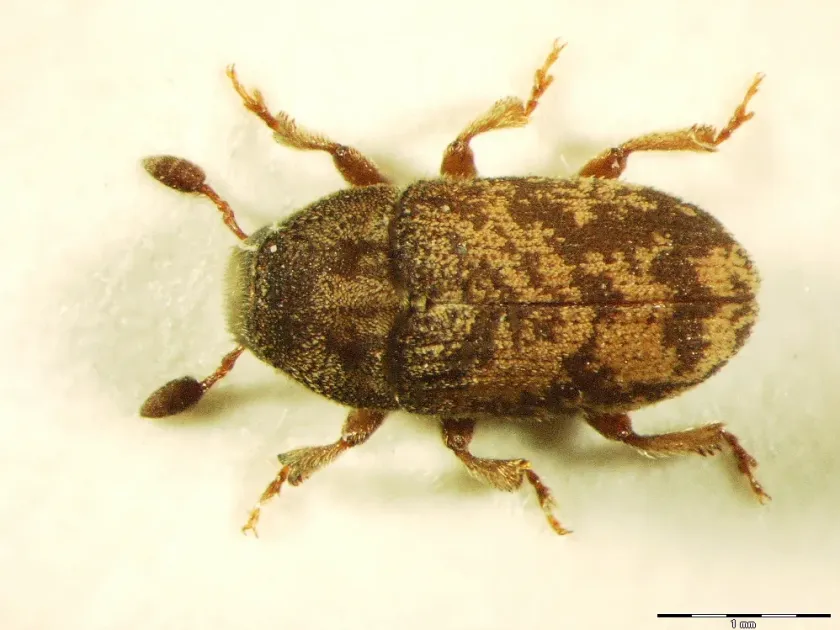
Description
How to identify
The wrinkled bark beetle (lat. Hylesinus porcatus) is a small beetle belonging to the Curculionidae family, specifically the bark beetle subfamily. Adult beetles typically measure 3–4 mm in length and possess a cylindrical body.
The body is colored dark brown to black and is covered in short, dense scales that give it a dull, matte appearance. The most distinctive feature is the coarse, wrinkled grooved pattern on the elytra, which inspired the common name.
Larvae are legless, white-colored with a yellowish-brown head, and typically adopt a C-shaped posture. They spend their entire developmental cycle beneath the bark of host trees.
Taxonomically, this insect is classified within the order Coleoptera and the family Curculionidae (formerly Scolytidae). It is known for its secretive behavior and tendency to infest woody tissue.
Entomologists often rely on pheromone traps and inspections of bark structures to confirm the presence of this species, as adult beetles are rarely seen outside their galleries.
What it damages
The wrinkled bark beetle primarily targets broad-leaved trees, including ash and olive species. It shows a preference for trees that are already stressed or weakened by environmental factors.
Both adults and larvae contribute to tree damage: adults feed on the bark and phloem, while larvae create elaborate tunnel systems that disrupt nutrient transport within the tree.
In cases of heavy infestation, the cumulative damage leads to wilting, branch dieback, and can result in the complete death of the host tree within a few years.
By damaging the cambium and phloem, the beetle weakens the tree's defense mechanisms, making it increasingly susceptible to secondary pathogens and fungal diseases.
- Severed phloem prevents essential nutrients from reaching the crown.
- Entry holes allow fungi and bacteria to penetrate deep into the trunk.
- Weakened trees lose their resistance to subsequent pest outbreaks.
When it appears
Adult beetles typically emerge from their wintering sites in early spring, once temperatures remain consistently above 15 degrees Celsius.
The active flight and colonization period extends through the summer months, allowing the species to potentially complete multiple generations depending on local climatic conditions.
Feeding activity persists until the onset of autumn, when both adult beetles and larvae seek shelter within the bark or tree litter to survive the winter season.
Monitoring for initial signs of colonization is critical before the growing season fully begins, as this is when preventive measures are most effective.
Variations in regional temperature play a major role in the timing of emergence and the overall reproductive success of the beetle populations each year.
Signs of infestation
The earliest indicator of an infestation is the appearance of tiny, circular entry holes on the surface of the bark, which look as though the tree has been pricked by a pin.
Fine wood dust, known as frass, often accumulates near these entry holes or within the crevices of the bark, acting as a clear visual signal of active boring activity.
Yellowing, curling, or premature dropping of leaves on specific branches are symptomatic of damage to the tree's vascular system caused by the beetle's galleries.
In advanced infestations, one might observe the loose or peeling bark, and inspection of the underlying wood will reveal the intricate patterns of maternal and larval tunnels.
Necrotic patches on the trunk often develop as a response to the beetle feeding and the introduction of fungal pathogens, signaling long-term structural distress.
Control measures
The most effective management strategy involves the timely removal and destruction of infested wood, which prevents the beetle population from spreading to healthy trees.
Maintaining tree vigor through proper irrigation, fertilization, and site management is crucial for helping trees withstand potential attacks from the wrinkled bark beetle.
During the spring flight season, systemic insecticides applied to the bark can be highly effective in preventing adults from establishing new galleries.
Biological control, including the encouragement of natural predators such as parasitic wasps, plays a vital role in keeping beetle populations at manageable levels.
Using trap logs—freshly cut sections of host trees—can lure beetles away from high-value specimens, allowing for their easy removal and destruction once colonized.
Taxonomy
- Latin name
- Hylesinus porcatus
- Order
- Coleoptera (beetles)
- Family
- Curculionidae
- EPPO code
- HYESPO
Discussion
No discussions yet — be the first.