
Teak defoliator
Hyblaea puera
Description
How to identify
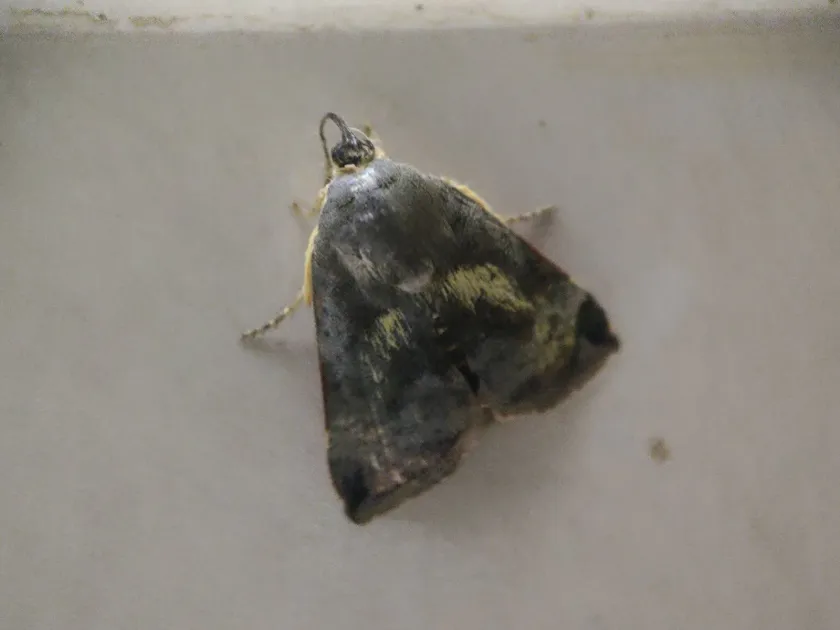
The teak defoliator (Hyblaea puera) is a small moth with a wingspan of approximately 35–40 mm. Its forewings exhibit a cryptic coloration, ranging from dark brown to greyish-brown, which provides excellent camouflage against tree bark. The hindwings feature distinct bright orange or yellow patches, serving as a warning signal when the insect is disturbed.
The larvae progress through five instars. Initially pale green, they gradually darken, developing brown or black longitudinal stripes with white or yellow spots. Fully grown larvae are roughly 40 mm long and highly active, capable of dropping on silk threads to escape predators.
Pupation typically occurs inside a protective shelter formed by folding a leaf and securing it with silk. This protective structure helps the pupae survive environmental fluctuations and reduces their exposure to parasitoids.
The life cycle is relatively short, usually lasting between three to four weeks under optimal conditions, allowing for multiple overlapping generations within a single season.
Adult moths are nocturnal and are strongly attracted to light, which makes light traps an essential tool for monitoring population dynamics in forest plantations.
What it damages
While teak (Tectona grandis) is the primary host, this species is known to attack various other plant families, including Verbenaceae and Bignoniaceae. Its polyphagous nature ensures survival even when primary hosts are scarce.
Larval feeding causes severe defoliation, where the caterpillars consume leaf tissues while leaving veins intact. In severe cases, the entire tree canopy can be stripped bare within a few days, leading to complete foliage loss.
Chronic defoliation significantly impairs the tree's photosynthetic capacity, resulting in reduced height and girth increment. This has long-term economic consequences for timber quality and forest productivity.
In nurseries and young plantations, the damage is particularly devastating as it often leads to the death of young seedlings or the loss of the apical leader, causing stem malformation.
The cumulative stress caused by repeated infestations increases the susceptibility of teak stands to secondary pathogens, wood-boring insects, and environmental stressors like drought.
When it appears
The occurrence of the teak defoliator is closely linked to the onset of the monsoon season. The flush of fresh, tender leaves provides the perfect substrate for oviposition and larval development.
In tropical environments, the pest can persist throughout the year if host plants remain evergreen or if rainfall supports continuous flushing of new growth.
Peak infestation levels typically occur during the mid-monsoon period, when humidity and temperature levels create an ideal environment for rapid insect multiplication.
Drier periods often lead to a reduction in population levels, as the moths undergo a period of reduced activity or diapause, awaiting favorable conditions for the next generation.
Effective forest management requires synchronizing monitoring activities with the arrival of the first rains to identify early larval stages before they reach high-density populations.
Signs of infestation
The most visible sign of an infestation is the presence of skeletonized leaves on the upper canopy, often with irregular holes and ragged margins.
Larvae are frequently found inside leaves that have been folded or rolled and secured with silk threads, serving as a larval retreat.
- Accumulation of dark, granular frass on the forest floor beneath the trees.
- Visibility of thin silk strands hanging from the branches, used by larvae to descend.
- Increased bird activity in the canopy as predators gather to feed on the abundant larval population.
A sudden, widespread "browning" of the canopy is a clear indicator that the infestation has reached a critical stage of damage.
The presence of adults around nocturnal light sources is a precursor to the next wave of larval damage and should trigger immediate field scouting.
Control measures
Biological control methods are preferred in forest management, particularly the use of Bacillus thuringiensis-based insecticides, which target the larvae specifically without harming non-target organisms.
Promoting a healthy ecosystem that supports natural enemies, such as parasitic wasps (e.g., Eadya paropsidis), predatory bugs, and insectivorous birds, is crucial for long-term population suppression.
Silvicultural techniques, such as the maintenance of mixed-species plantations and the removal of weed hosts, can act as natural barriers to the spread of the defoliator.
Chemical intervention is generally discouraged and restricted to high-value nursery stocks where immediate foliage protection is vital to prevent seedling mortality.
Monitoring populations through pheromone traps and light traps allows for precise timing of interventions, minimizing the frequency and scale of control measures required.
Taxonomy
- Latin name
- Hyblaea puera
- Order
- Lepidoptera (butterflies)
- Family
- Hyblaeidae
- EPPO code
- HYBLPU
Discussion
No discussions yet — be the first.