
Hyblaea
Hyblaea
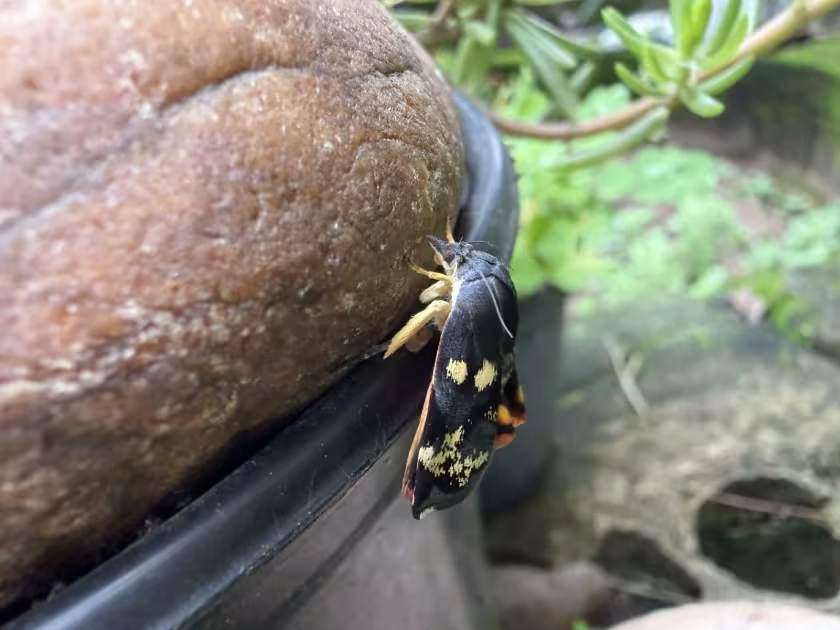
Description
How to identify
The genus Hyblaea belongs to the family Hyblaeidae within the order Lepidoptera. The most prominent and economically significant species is Hyblaea puera, commonly known as the teak defoliator.
Adult moths are medium-sized with a wingspan ranging from 30 to 40 mm. Their general coloration is dark brown or grayish, providing excellent camouflage against tree bark during the day.
The hindwings often exhibit vivid orange or yellow patches, which function as flash coloration to startle potential predators when the moth suddenly takes flight.
Larvae (caterpillars) go through several instars, transitioning from pale green to darker shades, often featuring longitudinal white stripes and a well-developed, dark-colored head.
Pupation typically occurs within folded leaves, which the larvae skillfully bind together using silk threads to create a protected cocoon during their transformation stage.
What it damages
The primary host plant for Hyblaea puera is teak (Tectona grandis), where infestations can lead to massive defoliation, significantly impacting timber production and tree growth.
Beyond teak, the pest affects a variety of other tree species, including members of the Avicennia, Catalpa, and several leguminous families common in tropical ecosystems.
Severe infestations result in a complete loss of foliage, which forces the tree to expend energy reserves to produce new leaves, leading to stunted development and reduced wood quality.
While adult moths feed on nectar and are harmless to the plants, their high reproductive rate ensures that a single infestation can escalate into a major outbreak within weeks.
Weakened trees are significantly more susceptible to secondary pathogens, wood-boring insects, and environmental stressors, making Hyblaea a major concern in reforestation projects.
When it appears
In tropical climates, the reproductive cycle of Hyblaea is continuous, as the absence of extreme winters allows for multiple generations throughout the year.
Populations tend to surge at the onset of the monsoon or rainy season when trees flush with new, nutrient-rich leaves that are ideal for the development of the larvae.
The entire lifecycle from egg to adult can be completed in approximately 3 to 4 weeks under optimal temperature conditions, facilitating rapid population explosions in plantations.
During drier periods, the pest population typically declines, although individuals may survive on alternative host plants or in dormant stages until favorable weather returns.
The migratory behavior of adult moths enables them to move quickly across vast distances, allowing the species to colonize new plantations shortly after the first rains arrive.
Signs of infestation
The most recognizable sign of infestation is the presence of folded or rolled leaves, securely fastened with silk, which serve as shelters for the feeding larvae.
Skeletal patterns on the foliage are common, where the caterpillars consume the green leaf tissue but leave the harder, vascular veins intact, giving the crown a lace-like appearance.
Large quantities of dark, granular frass (excrement) scattered beneath the trees provide a clear indicator of heavy larval feeding occurring in the canopy above.
Early leaf drop and premature yellowing of the canopy indicate severe stress on the trees, signaling an urgent need for intervention to prevent lasting ecological damage.
Active sightings of the caterpillars, which often drop from branches on a silken thread when disturbed, confirm the presence of an active Hyblaea population.
Control measures
Pheromone traps are highly effective for monitoring adult moth populations, providing essential data for timing the application of control measures during the early stages of a flight.
Biological control using Bacillus thuringiensis sprays is a standard practice, as it targets the larvae specifically while sparing beneficial insects and environmental predators.
Encouraging natural biological control by protecting avian predators, ants, and parasitic wasps helps to naturally suppress Hyblaea populations below economic thresholds.
Chemical insecticides are generally reserved for emergency management in high-value timber plantations where severe damage is anticipated and biological methods are insufficient.
- Regular inspection of young plantations for early signs.
- Maintaining species diversity to prevent mass outbreaks.
- Removing heavily infested foliage in controlled nurseries.
- Using systemic treatments in critical nursery stages.
Taxonomy
- Latin name
- Hyblaea
- Order
- Lepidoptera (butterflies)
- Family
- Hyblaeidae
- EPPO code
- HYBLSP
Discussion
No discussions yet — be the first.