
European apple sawfly
Hoplocampa chrysorrhoea
Description
How to identify
The European apple sawfly (Hoplocampa testudinea) is a Hymenopteran insect belonging to the Tenthredinidae family. Adult sawflies are small, about 6–7 mm long, with a yellowish-brown body and transparent wings, resembling small wasps.
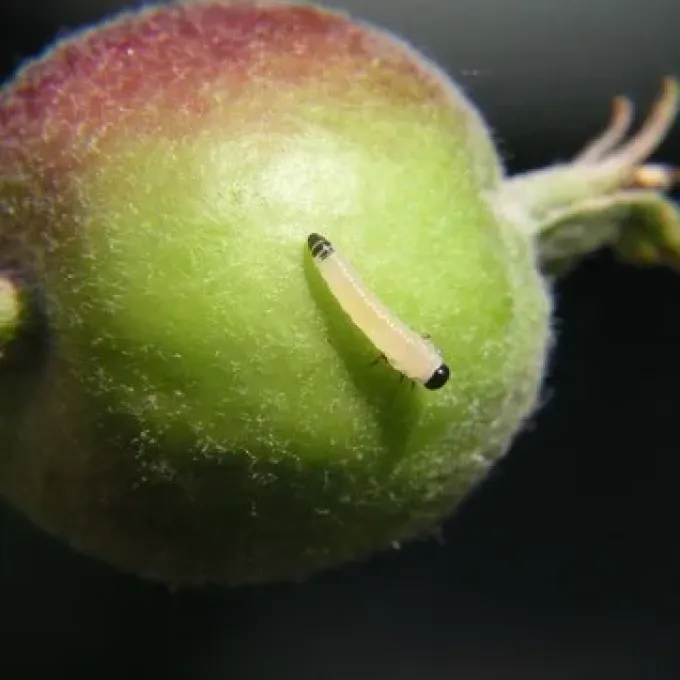
The larvae are creamy-white with a brown head and possess ten pairs of legs. A distinguishing biological characteristic of these larvae is the strong, unpleasant scent, similar to that of a stink bug, which they emit when handled.
The insect overwinters as a mature larva in a silken cocoon deep in the soil, usually within the root zone of the host tree. Pupation occurs in early spring, leading to the emergence of adults just as the apple trees begin to bloom.
Adult females use their saw-like ovipositor to insert individual eggs into the base of the apple blossoms. A single female can lay up to 50 eggs, systematically visiting many flowers to ensure optimal development conditions for her offspring.
Upon hatching, the larvae crawl to the developing fruitlets, boring into the center. They often leave a characteristic narrow hole on the surface before consuming the core, frequently moving from one fruitlet to another as they grow.
What it damages
The primary hosts are apple trees, though pears can also be affected. The damage is most severe in early summer when infested fruitlets drop prematurely in large numbers, often causing massive crop losses.
Larvae feed within the fruit, hollowing out the seed cavity and filling it with dark, wet frass. This internal feeding causes the fruitlets to shrivel and abort, resulting in significant yield reduction in heavily infested orchards.
Even if the fruit remains on the tree, the entry point created by the larva often results in a characteristic corky, spiraling scar on the apple's skin. This renders the fruit aesthetically unappealing and unsuitable for commercial sale.
Secondary infections by fungi and bacteria frequently occur via the larval boreholes, leading to rapid rotting of the fruit. This makes even partially damaged apples useless for processing or long-term storage.
High levels of infestation can devastate an orchard's harvest potential. Management of the population is critical during the blossom period to prevent the larvae from establishing themselves inside the growing fruit.
When it appears
The emergence of adults is highly synchronized with the flowering phenology of apple trees. They typically appear when temperatures rise above 12-14 degrees Celsius, coinciding with the pink bud to petal fall stages.
The larval stage lasts for about 3–4 weeks. Once fully grown, the larvae exit the fruit and drop into the soil to spin their overwintering cocoons, meaning they remain active and dangerous throughout the critical fruit-setting phase.
There is only one generation per year. However, because different apple varieties bloom at slightly different times, the window of risk for an orchard can be extended, necessitating ongoing monitoring during the entire flowering period.
Monitoring using white or yellow sticky traps is a standard practice to track the arrival of adults. Early detection allows for precise timing of interventions, which is crucial for achieving high control efficacy.
Throughout the remainder of the summer, autumn, and winter, the insect remains in the soil. This dormant phase makes it inaccessible to foliar treatments but susceptible to soil-based cultural management practices.
Signs of infestation
The earliest sign of infestation is the appearance of tiny slits or punctures at the base of the flower sepals. Tiny droplets of brown, sticky liquid (exudate) often appear at these puncture sites as the plant reacts.
Premature fruit drop of small, pea-sized apples is a clear indication of sawfly presence. If these fallen fruitlets are cut open, the yellowish larvae and their characteristic dark frass are usually visible inside the core.
A distinct, pungent odor is a key diagnostic feature of the European apple sawfly. When examining infested fruit or blossoms, the scent released is a reliable way to differentiate this pest from codling moth damage.
Corked, ribbon-like scars on the surface of harvested apples are evidence of larval activity. These are the remnants of failed entry attempts, where the larva either died or moved to a different, more suitable fruitlet.
Widespread presence of larvae in the orchard is confirmed by finding a significant number of hollowed-out fruitlets under the canopy, showing signs of internal feeding and external boring holes.
Control measures
Effective management requires a combination of monitoring, cultural practices, and chemical control applied at the correct stage of apple development.
- Cultivation of the soil beneath the canopy in late autumn or early spring to destroy overwintering larvae in their cocoons.
- Daily collection and removal of fallen fruitlets to prevent larvae from completing their life cycle and returning to the soil.
- Use of white sticky traps to monitor and catch adults before they deposit their eggs.
- Targeted insecticide applications during the late pink bud stage to eliminate adults before egg-laying occurs.
- Promotion of natural predators such as ground beetles and birds that forage for pupae and larvae in the soil.
It is vital to prioritize the protection of pollinators during the blooming stage. Any chemical applications must be strictly avoided while flowers are open, or only bee-safe alternatives should be used during the evening.
Systemic insecticides provide the best results if applied at the optimal threshold, as they protect the interior of the fruit from larval penetration. Always follow the manufacturer's guidance regarding pre-harvest intervals.
Integrated Pest Management (IPM) strategies, which balance cultural sanitation with precise chemical timing, provide the most sustainable way to protect apple harvests from European apple sawfly damage.
Taxonomy
- Latin name
- Hoplocampa chrysorrhoea
- Order
- Hymenoptera
- Family
- Tenthredinidae
- EPPO code
- HOPLCH
Discussion
No discussions yet — be the first.