
Alpine sawfly
Hoplocampa alpina
Description
How to identify
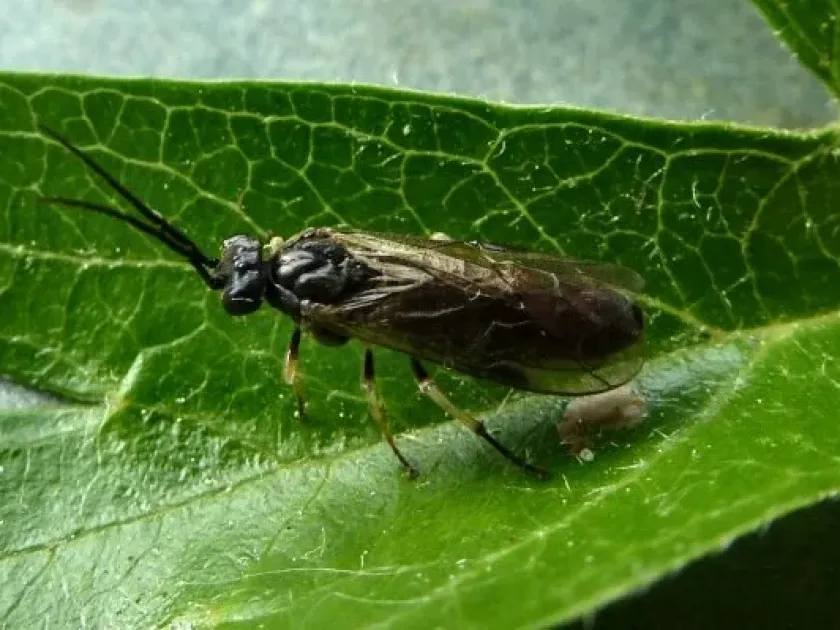
The Alpine sawfly (Hoplocampa alpina) is an insect belonging to the order Hymenoptera and the family Tenthredinidae. Adult sawflies are small, measuring approximately 5-6 mm in length, with a coloration that often includes shades of black and brown.
The larvae are typically creamy white with a brownish head and possess ten pairs of legs. They are internal feeders, developing inside the developing fruit, which makes them difficult to detect during the early stages of infestation.
The life cycle of this pest is univoltine, meaning there is only one generation produced per year. They overwinter as fully grown larvae in the soil, protected within a tough, silk-like cocoon.
Pupation occurs in the soil during the early spring. The emergence of adults coincides precisely with the flowering period of their primary host plants, allowing them to lay eggs directly into the developing buds.
Females utilize a saw-like ovipositor to insert eggs into the sepals of the flowers. This precise timing ensures that the emerging larvae find immediate nourishment in the rapidly developing young fruit.
What it damages
The Alpine sawfly is a specialized pest primarily affecting apricot trees. Its activity is concentrated during the fruit set phase, where it causes significant agricultural damage.
The larvae feed on the internal tissues of the young fruit, often destroying the seed or kernel. A single larva is capable of damaging multiple fruits during its developmental stage by moving from one fruit to another.
Economic damage is most pronounced in years with a light crop, where the loss of even a small percentage of fruit can significantly reduce the overall yield of the orchard.
Infested fruit typically stops developing and drops prematurely. This premature fruit drop is often mistaken for natural thinning or environmental stress by inexperienced growers.
Beyond direct loss, the feeding tunnels serve as pathways for secondary pathogens, leading to fruit rot and further degradation of the remaining harvestable crop.
Signs of infestation
The earliest sign of an infestation is the appearance of small, dark, puncture-like scars on the sepals of flowers or newly set fruit, indicating where the female deposited her eggs.
Frass, or larval excrement, often accumulates around these entry points, appearing as small, dark pellets on the skin of the fruit, serving as a clear indicator of active feeding.
Massive premature fruit drop shortly after flowering is a definitive symptom. If these dropped fruits are opened, one can usually find the larvae or the characteristic tunnels they have excavated.
Visible decay and premature ripening of fruit on the tree are also common, as damaged tissue becomes vulnerable to external environmental factors and fungal infections.
When handled, the larvae often emit a distinct, somewhat pungent odor, a defensive mechanism common to many sawfly species, which serves as a diagnostic feature for identification.
Control measures
Cultural control is a cornerstone of management, involving the rigorous collection and destruction of all fallen fruit to interrupt the larval life cycle and reduce the number of individuals reaching the soil.
Tilling the soil beneath the canopy in the autumn or early spring can disrupt the overwintering cocoons, exposing the larvae to predators and harsh environmental conditions, significantly reducing emergence rates.
Monitoring using white sticky traps hung in the branches is an effective way to detect the presence of adults and determine the appropriate timing for any necessary chemical intervention.
If chemical control is required, insecticides should be applied immediately after petal fall, before the larvae successfully penetrate deep into the young fruit where they are shielded from contact sprays.
Integrated Pest Management (IPM) practices recommend selecting selective insecticides that target sawfly larvae while preserving beneficial pollinator populations present in the orchard during the early season.
Taxonomy
- Latin name
- Hoplocampa alpina
- Order
- Hymenoptera
- Family
- Tenthredinidae
- EPPO code
- HOPLAL
Discussion
No discussions yet — be the first.