
Hoplia graminicola
Hoplia graminicola
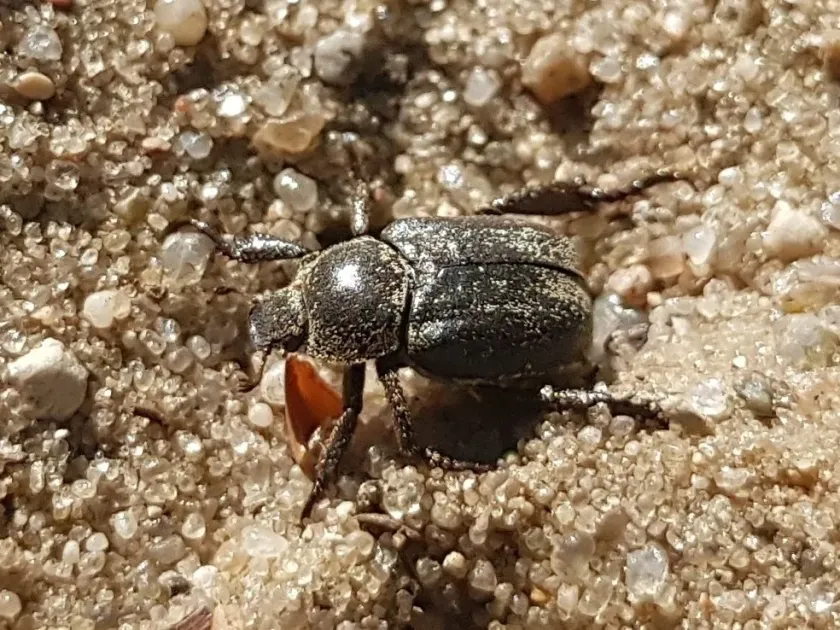
Description
How to identify
Hoplia graminicola is a species of scarab beetle (family Scarabaeidae) within the order Coleoptera. Adult beetles are typically 7–9 mm long, with an oval-shaped body covered in small scales, giving them a matte or metallic appearance.
The coloration of the adults ranges from brown to dark reddish-brown, with the head and pronotum often exhibiting a darker shade than the elytra. The larvae resemble typical scarab grubs: white, C-shaped, with a distinct brown head and well-developed legs.
These beetles are diurnal and highly mobile, especially during sunny days when they are often seen flying between plants. Unlike many other scarab species, they prefer open grassland environments and cultivated fields.
The life cycle is largely soil-dependent, as the larvae develop underground while feeding on roots. The life cycle involves four stages: egg, larva (multiple instars), pupa, and adult, with development often spanning one to two years.
Proper identification requires examining morphological features such as leg structure and the specific arrangement of scales on the body, which helps differentiate this species from related Hoplia beetles found in similar habitats.
What it damages
Hoplia graminicola attacks a wide range of agricultural crops, including cereals, forage grasses, and occasionally vegetable crops. Both adults and larvae contribute to the economic damage, though in different ways.
Adult beetles feed on above-ground plant parts, consuming leaf margins, flower buds, and reproductive structures. This herbivory reduces the photosynthetic surface area, leading to stunted plant growth and reduced yields.
The larvae, living in the soil, are particularly destructive as they feed on the root systems of crops. Severed roots impair water and nutrient uptake, causing plants to yellow, wilt, and eventually die.
Seedlings and young plants are most susceptible to larval damage. Root destruction by H. graminicola often creates gaps in fields, forcing farmers to consider reseeding or increased inputs to compensate for lost plants.
Mass outbreaks can lead to significant yield losses, especially in fields adjacent to natural meadows or pastures, which serve as primary reservoirs for the beetle population.
When it appears
Adult emergence typically occurs in late spring, generally peaking during May and June, which coincides with the active vegetative stage of many crops. During this time, they are most visible and active on foliage.
After mating, females lay eggs in the soil, favoring areas with high organic matter content that provide adequate moisture for larval development. The larval phase lasts through the summer and autumn.
As temperatures drop in late autumn, the larvae burrow deeper into the soil profile to overwinter. Their development is sensitive to environmental conditions, with moisture levels being a critical factor for survival.
Pupation takes place in the soil during spring, within specifically constructed earthen cells. Once the transformation is complete, the new adults emerge to the surface, beginning the cycle anew.
Monitoring environmental conditions like rainfall during the spring is vital, as it influences the timing of emergence and the success of the new generation of pests.
Signs of infestation
The presence of adult beetles on leaves and flowers during sunny daylight hours is the most common visual sign of an infestation. Their scale-covered bodies are usually easy to spot against green foliage.
Damage to leaves characterized by ragged edges and holes indicates adult feeding. Conversely, yellowing or wilting plants in isolated patches often signal root damage caused by larvae in the soil.
Plants affected by larval feeding can be easily pulled from the ground due to the lack of a substantial root system. Observing such symptoms necessitates immediate investigation of the soil profile.
Soil sampling by digging around the affected plants is the standard diagnostic procedure to confirm the presence of grubs. Finding these C-shaped larvae directly confirms the cause of the crop decline.
Regular field scouting throughout late spring allows agronomists to assess pest density and implement control measures before significant damage occurs.
Control measures
Crop rotation is the most effective cultural strategy for managing H. graminicola, as it deprives the larvae of a consistent food source and disrupts the beetle's life cycle. Deep tillage is also recommended to destroy pupal cells.
Managing weeds along field margins helps minimize refuge areas, as these spots often host the initial population before they disperse into the main crop field.
Chemical control using authorized insecticides may be necessary if population densities exceed economic injury thresholds. Applications are most effective when timed with the peak emergence of adults.
Biological control, including the use of entomopathogenic fungi and bacteria applied to the soil, offers a sustainable alternative that targets larvae without disrupting beneficial field fauna.
- Implement strict crop rotation schemes.
- Perform deep plowing to expose larvae and pupae.
- Improve soil fertility to support root regeneration in damaged areas.
Taxonomy
- Latin name
- Hoplia graminicola
- Order
- Coleoptera (beetles)
- Family
- Scarabaeidae
- EPPO code
- HOPIGR
Discussion
No discussions yet — be the first.